
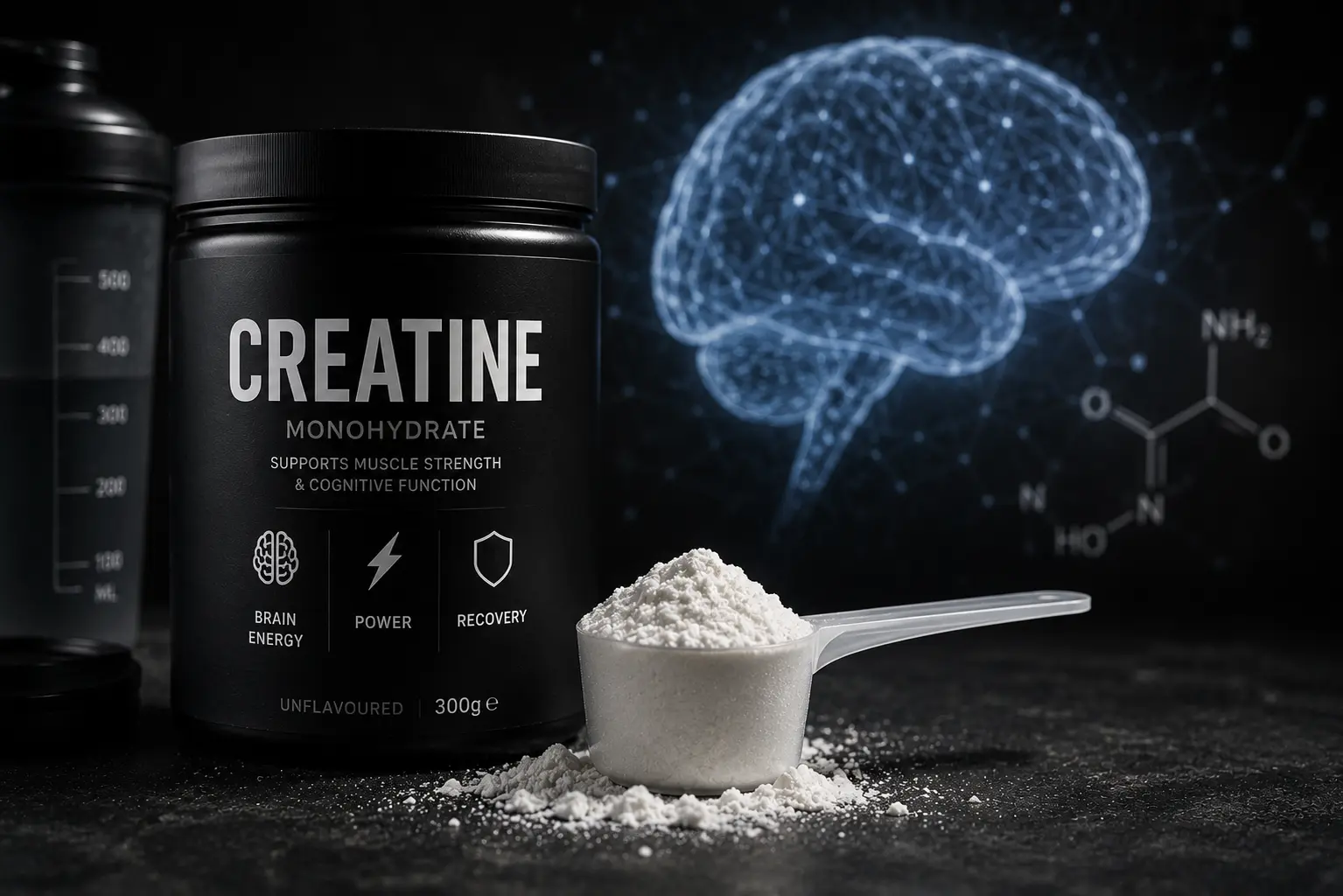
Creatine has one of the strongest evidence bases of any supplement in sports nutrition, built almost entirely around muscle performance. A newer body of research looks at a different question: what creatine does in the brain. The findings are genuinely interesting, and also easy to overstate. This article covers the mechanism, what the cognitive research actually shows, and where the mood and depression research currently stands.
The Same Energy System, a Different Organ
Creatine’s role in muscle is well understood. It helps regenerate ATP quickly during short, intense efforts, which is why it improves performance in activities like sprinting and heavy lifting. The brain runs on a related energy system.
Neurons rely heavily on the phosphocreatine pathway during periods of high energy demand, similar to how muscle does during a hard set. Brain tissue with impaired energy metabolism has been linked to several conditions, including depression, where reduced phosphocreatine levels in mood-relevant brain regions have been documented. This is the physiological basis for asking whether creatine supplementation, already well studied for muscle, might also support brain function under the right conditions.
What the Cognitive Research Shows
The cognitive findings are real, but narrower than headlines often suggest. Creatine’s effect on mental performance shows up most clearly under conditions of energy strain: sleep deprivation, mental fatigue, older age, and in people with lower baseline creatine intake, such as vegetarians.
Where the Effect Is Strongest
A single dose of creatine has improved cognitive performance during sleep deprivation in controlled studies, alongside measurable changes in brain energy markers. Effects tend to be more pronounced in older adults and in situations of metabolic stress than in young, healthy, well-rested people. The honest summary from recent reviews is direct: creatine does not upgrade a well-functioning brain. It tops up a reserve that is usually already full in a healthy, rested person eating a normal diet.
Where the Effect Is Weak
In rested, omnivorous, healthy young adults, cognitive effects are small to negligible. If someone’s mental fatigue is coming from genuine energy strain, poor sleep, high demands, low dietary creatine intake, supplementation may help. If none of those apply, there is little reason to expect a noticeable difference.
What the Depression Research Shows
This is the newer and more actively studied area. Several small randomized trials have tested creatine as an add-on to standard depression treatment, either SSRIs or cognitive behavioral therapy, rather than as a standalone treatment.
The results have been promising. A review of five randomized controlled trials, totaling 238 participants, found creatine supplementation improved depressive outcomes when added to existing treatment. Effects have been most consistent in women, who show lower baseline brain creatine levels in some studies. One proposed mechanism involves creatine’s influence on dopamine and serotonin, the neurotransmitters most depression treatments already target.
The Important Caveat
These trials are small, and the researchers involved describe the underlying mechanisms as still theoretical. This is not evidence that creatine treats depression on its own, and it has been studied exclusively as an addition to existing treatment, not a replacement for it. The direction is genuinely encouraging. The evidence base is still early.
The Practical Takeaway
Creatine’s muscle benefits are well established and require no new evidence to justify. The brain research adds a plausible, mechanistically sound reason to expect some cognitive benefit under specific conditions, mainly energy strain from sleep loss, aging, or low dietary intake, and a genuinely promising but early signal in depression research as an adjunct to standard treatment. For a healthy, well-rested athlete already using creatine for performance, the brain effects are a reasonable secondary benefit to expect, not a reason to change how or why creatine is being used.
References
- Kondo D, Forrest LN, Shi X, et al. Creatine target engagement with brain bioenergetics: a dose-ranging phosphorus-31 magnetic resonance spectroscopy study of adolescent females with SSRI-resistant depression. Amino Acids. 2016;48(9):1941-1954. DOI: 10.1007/s00726-016-2194-3
- Sherpa MT, et al. Efficacy and safety profile of oral creatine monohydrate in add-on to cognitive-behavioural therapy in depression: an 8-week pilot, double-blind, randomised, placebo-controlled feasibility and exploratory trial. Eur Neuropsychopharmacol. 2025;90:28-35. DOI: 10.1016/j.euroneuro.2024.10.004
- Gordji-Nejad A, Matusch A, Kleedorfer S, et al. Single dose creatine improves cognitive performance and induces changes in cerebral high energy phosphates during sleep deprivation. Sci Rep. 2024.
- Lyoo IK, et al. A brain MRS study of creatine and phosphocreatine response to creatine monohydrate supplementation in patients with major depressive disorder. Amino Acids. 2012.
- Avgerinos KI, Spyrou N, Bougioukas KI, Kapogiannis D. Effects of creatine supplementation on cognitive function of healthy individuals: a systematic review of randomized controlled trials. Exp Gerontol. 2018;108:166-173. DOI: 10.1016/j.exger.2018.04.013
Leave a Reply
You must be logged in to post a comment.