

Author: Afitpilot Engineering Team
At Afitpilot, improvement does not come from shipping more features. It comes from tightening the logic that governs how training decisions are made.
This post documents a concrete example of that process: how we identified a systematic under-stimulation issue, why our original solution was insufficient, and how we rebuilt the logic to respond proportionally to athlete capacity instead of relying on arbitrary progression rules.
The Problem: When +5% Per Week Isn’t Enough
We had an athlete — let’s call her Sarah — who had been training consistently with Afitpilot for several weeks. She logged her sessions properly, including RPE (Rate of Perceived Exertion).
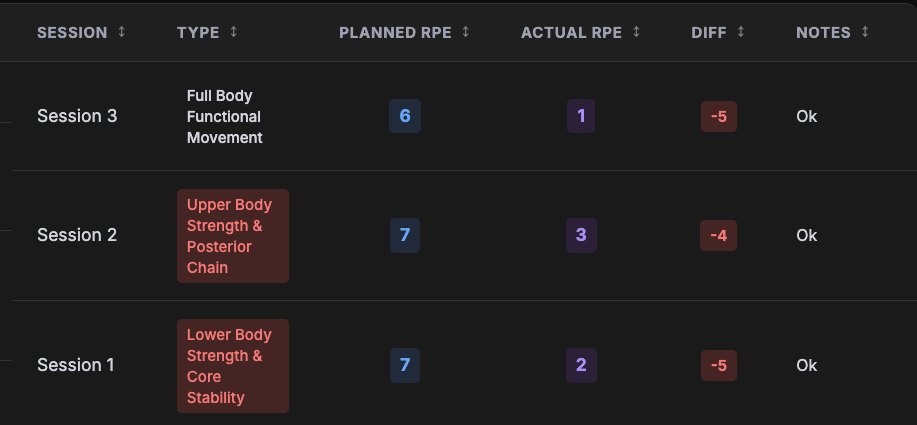
The pattern was clear:
- Prescribed RPE: 7
- Reported RPE: 3
Sessions designed to be challenging were barely registering as effort. In practical terms, Sarah was training at roughly 43% of the intended stimulus.
Our system responded as designed:
+5% intensity, +10% to +15% volume the following week.
The issue was obvious.
At that rate, it would take months to reach an appropriate stimulus level. During that time, Sarah would continue undertraining, accumulating little adaptation while sessions felt trivial. Motivation risked dropping, not because training was hard, but because it was meaningless.
We needed to stop inching forward blindly.
The Old Approach: Tier-Based Escalation
Our initial solution relied on escalation tiers:
| Tier | Trigger | Adjustment |
|---|---|---|
| Normal | RPE diff > -2 | +5% intensity, +15% volume |
| Moderate | RPE diff ≤ -2 | +10% intensity, +20% volume |
| Aggressive | RPE diff ≤ -3 | +15% intensity, +25% volume |
This was directionally correct, but fundamentally flawed.
The values were arbitrary.
They described how hard we felt comfortable pushing, not how wrong the prescription actually was.
For an athlete with a 4-point RPE gap, even “aggressive” escalation was mathematically incapable of closing the gap quickly.
The Insight: RPE Quantifies Capacity Error
RPE is not just subjective feedback. It is a proxy for percentage of maximal capacity.
Approximate interpretation:
- RPE 10: ~100% (failure)
- RPE 7: ~70–80% (hard but sustainable)
- RPE 3: ~30–40% (warm-up territory)
If we prescribe RPE 7 and receive RPE 3, the athlete is telling us exactly how far off we are.
Capacity Ratio = Target RPE / Actual RPE
               = 7 / 3
               = 2.33
This means Sarah’s capacity is roughly 2.33× higher than what we prescribed.
The theoretical correction is therefore:
(Theoretical Adjustment) = (2.33 − 1) × 100 = +133%
This number is not opinion-based.
It is derived directly from athlete feedback.
The New Approach: Capacity-Based Recalibration
Instead of stepping through tiers, we now calculate the required correction from the capacity mismatch itself.
Core Calculation
if actual_rpe > 0:
    capacity_ratio = target_rpe / actual_rpe
    theoretical_adjustment = (capacity_ratio - 1) * 100
This gives us the true magnitude of the error.
Safety Bounds: Aggressive, Not Reckless
Of course, no system should apply a +133% increase in one step. Biology still applies.
We enforce strict safety caps:
- Maximum intensity increase: +30% per week
- Maximum volume increase: +50% per week
These limits allow rapid correction while staying within known injury-risk thresholds.
What This Means in Practice
For Sarah:
- Calculated need: +133%
- Applied adjustment: +30% intensity, +50% volume
Compared to the old system, this is:
- 6× faster intensity correction
- 3.3× faster volume correction
After one week, the system reassesses. If the mismatch persists, recalibration continues until perceived effort aligns with prescription.
Phase-Aware Control
Recalibration is not applied blindly. Training context always wins.
| Phase | Recalibration | Rationale |
|---|---|---|
| Progressive Volume | Yes (full) | Capacity building tolerates fast correction |
| Initial Adaptation | Capped | New athletes require conservative ramps |
| Deload | No | Recovery overrides stimulus matching |
| Taper | No | Competition preparation takes priority |
| Active Recovery | No | Load reduction is intentional |
What the Athlete Sees
When recalibration occurs, the reasoning is made explicit:
“Sessions have been feeling 4 RPE points easier than intended (target RPE 7, reported RPE 3). This indicates your current fitness significantly exceeds the current prescription. You’re operating at approximately 43% of intended capacity.
Applying capacity-based recalibration: +30% intensity and +50% volume to realign stimulus with your current ability.”
This transparency is deliberate. Athletes should understand why training changes, not just notice that it does.
Results So Far
| Metric | Old System | New System |
|---|---|---|
| Time to resolve 4-point RPE gap | 8–12 weeks | 2–3 weeks |
| Max weekly intensity increase | +15% | +30% |
| Max weekly volume increase | +25% | +50% |
| Decision basis | Tier rules | Capacity ratio |
Key Takeaways
- RPE is diagnostic data, not just feedback. It quantifies prescription error.
- Fixed rules fail proportional problems. Real mismatches require calculated responses.
- Safety bounds enable speed. Caps allow aggression without recklessness.
- Context matters. Phase logic prevents misuse.
- Transparency builds trust. Athletes respond better when the system explains itself.
What’s Next
This same framework applies in reverse.
Athletes who consistently report higher RPE than prescribed are signaling overload. The math is identical, only the direction changes.
We’re also using this data to improve initial prescriptions, reducing how often recalibration is needed at all.
This is how Afitpilot evolves: not by adding noise, but by tightening signal.
Leave a Reply
You must be logged in to post a comment.