

Adolphe Quetelet founded the science of anthropometry. The Body Mass Index is his work too, although neither the name nor most of how the formula is now used were.
Quetelet was born in Ghent in 1796, when the city was still part of the First French Republic. He earned a doctorate in mathematics from Ghent University in 1819 for work on conic sections, moved to Brussels to teach, and in 1828 founded what became the Royal Observatory of Belgium, where he stayed for the rest of his life. He served as perpetual secretary of the Belgian Royal Academy from 1834 until his death in 1874, and he organised the first International Statistical Congress in 1853.
His training was in astronomy, where statistical methods had mostly been developed for handling measurement error — Laplace’s least-squares techniques for inferring the true position of a celestial body from a noisy set of observations. Quetelet’s contribution was to take those same techniques and turn them on people. If you could describe a star’s position with a probability distribution, you could describe a population’s heights, chest measurements, crime rates, or marriage rates the same way. He called the project physique sociale — social physics. Auguste Comte had used the term first, and partly because Quetelet appropriated it, Comte invented “sociology” to distinguish his own work.
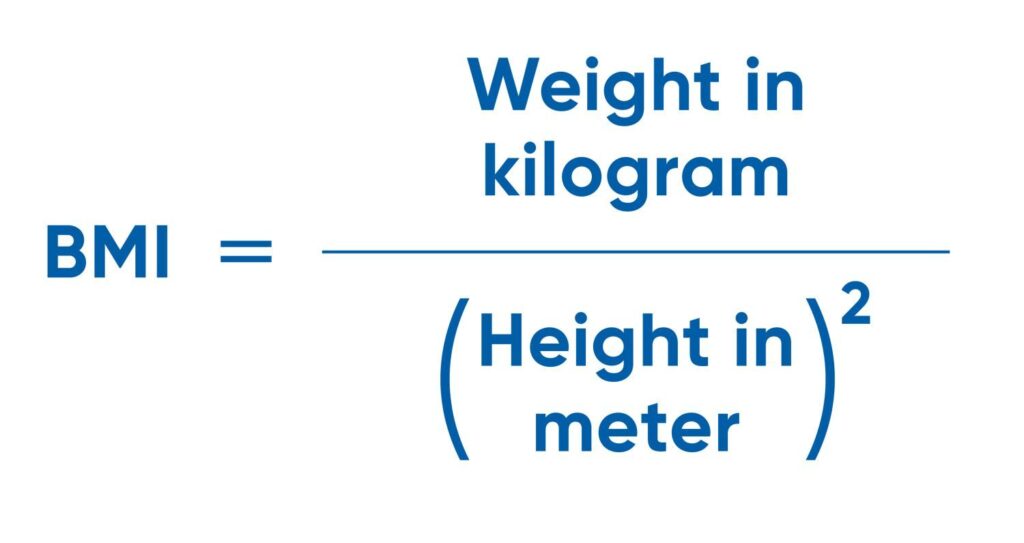
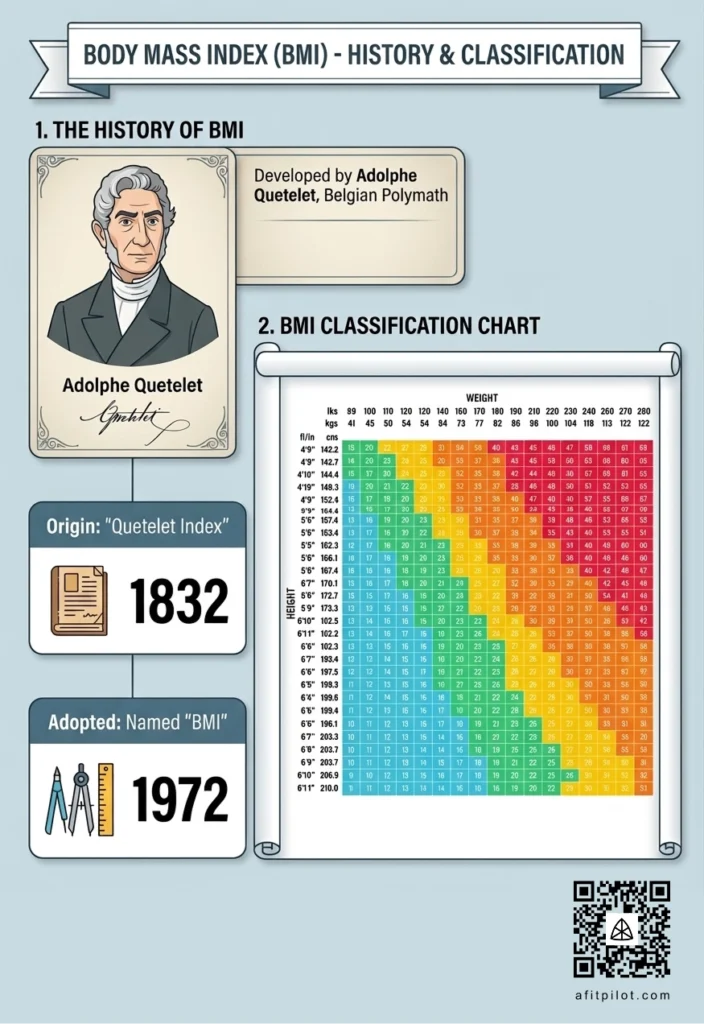
The most famous output was l’homme moyen — the “average man” — introduced in his 1835 book Sur l’homme et le développement de ses facultés. The idea was that for any measurable human trait, the population’s average value was a meaningful description of the population. Quetelet treated the average as an ideal, which is the part that aged worst: his framing was an early intellectual ingredient in Francis Galton’s eugenics, and it is why the index he derived inherits a structural problem when applied to individuals. The formula — weight in kilograms divided by height in metres squared — was a population statistic. It was never designed as a clinical or personal measure.
It carried his name, the Quetelet Index, for over a century. In 1972, in the Journal of Chronic Diseases, the American physiologist Ancel Keys validated it against skinfold measurements as the best of several available weight-for-height indices and renamed it the Body Mass Index. The use case Keys had in mind was epidemiology — population-level studies of obesity and cardiovascular disease — not the individual-diagnostic role BMI later played as it filtered into clinical practice.
Where BMI breaks down
The renaming did not change the underlying object. BMI is the same ratio Quetelet derived. What it inherited from him is the limitation he never tried to hide: it describes a population well and an individual badly.
The technical reasons are well documented. BMI does not distinguish fat mass from lean tissue, so a muscular athlete and a sedentary person of the same height and weight are treated identically. It does not capture where fat is distributed, which matters because visceral fat (around the internal organs) carries metabolic risk that subcutaneous fat does not. The original calibration was derived from a narrow sample — Scottish Highland soldiers and French gendarmerie, mostly white European men of working age — and the cut-offs that came out of it apply badly to women, older adults, and non-European populations. Used as a clinical screen, it can underdiagnose eating disorders in patients whose BMI sits in the “normal” range, and it can label muscular individuals as overweight or obese without any underlying health concern.
The medical consensus on this has shifted formally in the last few years. In June 2023, the American Medical Association adopted a policy stating that BMI has “significant limitations” and recommending it be used in conjunction with other measures — visceral fat, waist circumference, relative fat mass — rather than as a stand-alone metric. The AMA also flagged the historical issue: BMI has been used “for racist exclusion,” and its data foundation was never global to begin with.
In January 2025, a Lancet Diabetes & Endocrinology Commission on Clinical Obesity, endorsed by more than 75 medical organisations, went further. It proposed redefining the diagnosis of obesity to require an additional anthropometric measurement — waist circumference, waist-to-hip ratio, or waist-to-height ratio — on top of BMI. It also introduced two new diagnostic categories: “preclinical obesity,” meaning excess adiposity without organ dysfunction, and “clinical obesity,” meaning excess adiposity with measurable impairment of organs, tissues, or daily function. Under the Commission’s framework, BMI alone is no longer sufficient to diagnose anything. It is a screening signal that triggers a more detailed assessment.
None of this contradicts Quetelet. He built a population statistic; it still functions as one. The shift in medical practice is mostly a correction of how the index has been used in the 150 years since, not a rejection of the underlying mathematics.
Quetelet’s substantive work spans astronomy, meteorology, demography, criminology, and education. The thread through it is the idea that human variation can be described with numbers, distributions, and regularities — that there are statistical patterns underlying social and physical phenomena we would otherwise treat as individual fates. Modern anthropometry, including the Heath-Carter somatotype method, sits on that foundation. So does the work of correcting it.
Today, the Quetelet Society — the Belgian regional chapter of the International Biometric Society — still carries his name. Its remit is the development and application of statistical and mathematical methods in the biosciences, which is recognisably what Quetelet himself was doing nearly two centuries ago. The society also awards an annual Quetelet Prize.
I wrote separately about William Sheldon, who followed Quetelet’s anthropometric thread into the 20th century and pushed it in directions that did not age well — [link to Sheldon post]. And about how Heath and Carter eventually corrected Sheldon’s framework into the somatotype method still used in sports science today — [link to somatotype experiment post].
Leave a Reply
You must be logged in to post a comment.