
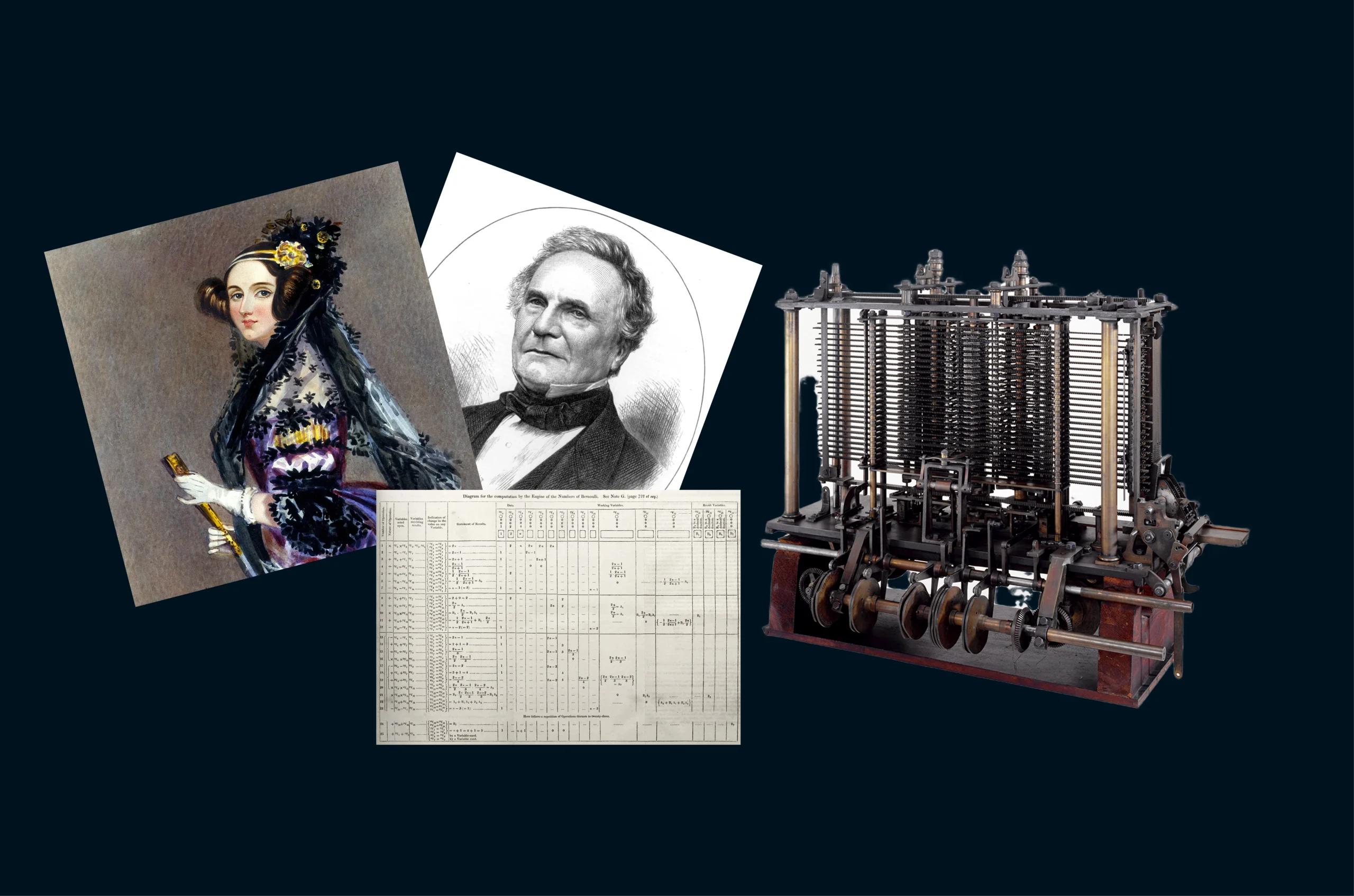
Ada Lovelace wrote what is generally regarded as the first published computer program — a step-by-step procedure for computing Bernoulli numbers on a machine that did not yet exist, and would not be built in her lifetime. The program is in Note G of her 1843 paper, the longest of seven appendices she added to her translation of an Italian engineer’s account of Charles Babbage’s Analytical Engine.
.jpg)
She was born Augusta Ada Byron in London in December 1815, the only legitimate child of the poet Lord Byron and the mathematician Annabella Milbanke. Her parents separated two months after her birth; Byron left England forever shortly afterwards and died in Greece when Ada was eight. Her mother, determined to root out any trace of what she considered Byron’s poetic instability, ensured Ada was educated rigorously in mathematics and science from a young age — an unusual programme of study for a girl in the 1820s. Her tutors included William Frend, William King (the family physician, no relation to her later husband), Mary Somerville, and from the 1840s, Augustus De Morgan, the first professor of mathematics at the University of London. De Morgan wrote to Lady Byron suggesting that Ada’s mathematical ability might lead her to become “an original mathematical investigator, perhaps of first-rate eminence.”
She married William King in 1835. He was created Earl of Lovelace three years later, making her the Countess of Lovelace.
The Analytical Engine
Lovelace met Charles Babbage in 1833, when she was seventeen, through their mutual friend Mary Somerville. Babbage was working on his Difference Engine, a mechanical calculator. By the time their collaboration matured a decade later, he had moved on to a more ambitious design: the Analytical Engine, a steam-powered general-purpose computer that could be programmed using punched cards adapted from the Jacquard loom. The Analytical Engine was never built. Babbage produced detailed drawings and a partial prototype, but the British government withdrew funding and the full machine remained on paper.
.jpg)
In 1840 Babbage was invited to lecture on the Engine at Turin, the only public account he ever gave of it. The Italian engineer Luigi Menabrea — later prime minister of Italy — wrote up the lecture in French and published it in 1842. Charles Wheatstone asked Lovelace to translate Menabrea’s paper into English, and Babbage suggested she expand it with notes of her own. The published version appeared in Taylor’s Scientific Memoirs in August 1843, signed only with her initials A.A.L. Of its sixty-six pages, forty-one were her appendices.

The notes are what make the paper historically significant. Two contributions stand out.
The first is in Note A, where Lovelace describes what the Analytical Engine could do beyond arithmetic. She observed that the Engine’s operations were defined by the punched cards independently of the data being processed, and that this separation meant the machine could in principle act on anything reducible to formal symbolic relationships — not only numbers. She used music as her example: if the relations of pitch and harmony could be expressed in the Engine’s notation, the machine “might compose elaborate and scientific pieces of music of any degree of complexity or extent.” That observation — that a computer is a general symbol-manipulator, not just a calculator — is the conceptual leap that distinguishes Lovelace’s reading of the Engine from Babbage’s.
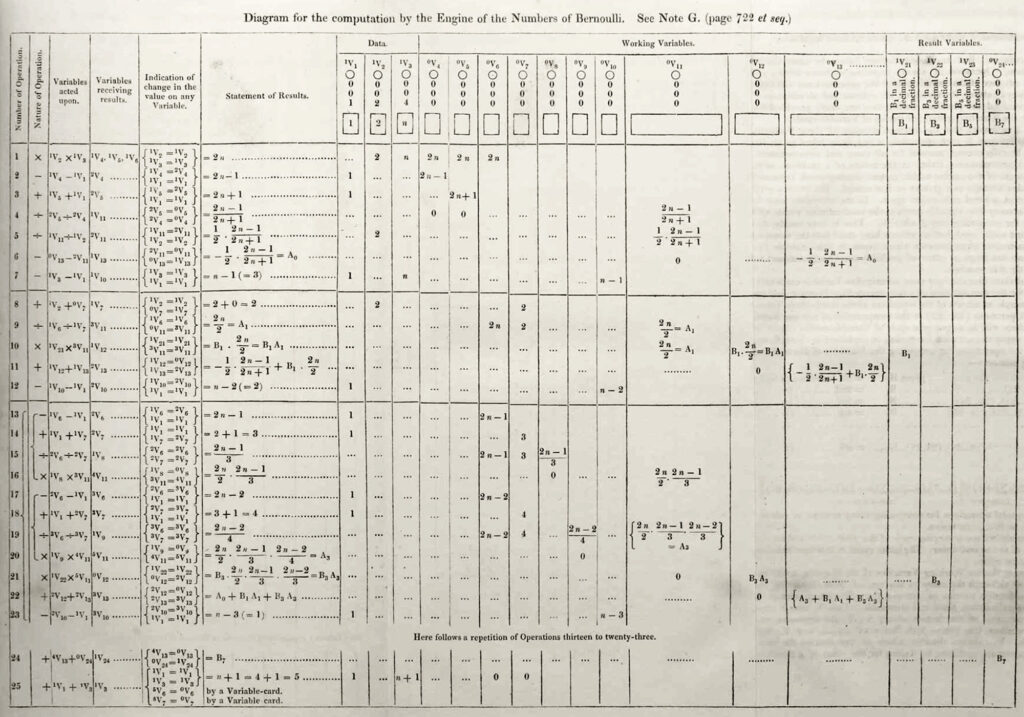

The second is Note G, the algorithm. Lovelace laid out a step-by-step procedure for computing Bernoulli numbers using the Engine’s operations and storage. The algorithm uses iteration, conditional structure, and what we would now call variables — the basic vocabulary of programming. Babbage had drafted earlier programs for the Engine that were never published; Lovelace’s was the first to appear in print, with full explanation, intended to demonstrate to readers what the machine was capable of. She also caught a bug in Babbage’s working that he had not seen.
Note G is also where she stated what Alan Turing would later call “Lady Lovelace’s Objection” — the position that the Analytical Engine “has no pretensions whatever to originate anything” and could only do what it was instructed to do. Turing took this seriously enough to address it directly in his 1950 paper Computing Machinery and Intelligence, which laid the groundwork for modern artificial intelligence. The exchange across a century — Lovelace’s claim, Turing’s response — is part of the foundational literature of the field.
What survived
Lovelace’s contemporary reputation rested on the Menabrea paper, but her wider scientific career was cut short. She suffered increasingly from uterine cancer through her early thirties and died in November 1852, aged 36 — the same age her father had been when he died. Her notes were largely forgotten for nearly a century. They were republished in 1953 as an appendix to B.V. Bowden’s Faster than Thought, and from there entered the historiography of computing.
The early programming language Ada, developed by the US Department of Defense in 1980 and standardised in 1983, is named after her. The Lovelace Test, proposed in 2001, is a formalisation of her objection — a benchmark proposing that a machine should be considered intelligent only when it can produce something genuinely original, beyond what it has been programmed to do. The Bodleian’s recent scholarship, particularly Hollings, Martin, and Rice’s Ada Lovelace: The Making of a Computer Scientist (2018), has worked through her surviving mathematical manuscripts to settle a long-running debate about whether her contribution was substantive or symbolic. The current scholarly consensus is that it was substantive: she was a competent mathematician working at the edge of what was understood, and her conceptual reading of the Engine was her own.
Her claim to be the first computer programmer is sometimes contested — Babbage had drafted earlier programs; her algorithm was developed in dialogue with him. The narrower claim that holds is that she wrote the first published, fully-worked computer program, and that she was the first person to articulate what a programmable computer was.
A brief personal note
I first heard her name in 2019, in a coding bootcamp at BeCentral in Brussels. The cohort I was placed in was called the Lovelace class — twenty-odd self-taught coders, named after her. I knew nothing about her at the time beyond the fact of the name.
A year or so later I read Walter Isaacson’s The Innovators (2014), which opens with Lovelace and gives her real space — her mathematics, her relationship with Byron’s reputation, her work with Babbage. It’s where I first understood why the bootcamp had used her name.
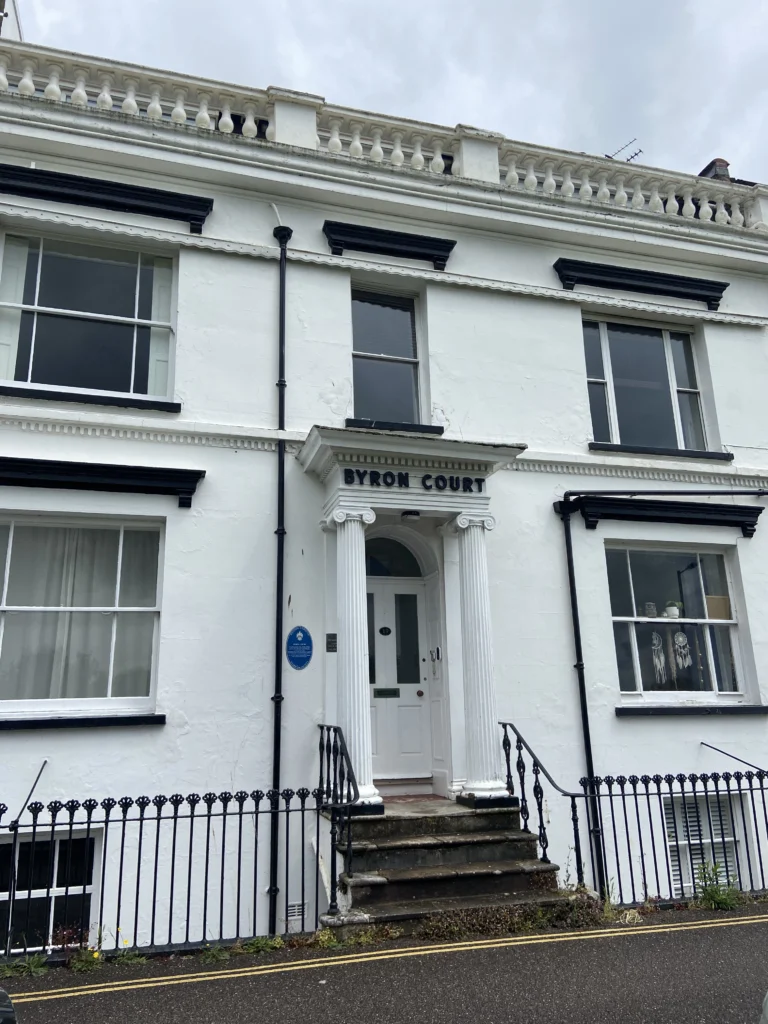
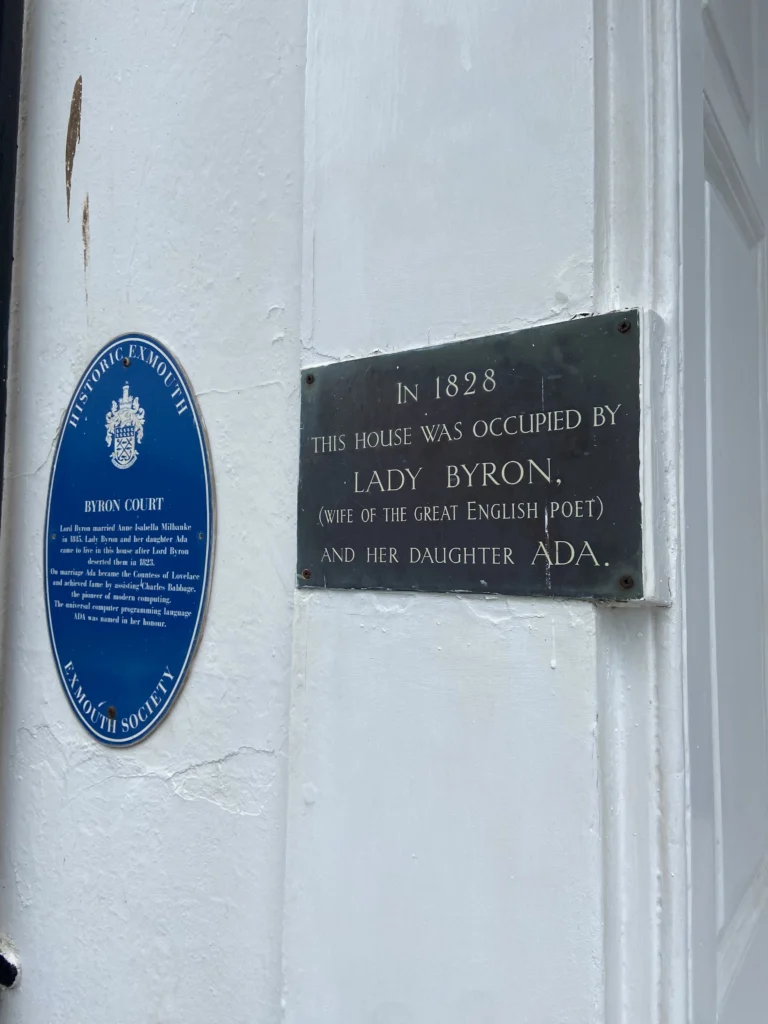
The third thing was domestic. My grandfather has lived for years in a flat in Exmouth, in a building called Byron Court at 19 The Beacon. The building was the former Chapman’s Beacon Hotel, where Lady Byron took the eight-year-old Ada to stay through autumn 1828. There’s a blue plaque on the front. My grandfather’s flat is below the rooms the family used.
Three coincidences in a row don’t mean anything in particular — coincidences accumulate around any subject you spend time with, and confirmation bias does the rest. But they’re real, and the woman they point to is genuinely worth knowing about.
I wrote separately about Adolphe Quetelet and William Sheldon, two other 19th-century figures whose work shaped how I think about measurement and computation in the platform I’m building.
Image credits
Header image: composite by Walter Clayton, CC BY-SA 2.0. Sources: Analytical Engine photograph © Science Museum London via Wikimedia Commons (CC BY-SA 2.0); Ada Lovelace portrait by Margaret Sarah Carpenter, c.1836 (public domain); Charles Babbage engraving (public domain); Note G diagram from Lovelace’s translation of Menabrea, 1843 (public domain).
Leave a Reply
You must be logged in to post a comment.