
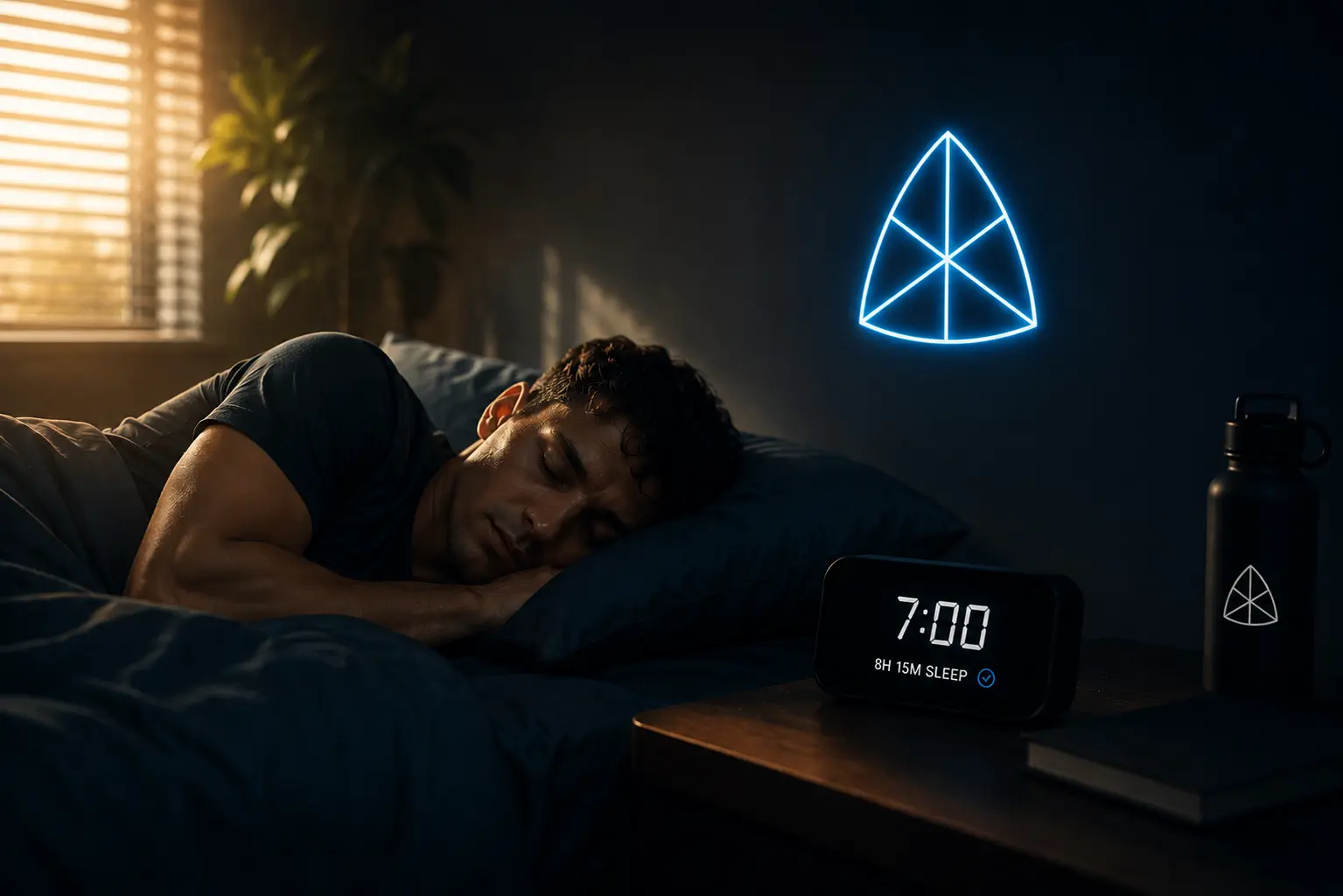
Sleep is often treated as a lifestyle factor that sits outside the training programme, something that affects how an athlete feels rather than how they perform. The research does not support that separation. Sleep is the period in which much of the adaptation to training occurs, and inadequate sleep measurably reduces the return on the training itself.
This article summarises sleep and athletic performance, how sleep loss affects perceived exertion, and why sleep is a variable coaches have reason to account for when interpreting an athlete’s training response.
Sleep and Adaptation
Sleep is not separate from training. It is the phase in which the body carries out much of the work of adaptation: protein synthesis, consolidation of motor patterns, and regulation of the hormones that determine whether a given session produces a positive adaptation or accumulated fatigue.
A 2025 systematic review in the Journal of Clinical Medicine described sleep as central to tissue regeneration, exercise adaptation, and injury prevention. The authors reported that disruptions in sleep architecture are consistently associated with reduced muscular strength, power output, and endurance capacity.
The mechanism is reasonably well understood. The majority of daily growth hormone is released during deep slow-wave sleep, and growth hormone supports muscle protein synthesis and tissue repair. Reduced sleep compresses the window in which this occurs. At the same time, sleep restriction is associated with elevated cortisol, a catabolic hormone, which further shifts the recovery environment away from adaptation.
The Effect of Sleep Loss on Performance
The effects of sleep loss are not limited to severe deprivation. A 2025 meta-analysis in Frontiers in Physiology reviewed 45 studies covering aerobic endurance, anaerobic performance, explosive power, maximum force, speed, skill control, and perceived exertion. It found that sleep deprivation measurably impairs performance across these domains, and that the effects are not trivial.
One finding is particularly relevant to coaches who use RPE to gauge training. Sleep deprivation significantly elevates perceived exertion. The same session, performed by the same athlete, is rated as harder after poor sleep, not because fitness has changed overnight but because the nervous system processes effort differently in a sleep-restricted state. A session intended as RPE 7 may be experienced and reported as a 9.
This has a direct consequence for load interpretation. An athlete training by prescribed effort, or a coach reading reported effort, will see an inflated cost for the same nominal session. The training stimulus is unchanged, but the physiological and perceptual cost is higher.
Partial Sleep Loss
Most sleep loss in practice is not total deprivation but chronic partial restriction: consistently sleeping six hours instead of eight, for example. The research distinguishes between losing the early portion of the night and losing the later portion, and the two have somewhat different effects.
Loss of the later portion of the night, which tends to be richer in REM and lighter sleep stages, has a greater effect on cognitive function, mood, and reaction time. Loss of the earlier portion, which contains more deep slow-wave sleep, more directly reduces growth hormone release and tissue repair. In both cases, the recovery window between training sessions is shortened, and the adaptation that the training is intended to produce is partially reduced.
The Cumulative Effect
Individual nights of poor sleep are less significant than the pattern over weeks. Athletes with consistent life stress often sustain a regular sleep deficit, and unlike missed sessions, which are visible and recorded, sleep debt accumulates without being logged.
The signs of this are usually visible in the training response if a coach is tracking it. A consistently under-slept athlete tends to show elevated RPE for sessions that should feel manageable, stalled progress despite maintained training volume, slower recovery between sessions, and a general flatness in output. These are frequently misread as a need to train harder.
Increasing load in response is generally the wrong adjustment. The gap between the prescribed training and what the athlete is absorbing is already present, and adding volume widens it rather than closing it.
Sleep Requirements for Athletes
General sleep advice, such as aiming for eight hours, is a reasonable floor but assumes ideal conditions. A 2025 review in the Journal of Sports Sciences noted that athletes’ sleep requirements tend to exceed population norms, because their demands for tissue repair, hormonal recovery, and neurological consolidation are higher.
A few points from the research are worth noting for practical purposes.
Consistency of sleep and wake timing supports circadian alignment, which governs the timing of growth hormone release and the natural decline of cortisol. Irregular sleep timing disrupts this even when total hours are adequate.
Sleep quality and sleep quantity are not equivalent. Uninterrupted sleep is more restorative than the same number of fragmented hours. High training loads, caffeine late in the day, alcohol, and light exposure can fragment sleep architecture without necessarily reducing total recorded hours.
The period before competition is a common point of sleep disruption, through anxiety, travel, and changes in routine, and it coincides with the period in which sleep matters most. Research on pre-competition sleep loss consistently shows impaired performance, particularly in skill-based and high-intensity events.
Why This Matters for Load Interpretation
Sleep is distinct from most training variables in that it affects several systems at once. Poor sleep raises cortisol, reduces protein synthesis, disrupts motor consolidation, slows recovery signalling, and inflates perceived exertion. A single difficult session affects one session. A sustained sleep deficit affects every session that follows.
This is the practical reason sleep is relevant to coaches rather than only to athletes. An athlete who appears to have stalled, or whose effort seems disproportionate to the work prescribed, is often not under-trained but under-recovered, and sleep is the most commonly overlooked component of recovery.
This is also where systematic monitoring is useful. When an athlete’s RPE for a standard session is trending upward over several weeks, sleep is one of the first factors worth examining. Tracking perceived effort over time, which is the signal Afitpilot is built around, gives a coach a way to detect this pattern before it is misinterpreted as a need for more training. The sleep itself sits outside the programme, but its effect shows up clearly in the training response, provided that response is being monitored.
References
- Kaczmarek F, et al. Sleep and athletic performance: a multidimensional review of physiological and molecular mechanisms. J Clin Med. 2025;14(21):7606. DOI: 10.3390/jcm14217606. PMC: PMC12610528
- Kong Y, Yu B, Guan G, Wang Y, He H. Effects of sleep deprivation on sports performance and perceived exertion in athletes and non-athletes: a systematic review and meta-analysis. Front Physiol. 2025;16:1544286. DOI: 10.3389/fphys.2025.1544286. PMC: PMC11996801
- Bonnar D, et al. Sleep and performance across the lifespan: what is known about athlete requirements. J Sports Sci. 2025. DOI: 10.1080/09291016.2025.2508808
- Bah TM, et al. A narrative review of the impact of sleep on athletes: sleep restriction, monitoring, and interventions. PMC. 2025. PMC: PMC11779686
- Selye H. General adaptation syndrome and diseases of adaptation. J Clin Endocrinol Metab. 1946;6:117-230.
Leave a Reply
You must be logged in to post a comment.