
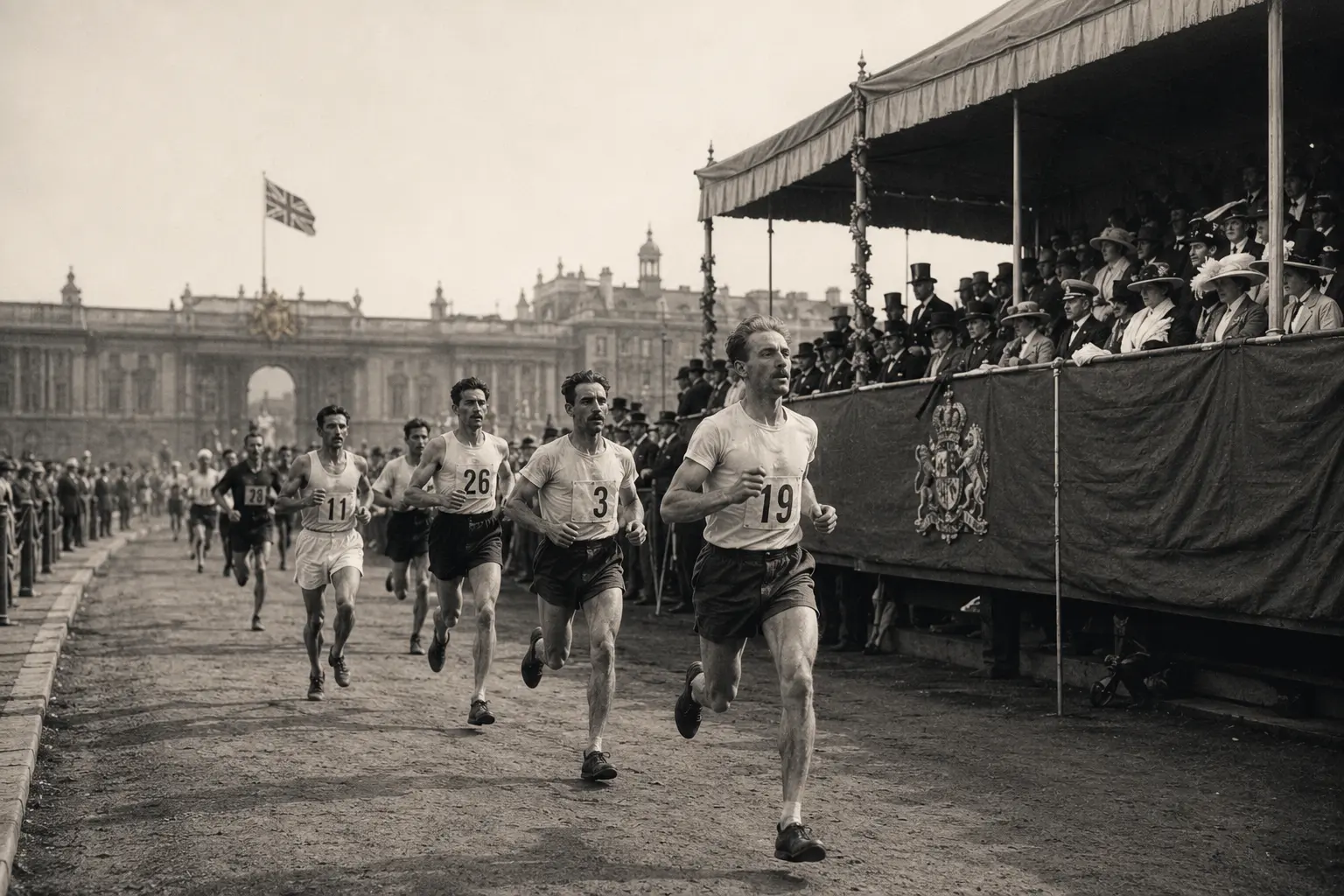
The marathon is 42.195 kilometres. Not a clean 42, not 40, but an oddly specific 42.195. The number is precise enough to feel deliberate, as though it were derived from some physiological limit or ancient measurement. It was not. The distance owes its final 352 metres to the sightlines of the British royal family at a single race in 1908, and it stuck largely by accident.
This article traces where the distance came from, corrects the myth most runners have been told about its origins, and looks at what that specific distance actually demands of the body.
The Myth at the Start
The marathon is named for the Battle of Marathon in 490 BCE, and the standard story is well known: a Greek soldier ran from the battlefield at Marathon to Athens, about 40 kilometres, announced the Athenian victory, and dropped dead. It is a good story. It is also almost certainly untrue.
The Greek historian Herodotus, who lived close enough to the battle to interview veterans of it, never mentions anyone running from Marathon to Athens to announce victory. What he does describe is a professional long-distance runner named Pheidippides, sent from Athens to Sparta to request military help before the battle, a run of roughly 240 kilometres, not 40. The dramatic collapse-at-the-finish version appears to be a later invention, stitched together centuries after the fact. The race commemorates something that most likely did not happen the way it is told.
No Fixed Distance at All
When the marathon entered the first modern Olympics in 1896, it had no standard length. The organizers set it at roughly 40 kilometres, approximating the legendary run, and for the next several Games the distance floated. The first seven Olympic marathons, across 24 years, used six different distances, ranging from about 40 to 42.75 kilometres. The idea that a marathon meant a specific distance simply did not exist yet.
1908: Windsor Castle to the Royal Box
The 1908 London Olympics is where the modern number was set, and the reason is almost comically mundane. The organizers planned a course from Windsor Castle to the White City Stadium. By most accounts, the start was placed on the lawn beneath the castle so that the royal children could watch from their nursery window, and the finish was positioned directly in front of the royal box so the King and Queen had a clear view of the end.
Fitting the course between those two fixed points, the castle and the royal box, produced a distance of 42.195 kilometres, 26 miles and 385 yards in the imperial measurement used at the time. The extra 352 metres were not a physiological milestone or a nod to history. They were the length required to line the finish up with where the royal family was sitting.
The race itself became famous for a different reason. The Italian runner Dorando Pietri entered the stadium first, then collapsed repeatedly on the track, disoriented and unable to finish on his own. Officials helped him across the line, which got him disqualified, but the spectacle made the 1908 marathon internationally famous. Its distance lodged in public memory far more firmly than any of the shorter, earlier versions.
How an Accident Became the Standard
Even after 1908, the distance did not immediately become universal. The 1912 Stockholm Games used a course of about 40.2 kilometres; the 1920 Antwerp Games ran longer, at 42.75 kilometres. The marathon was still a flexible distance for more than a decade after the famous London race.
Standardization came in 1921, when the International Amateur Athletic Federation, now World Athletics, formally fixed the marathon at 42.195 kilometres, most likely in deference to the memorable 1908 London race. From that point every certified marathon has been that distance. An accident of royal sightlines became a permanent global standard, and the number now printed on race bibs and finisher medals worldwide traces directly back to the geometry of a stadium in 1908.
What That Distance Actually Demands
The distance is arbitrary in origin, but it is not arbitrary in effect. The last 350 metres or so sit exactly where they cause the most trouble. Marathon performance is limited heavily by glycogen depletion, the point at which the muscles’ stored carbohydrate runs low, often experienced around 32 to 35 kilometres as the well-known “wall.” A distance that ends at 42.195 kilometres places the finish well past that point for most runners, which is a large part of why the marathon is a genuine test rather than simply a long run.
This is worth keeping in mind precisely because the final stretch was set by a royal box rather than by physiology. The 352 metres that were added for the Queen’s sightline now fall in the exact territory where pacing errors made earlier in the race come due. A runner who goes out too hard does not pay for it at the 16-kilometre mark. They pay for it in the added distance at the end, the stretch that exists because of where a monarch happened to be sitting. The origin is trivia; the consequence, for anyone who has run the distance, is not.
References
- Martin DE, Gynn RWH. The Olympic Marathon. Human Kinetics; 2000.
- Britannica. Why is a marathon 26.2 miles? Encyclopaedia Britannica. 2026. https://www.britannica.com/sports/Why-Is-a-Marathon-26-2-Miles
- Herodotus. The Histories, Book VI (on Pheidippides and the run to Sparta). c. 430 BCE.
- Rapoport BI. Metabolic factors limiting performance in marathon runners. PLoS Comput Biol. 2010;6(10):e1000960. DOI: 10.1371/journal.pcbi.1000960. PMID: 20975938
- World Athletics. Competition and technical rules: road races and course measurement. World Athletics; 2023.
Leave a Reply
You must be logged in to post a comment.