
A dataset built from published measurements
We assembled a reference dataset of 507 athlete cohorts (see here), each scored for somatotype using the Heath-Carter method. The rows span 79 sports and 34 countries, with 206 cohorts of women. The backbone comes from two sources: a 2025 scoping review of somatotype in modern elite athletes (Martínez-Mireles et al.), and a separate national study by the same group that measured 889 Mexican athletes across 43 sports. We then extended it with primary studies chosen to fill gaps the review had left thin, mainly amateur and recreational athletes, women’s sports, and countries outside the Mexico and Spain concentration.
Every value is a cohort mean read from a primary paper or its supplementary table. Where a study reported medians rather than means, or derived somatotype from bioelectrical impedance rather than skinfolds, we flagged it rather than silently mixing methods. The result is a dataset a coach can query by sport, position, sex, and competitive level, with the three somatotype components kept as separate numeric columns so they can be analysed rather than read as a label.
What somatotype actually measures
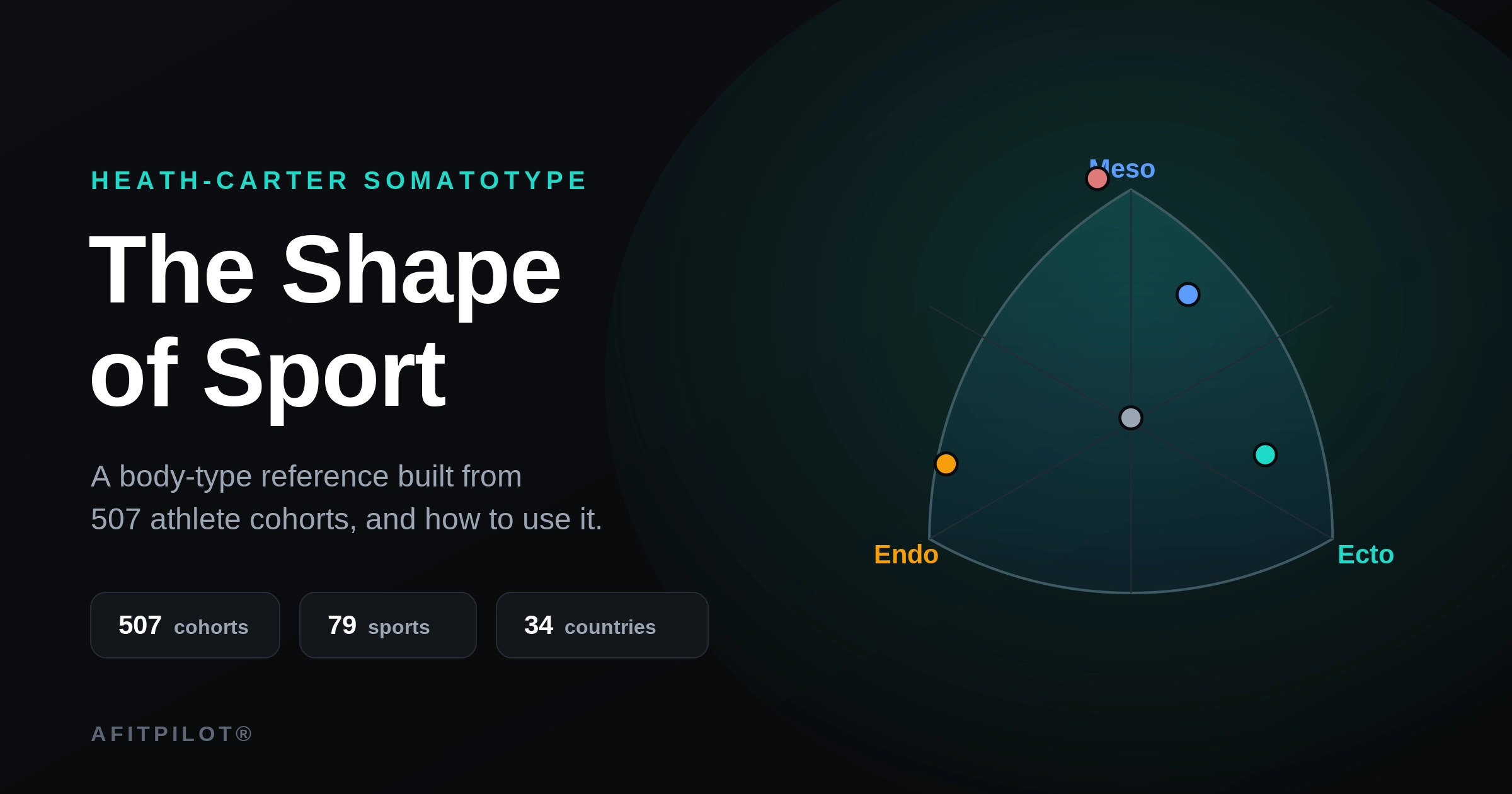
Somatotype describes physique on three components. Endomorphy is relative fatness. Mesomorphy is relative musculoskeletal robustness. Ectomorphy is relative linearity, essentially how much height a person carries per unit of mass. Each is rated on an open-ended scale that runs roughly from 1 to 7 in practice but is not capped, and the three together place a person on a two-dimensional somatochart.
The rating is derived from field measurements: skinfolds at defined sites, a few girths and bone breadths, plus height and weight, entered into the Heath-Carter equations. Most of the studies here followed the ISAK protocol, which standardises those measurement sites and techniques. The appeal for practitioners is that the whole assessment costs a caliper and a tape, takes minutes, and produces a stable three-number summary that can be compared across athletes and tracked over time.
It is worth being clear about what the number is not. Somatotype is a description of shape, not a measure of body composition, fitness, or performance. Two athletes can share a somatotype and differ substantially in fat mass or power output. The value of the method is that it captures the structural pattern of a physique in a way that a single figure like BMI or body-fat percentage cannot.
Why the measurement persists
Body-shape scoring has been in and out of fashion since the 1940s, and it survives for a practical reason: within a given sport and position, elite physiques converge. When a role imposes consistent mechanical demands, the athletes who succeed in it tend to arrive at a similar build, and that build is legible in the somatotype. This makes the method useful for two things coaches genuinely need, benchmarking an athlete against the population that already performs their role, and monitoring how an individual’s physique shifts across a training year.
What the dataset shows
The clearest pattern is convergence by demand. The most muscular cohorts in the entire set are heavyweight powerlifters, who reached a mesomorphy near 10.7, well beyond the nominal top of the scale (Keogh et al., 2007). The most linear is a volleyball center standing 200 cm at 73.5 kg, with an ectomorphy of 6.4 and a BMI of 18.4. The heaviest and roundest are Korean ssireum wrestlers, averaging 136 kg at a BMI above 40 (Noh et al., 2013). These are not curiosities. They are the visible endpoints of the same process that shapes every cohort in between: the sport selects for the build that does the job.
The most common physique across all 507 cohorts is the endomorphic mesomorph, a muscular build carrying some fat mass. This is the default of competitive sport, and it holds across most team and combat disciplines. It is worth internalising, because it means that for the majority of athletes the relevant question is not which somatotype category they belong to, but where they sit within the endomorphic-mesomorphic cluster their sport occupies.
Position sharpens the picture. In the Mexican dataset, American football defensive ends averaged an endomorphy near 4.9 and a mesomorphy near 7.0 with almost no ectomorphy, while wide receivers in the same sport were markedly leaner and more linear. Volleyball splits the same way, with centers tall and linear and liberos shorter and more muscular. A sport-level somatotype average hides these differences, which is why position-specific reference values are more useful to a coach than a single team number.
Endurance sits at the linear end and skews older. The most ectomorphic endurance cohorts include Kenyan marathon runners near an ectomorphy of 3.9 (Vernillo et al., 2013) and Japanese collegiate distance runners (Ota et al., 2023). The three oldest cohorts in the dataset are all ultra and trail runners, with mean ages in the low forties. Endurance rewards a light, linear frame and tolerates, even rewards, accumulated years of aerobic adaptation, whereas the explosive sports are populated by younger athletes.
Sex differences run in a consistent direction. Female cohorts tend to sit higher on endomorphy and lower on mesomorphy than male cohorts in the same sport, which reflects normal differences in body composition rather than anything sport-specific. The practical consequence is that reference values must be sex-specific; a male positional norm is not a usable target for a female athlete in the same role.
What an athlete can do with it
Start with benchmarking, and read it correctly. A somatotype tells an athlete how their structure compares with others who already perform their role. That comparison is informative when it is large and directional, for example a prop forward who is considerably more ectomorphic and less mesomorphic than the positional norm may lack the mass the role rewards. It is not informative as a demand to match a number. The spread within any elite cohort is wide, and physiques that differ on paper can perform identically.
The more durable use is longitudinal monitoring, because the three components respond differently to intervention. Endomorphy tracks fatness and moves with nutrition and energy balance. Mesomorphy tracks musculoskeletal development and moves, slowly, with resistance training. Ectomorphy is largely a function of frame and height and does not meaningfully change in an adult. This separation is what makes the method a useful monitoring tool: a mesomorphy that climbs while endomorphy falls across a preparation block is direct structural evidence that a body-recomposition program is working, independent of scale weight.
That same separation sets the limits of what can be changed. An athlete cannot train toward a more ectomorphic build; linearity is fixed by skeletal proportions. Framing a leaner physique as a somatotype target confuses a change in fatness, which is achievable, with a change in shape, which is not. The honest coaching message is that endomorphy and mesomorphy are the levers, and ectomorphy is a constraint to design around rather than a goal to pursue.
Somatotype also has a place in talent identification and transfer, used with restraint. A young athlete whose build already resembles a positional norm has one fewer barrier to overcome, and an athlete whose structure is a poor fit for one role may be a strong fit for another within the same sport. This is a screening input, not a verdict. Physique is one of several factors behind performance, and its predictive value is modest and sport-dependent; in some anaerobic tasks mesomorphy shows a measurable association with output, but the relationship is far from deterministic (Ryan-Stewart et al., 2018).
For weight-class sports, the useful signal is the pairing of somatotype with the class an athlete competes in. The judo, boxing, wrestling, and taekwondo cohorts here show mesomorphy rising and ectomorphy falling as weight class increases, which tells an athlete what a competitive build looks like at their target class rather than in the sport as a whole. Choosing a class that suits an athlete’s natural build is usually sounder than forcing the build to suit a chosen class.
You can test your own somatotype here.
Limits worth stating plainly
The dataset is cross-sectional, so every pattern in it is an association between physique and participation, not evidence that a physique caused performance. The elite athletes who define these norms are survivors of long selection, and the norms describe who remains rather than who will succeed.
Method heterogeneity is real. Most cohorts used skinfold-based Heath-Carter under the ISAK protocol, but a few derived somatotype from bioelectrical impedance, and a handful reported medians rather than means. Those rows are flagged, and anyone using the data for close comparison should filter to a consistent method. Geographic coverage is also uneven, with Mexican athletes forming close to half the rows because a single large national study contributes 221 cohorts, so cross-country comparisons should be read cautiously.
None of this undermines the core use. As a cheap, repeatable description of physique that can be benchmarked against sport-specific norms and tracked within an athlete over time, somatotype earns its place in a monitoring toolkit. It is most valuable when treated as one descriptive input among several, and least valuable when treated as a target to sculpt toward.
References
Carter, J. E. L., & Heath, B. H. (1990). Somatotyping: Development and Applications. Cambridge University Press.
Heath, B. H., & Carter, J. E. L. (1967). A modified somatotype method. American Journal of Physical Anthropology, 27(1), 57 to 74. https://doi.org/10.1002/ajpa.1330270108
Marfell-Jones, M., Olds, T., Stewart, A., & Carter, L. (2006). International Standards for Anthropometric Assessment. International Society for the Advancement of Kinanthropometry (ISAK).
Martínez-Mireles, X., Nava-González, E. J., López-Cabanillas Lomelí, M., et al. (2025). The Shape of Success: A Scoping Review of Somatotype in Modern Elite Athletes Across Various Sports. Sports, 13(2), 38. https://doi.org/10.3390/sports13020038
Martínez-Mireles, X., et al. (2025). A National Study of Somatotypes in Mexican Athletes Across 43 Sports. Journal of Functional Morphology and Kinesiology, 10(3), 329. https://doi.org/10.3390/jfmk10030329
Keogh, J. W. L., Hume, P. A., Pearson, S. N., & Mellow, P. (2007). Anthropometric dimensions of male powerlifters of varying body mass. Journal of Sports Sciences, 25(12), 1365 to 1376. https://doi.org/10.1080/02640410601059630
Slater, G. J., Rice, A. J., Mujika, I., et al. (2005). Physique traits of lightweight rowers and their relationship to competitive success. British Journal of Sports Medicine, 39(10), 736 to 741. https://doi.org/10.1136/bjsm.2004.015990
Malousaris, G. G., Bergeles, N. K., Barzouka, K. G., et al. (2008). Somatotype, size and body composition of competitive female volleyball players. Journal of Science and Medicine in Sport, 11(3), 337 to 344. https://doi.org/10.1016/j.jsams.2007.05.002
Franchini, E., Del Vecchio, F. B., Matsushigue, K. A., & Artioli, G. G. (2011). Physiological profiles of elite judo athletes. Sports Medicine, 41(2), 147 to 166. https://doi.org/10.2165/11538580-000000000-00000
Vernillo, G., Schena, F., Berardelli, C., et al. (2013). Anthropometric characteristics of top-class Kenyan marathon runners. Journal of Sports Medicine and Physical Fitness, 53(4), 403 to 408. https://www.minervamedica.it/en/journals/sports-med-physical-fitness/article.php?cod=R40Y2013N04A0403
Noh, J. W., Kim, J. H., Kim, J., et al. (2013). Somatotype analysis of Korean wrestling athletes compared with non-athletes for sports health sciences. Toxicology and Environmental Health Sciences, 5(4), 189 to 196. https://doi.org/10.1007/s13530-013-0170-9
Noh, J. W., Kim, J. H., & Kim, J. (2014). Somatotype analysis of elite boxing athletes compared with nonathletes for sports physiotherapy. Journal of Physical Therapy Science, 26(8), 1231 to 1235. https://doi.org/10.1589/jpts.26.1231
Gryko, K., Kopiczko, A., Mikołajec, K., et al. (2018). Anthropometric variables and somatotype of young and professional male basketball players. Sports, 6(1), 9. https://doi.org/10.3390/sports6010009
Sánchez-Muñoz, C., Muros, J. J., Zabala, M., et al. (2018). World and Olympic mountain bike champions’ anthropometry, body composition and somatotype. Journal of Sports Medicine and Physical Fitness, 58(6), 843 to 851. https://doi.org/10.23736/S0022-4707.17.07482-7
Ryan-Stewart, H., Faulkner, J., & Jobson, S. (2018). The influence of somatotype on anaerobic performance. PLOS ONE, 13(5), e0197761. https://doi.org/10.1371/journal.pone.0197761
Ota, M., et al. (2023). Anthropometric and somatotype characteristics of Japanese female collegiate long-distance runners. Applied Sciences, 13(11), 6442. https://doi.org/10.3390/app13116442
Penichet-Tomas, A., Pueo, B., Selles-Perez, S., & Jimenez-Olmedo, J. M. (2021). Analysis of anthropometric and body composition profile in male and female traditional rowers. International Journal of Environmental Research and Public Health, 18(15), 7826. https://doi.org/10.3390/ijerph18157826
Leave a Reply
You must be logged in to post a comment.