
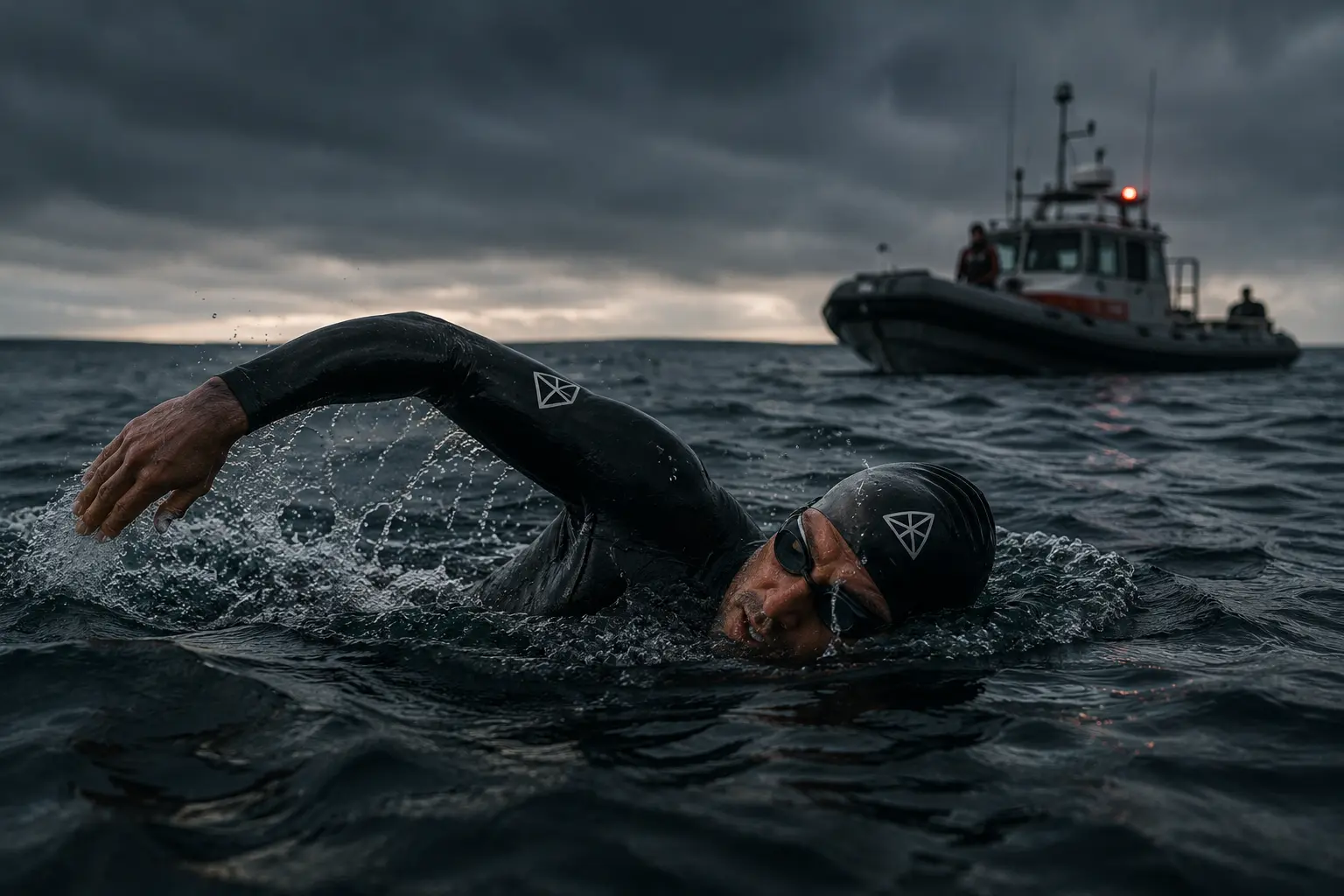
On Sunday evening, a Polish swimmer named Bartłomiej Kubkowski dragged himself onto a beach in Dziwnów, Poland. He’d just become the first person in history to swim across the Baltic Sea between Sweden and Poland. He’d covered just over 160 kilometres. He’d been in open water for roughly 56 hours straight. It was his fifth attempt at this exact crossing since 2022. This article isn’t a profile of Kubkowski. It’s a look at what a continuous, multi-day open-water swim actually requires of the body. His crossing is the entry point.
The Basic Facts
Kubkowski set off from Kaseberga, Sweden, on a Friday. He reached Dziwnów on Poland’s northern coast on Sunday evening, roughly 56 hours later. A support boat provided food and drink throughout. But under the rules governing this kind of unassisted swim, he was never allowed to touch the vessel itself. He did not sleep for the duration of the crossing.
His swim came close to the longest continuous, unassisted open-water swim ever ratified by the Marathon Swimmers Federation. That record, 168.3 kilometres, belongs to American swimmer Sarah Thomas, across Lake Champlain in 2017. Last year, Kubkowski came within 11 kilometres of completing this same Baltic route. Exhaustion and worsening weather forced him to stop. He also holds the world record for longest distance swum in a pool over 24 hours: 103.6 kilometres.
Why Sleep Deprivation Is a Different Problem in Water
On land, sleep deprivation during an ultra-endurance event is primarily a performance problem. It slows reaction time, degrades decision-making, and raises perceived effort. In open water, it’s also a direct safety problem, in a way running or cycling isn’t. A swimmer who loses consciousness, even briefly, is at immediate risk of drowning. This is one of the primary factors limiting how far a human can realistically swim continuously. It’s separate from raw physical fatigue.
Sleep researchers studying ultra-marathon swimmers have found something else worth noting. There’s a real tension in how these swimmers prepare. Some swimmers deliberately increase body mass before a cold-water crossing, believing added insulation reduces hypothermia risk. Research on masters-level open-water swimmers found a real trade-off here. Higher BMI was associated with meaningfully reduced total sleep time in the lead-up training period, even before the swim itself begins. The preparation for a swim like this involves competing physiological priorities, not a single variable to optimize.
The Cold Water Problem
The Baltic Sea in early August sits considerably below body temperature. Even in its warmer months, open-water swimmers face a persistent core-to-water gradient of more than 10°C. Sustained heat loss over many hours is one of the central threats in a swim like this. It’s distinct from the muscular fatigue most endurance sports primarily manage.
This is part of why elite ultra-marathon swimmers typically carry meaningfully higher body fat than elite runners or cyclists at a comparable level. Body fat insulates against heat loss and adds buoyancy, both directly useful in a multi-day cold-water swim. In running or cycling, that same mass would just be extra weight to carry. It’s a clear example of how a sport’s specific demands reshape what an optimal body composition means. One standard doesn’t apply everywhere.
Fueling a Body That Can’t Stop Moving
A runner or cyclist in a multi-day event can slow down, walk, or briefly pause to eat without major consequence. A swimmer attempting an unassisted crossing generally can’t stop moving without risking heat and momentum loss. Under the rules, they can’t touch the support boat at all. Food and fluid have to be passed to the swimmer and consumed while still moving through the water.
Research on other multi-day ultra-endurance events gives a useful reference point for what’s at stake if fueling goes wrong. A study tracking runners across a 225-kilometre multi-stage race in hot conditions found meaningful body mass loss despite structured fluid intake. Nearly half the sampled athletes showed signs of mild hyponatremia at some point, even with aid stations and planned intake. A continuous 56-hour swim has far less opportunity to carefully plan each feed. It has to manage this same fluid and electrolyte balance under considerably harder conditions.
What This Demonstrates, Beyond One Swim
The specific numbers here belong to one crossing and one swimmer. The pattern they illustrate is broader. Extreme endurance events force multiple systems, sleep, thermoregulation, fueling, fatigue management, to be solved simultaneously. Failure in any one can end the attempt, regardless of how well the others are managed.
This is an extreme version of a pattern covered elsewhere on this blog, at every level of training. A deload week, a taper, an autoregulated session. All of them manage the same tension: the stress an effort demands against the body’s capacity to absorb it. Just at a much smaller scale than a 56-hour, sleep-deprived swim. Kubkowski’s fifth attempt succeeded where four previous ones didn’t. That’s a reminder the margin here is often thin. Solving it can take years of accumulated, deliberate attempts, not one well-prepared try.
References
- Kubkowski becomes first person to swim 160km Baltic Sea route between Sweden and Poland. Notes from Poland. August 2, 2026.
- Dunican IC, Perry EL, Gemma M, Nesci E, Roberts S. Understanding the sleep of ultra-marathon swimmers: guidance for coaches and swimmers. J Sports Sci. 2022. DOI: 10.1177/17479541221089385
- How far could a human swim? World Open Water Swimming Association.
- Water and sodium intake habits and status of ultra-endurance runners during a multi-stage ultra-marathon conducted in a hot ambient environment. PMC3554439.
- Ultraswimming.org. Longest swims database, Marathon Swimmers Federation.
Leave a Reply
You must be logged in to post a comment.