
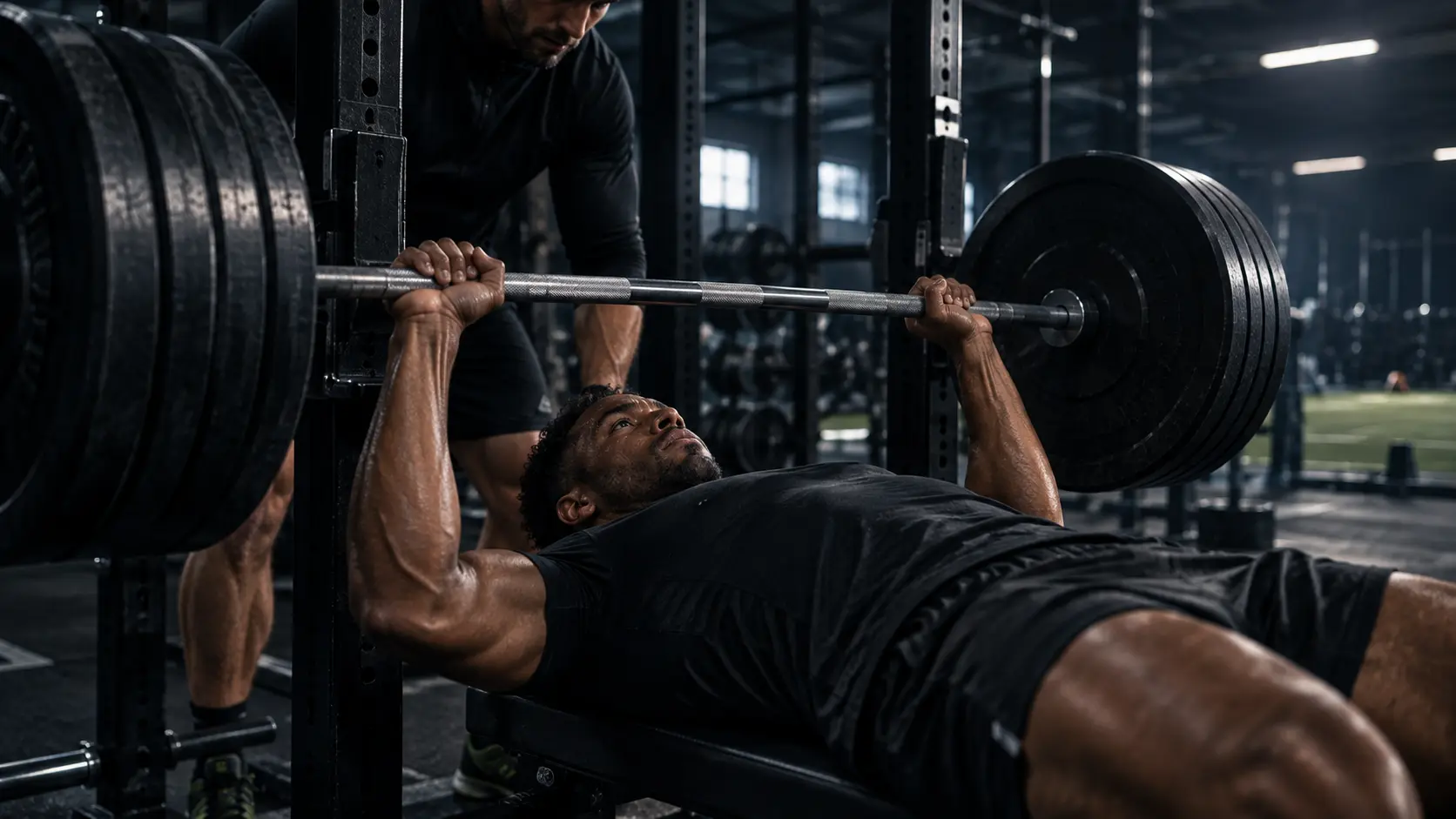
A rugby prop stands in the tunnel. Eight minutes ago, he loaded the bar for a heavy bench press set. Now he waits, rolling his shoulders, before the first scrum engagement. He isn’t resting by accident. He’s timing it.
This is complex training. A heavy lift, paired with a sport-specific power movement, placed a set number of minutes apart.
Part one of this series covered the mechanism behind it. That mechanism is post-activation potentiation (PAP). It also covered the rest window the research supports. This part covers what it looks like in practice. Two real sports, with real numbers.
Rugby: Bench Press Into Bench Throw
Bevan and colleagues (2010) tested this with professional rugby union players. Each player did a heavy bench press set: three reps at 85 percent of their one-rep max. Then came bench throw power, a fast, explosive push. It was tested at five rest points: 4, 8, 12, 16, and 20 minutes later.
Peak power was highest at the 8-minute mark. That matches the window found across the wider research in part one.
One detail stood out more than the average. Stronger players showed a bigger boost than weaker ones. This lines up with Seitz and Haff (2016). Across many sports, a higher training age sharpens the effect. A prop with years of heavy bench pressing behind him gets more from this protocol than a player still building his strength base.
Sprinting: Heavy Squats Into a 30-Meter Sprint
Chatzopoulos and colleagues (2007) ran a similar test with sprinters. Each athlete did a heavy half-squat set: three reps at 90 percent of their one-rep max. Four minutes later, they ran a 30-meter sprint.
Sprint times improved, compared to a no-squat control condition. The window here, 4 minutes, sits earlier than rugby’s 8-minute mark. The squat and the sprint share more mechanical overlap than a bench press and a scrum engagement do. That overlap may explain why potentiation showed up faster.
Why the Movements Are Chosen the Way They Are
Both protocols pair a heavy lift with a movement using the same muscle groups. The direction of force matches too. Bench press and bench throw both push horizontally through the chest, shoulders, and triceps. Squats and sprinting both drive force down and back through the hips and legs.
This isn’t incidental. A heavy lift with little mechanical overlap with the target movement won’t transfer much potentiation, even in the right time window. The lift has to resemble the sport action it’s meant to boost.
It Doesn’t Work for Everyone, and That’s Worth Saying
Not every study finds a clean effect. Chiu and colleagues (2003) tested complex training in a mixed group. It included less experienced athletes. They found no significant benefit. The weaker response in less-trained athletes was already flagged in part one. Here, it shows up as a real result, not just a theoretical caveat.
A coach deciding whether to build a complex training protocol into a warm-up or a training block should check two things first. Does the athlete have a real strength base in the lift being used? Does that lift resemble the sport movement it’s meant to boost? Without both, the protocol is unlikely to do much.
Where This Fits in a Season
A heavy-lift-into-power-movement pairing isn’t something to run every session. It fits best in two spots. One is a pre-competition warm-up, timed against the athlete’s known window. The other is a dedicated power-development session, during a strength or power phase of the year.
Running it daily, for every athlete, turns a precise tool into a generic habit. The research behind it is specific. The application should be too.
References
Bevan HR, Cunningham DJ, Tooley EP, Owen NJ, Cook CJ, Kilduff LP. Influence of postactivation potentiation on sprinting performance in professional rugby players. J Strength Cond Res. 2010;24(3):701-705. DOI: 10.1519/JSC.0b013e3181c7b68a. PMID: 20145567
Chatzopoulos DE, Michailidis CJ, Giannakos AK, et al. Postactivation potentiation effects after heavy resistance exercise on running speed. J Strength Cond Res. 2007;21(4):1278-1281. DOI: 10.1519/R-19835.1. PMID: 18076243
Chiu LZ, Fry AC, Weiss LW, Schilling BK, Brown LE, Smith SL. Postactivation potentiation response in athletic and recreationally trained individuals. J Strength Cond Res. 2003;17(4):671-677. DOI: 10.1519/1533-4287(2003)017<0671:pprian>2.0.co;2. PMID: 14596579
Seitz LB, Haff GG. Factors modulating post-activation potentiation of jump, sprint, throw, and upper-body ballistic performances: a systematic review with meta-analysis. Sports Med. 2016;46(2):231-240. DOI: 10.1007/s40279-015-0415-7. PMID: 26508319
Leave a Reply
You must be logged in to post a comment.