
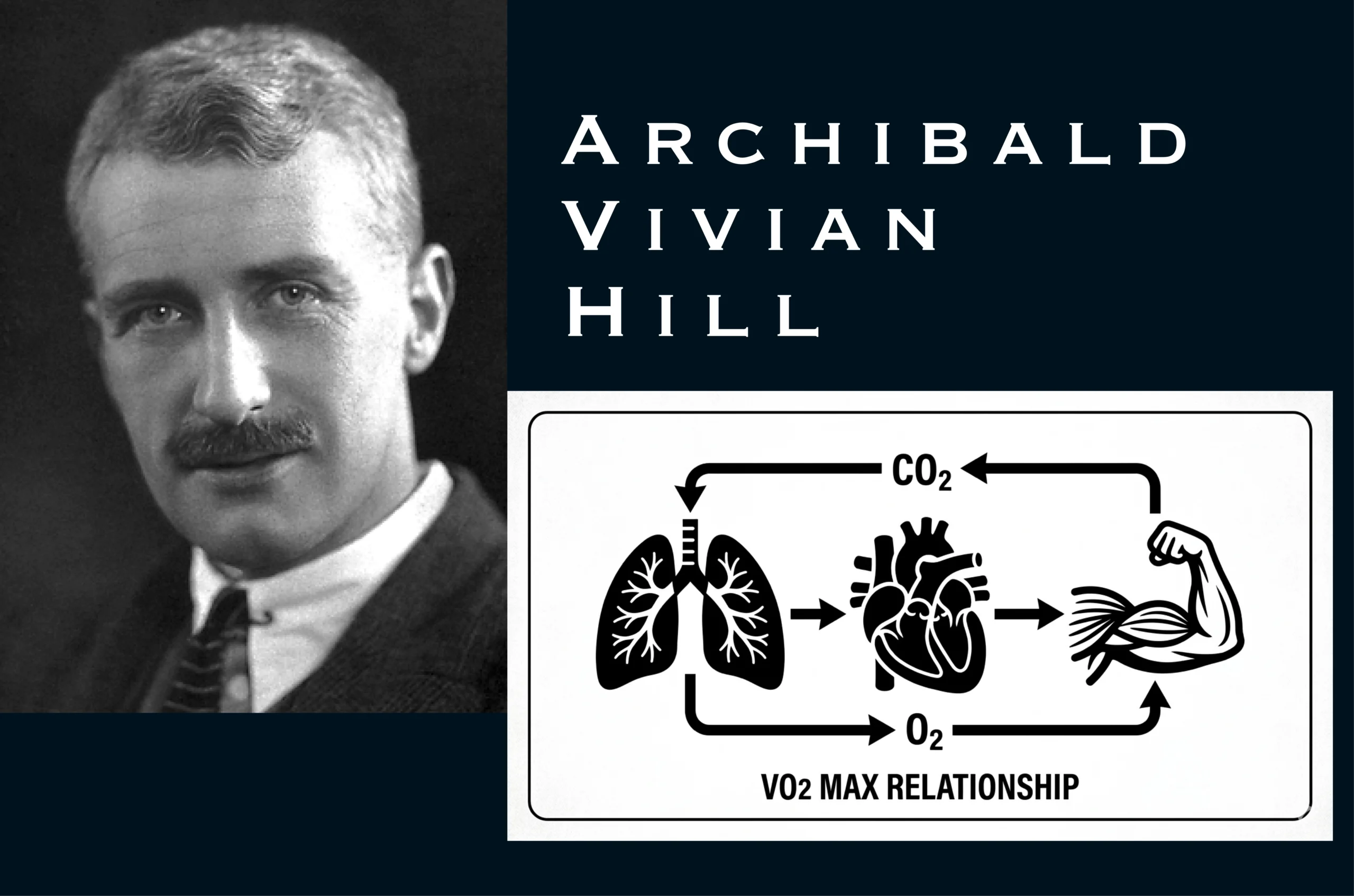
Archibald Vivian Hill won the 1922 Nobel Prize in Physiology or Medicine for his work on heat production in muscle. Most people who recognise his name today do so for a different reason: he is the physiologist who introduced the concept of maximum oxygen uptake — VO₂ max — in the same year, while running on a grass track in Manchester.
Hill was born in Bristol in September 1886. He read mathematics at Trinity College, Cambridge, taking the Mathematical Tripos as Third Wrangler in 1907, and was advised by his teacher Walter Morley Fletcher to switch to physiology. He started his research in 1909 at Cambridge, working under J.N. Langley on the energetics of muscular contraction. The combination of formal mathematical training and experimental physiology became his characteristic approach — he treated muscle as a thermodynamic system and brought the tools of mathematics to questions that were then mostly handled descriptively.
He served as a captain in the Cambridgeshire Regiment in the First World War, where his mathematical skills were used in operational research on anti-aircraft fire — work that prefigured his Second World War contributions thirty years later. After the war he held the chair of physiology at Manchester from 1920 to 1923, then succeeded Ernest Starling at University College London, where he stayed for the rest of his career, eventually as Royal Society Foley Research Professor until his retirement in 1951.
The Nobel Prize and the running track
The work that won Hill the 1922 Nobel Prize, shared with the German physiologist Otto Meyerhof, was on the production of heat in muscle. Hill’s contribution was to demonstrate experimentally — using thermocouples sensitive enough to detect temperature changes of millionths of a degree — that muscle contraction has distinct phases of heat release, separating an initial work phase from a subsequent recovery phase that requires oxygen. He showed that mechanical contraction and chemical recovery were not parallel processes, as had been assumed, but sequential. The Nobel citation was specifically for “his discovery relating to the production of heat in the muscle.” The mainstream of muscle physiology moved past the specific model within a decade, but the methodology and the mathematical framework Hill brought to the field were durable.
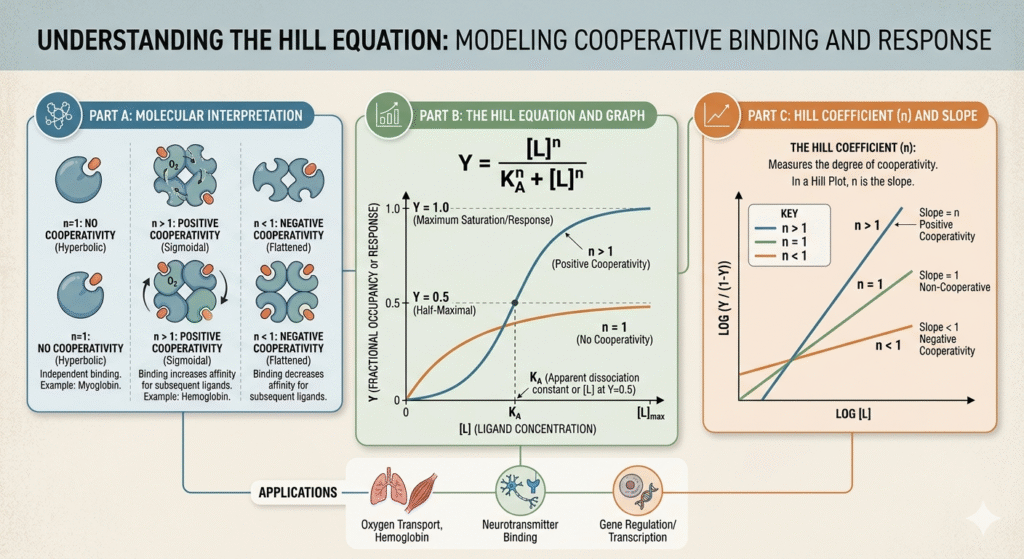
Interactive Hill equation explainer with adjustable Hill coefficient and dissociation constant, showing the binding saturation curve.
The VO₂ max work happened in parallel. Between 1922 and 1924, Hill — together with Hartley Lupton and C.N.H. Long — ran a series of experiments using human subjects on a grass track in Manchester. Hill himself was the principal subject. He ran every morning from 7:15 to 10:30, often training and being measured on the same runs.
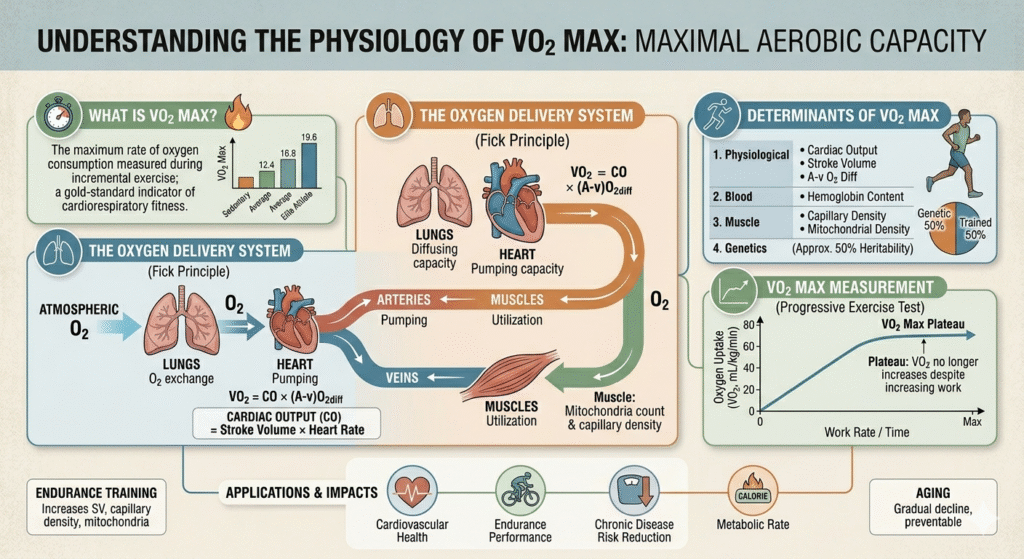
The experiments collected expired air using gas-collection methods descended from Claude Gordon Douglas's 1911 work, which I wrote about separately. The runners ran at progressively faster speeds; Hill measured how oxygen consumption changed with running speed; and he found that beyond a certain point, oxygen uptake stopped increasing despite continued increases in workload. He called this ceiling the maximum oxygen intake — what we now call VO₂ max — and proposed that it represented the limit of the cardiovascular and respiratory systems' ability to deliver oxygen to working muscle.
The same series of experiments produced the concept of "oxygen debt": the elevated oxygen consumption that persists for some time after intense exercise ends, which Hill interpreted as the body repaying the deficit between oxygen demand and oxygen supply during the exertion. The terminology has been refined (modern usage prefers "excess post-exercise oxygen consumption," EPOC, and the underlying mechanisms are more complex than Hill proposed), but the basic observation — that recovery has a metabolic cost — survives.
Where Hill's model breaks down
The classical Hill model — that VO₂ max is set by a hard physiological ceiling on cardiac output, beyond which performance is limited by anaerobic metabolism — has dominated exercise physiology for a century. It is also contested.
In 1997, the South African sports scientist Tim Noakes published a critique arguing that the VO₂ plateau Hill described is rarely observed in modern testing, and that exercise is not limited by oxygen delivery at all. Noakes proposed an alternative: the central governor model, in which the brain regulates muscle recruitment to prevent damage to the heart and other organs, and what looks like a VO₂ ceiling is actually a neurally-imposed limit set well below the cardiovascular maximum. Noakes and his collaborators developed the model in a series of papers in the British Journal of Sports Medicine in 2004-2005, and the framework now has substantial support among exercise physiologists, particularly in endurance research.
The historical irony is that Hill anticipated something close to the central governor argument himself. In a 1924 paper he wrote that "either in the heart muscle itself or in the nervous system" there might be a mechanism that slows the circulation when oxygen supply becomes inadequate, protecting the heart from damage. Noakes's central governor model is, on Noakes's own reading, a return to an idea Hill briefly considered and then set aside.
The current state of the debate is unresolved. The classical model survives in clinical cardiopulmonary testing and in most textbook treatments; the central governor framework is increasingly accepted in performance science. The 2014 reviews tend to treat the two models as complementary rather than mutually exclusive — VO₂ max as a real physiological limit at the very top of the range, with neural regulation determining when and how that limit is approached. The plateau itself is harder to demonstrate cleanly than Hill's original papers suggested.
What survives unambiguously is the measurement. VO₂ max as a quantitative indicator of cardiovascular fitness, regardless of which model best explains it, remains one of the strongest predictors of all-cause mortality in epidemiological studies, and the standard outcome variable in cardiopulmonary exercise testing.
Beyond the laboratory
Hill's scientific work would have been enough on its own. What raises his standing is what he did with the position it gave him.
In April 1933, three months after Hitler's appointment as Chancellor of Germany, the British economist William Beveridge founded the Academic Assistance Council to help scholars dismissed from German universities under the new race laws find positions abroad. Hill was a founding vice-president and the leading active scientific figure in the organisation throughout the 1930s and 1940s. The Council, renamed the Society for the Protection of Science and Learning in 1936, helped resettle around 2,500 academic refugees from Nazi Germany and occupied Europe — including Max Born, Hans Krebs, Ernst Chain, and Bernard Katz, who later became Hill's son-in-law and shared the 1970 Nobel Prize. Hill's biographer Bernard Katz wrote that "it was his devotion to such wider issues, outside the boundaries of his own research, through which he exerted his most important influence on other people's lives and on the course of events."
Hill served as Independent MP for Cambridge University from 1940 to 1945 and as Biological Secretary of the Royal Society from 1935 to 1945. During the Second World War he led scientific liaison missions to the United States and India and continued operational research work for the British military. He retired from UCL in 1951 and died in 1977, aged 90.
The VO₂ max work that bears his name was a small fraction of what he did. It is the part that lasted into popular memory because it gave a generation of athletes, coaches, and clinicians a number to attach to fitness — and a foundation, contested or not, for thinking about the limits of human aerobic performance.
I wrote separately about Claude Gordon Douglas, whose 1911 gas-collection method made Hill's measurements possible.
Leave a Reply
You must be logged in to post a comment.