
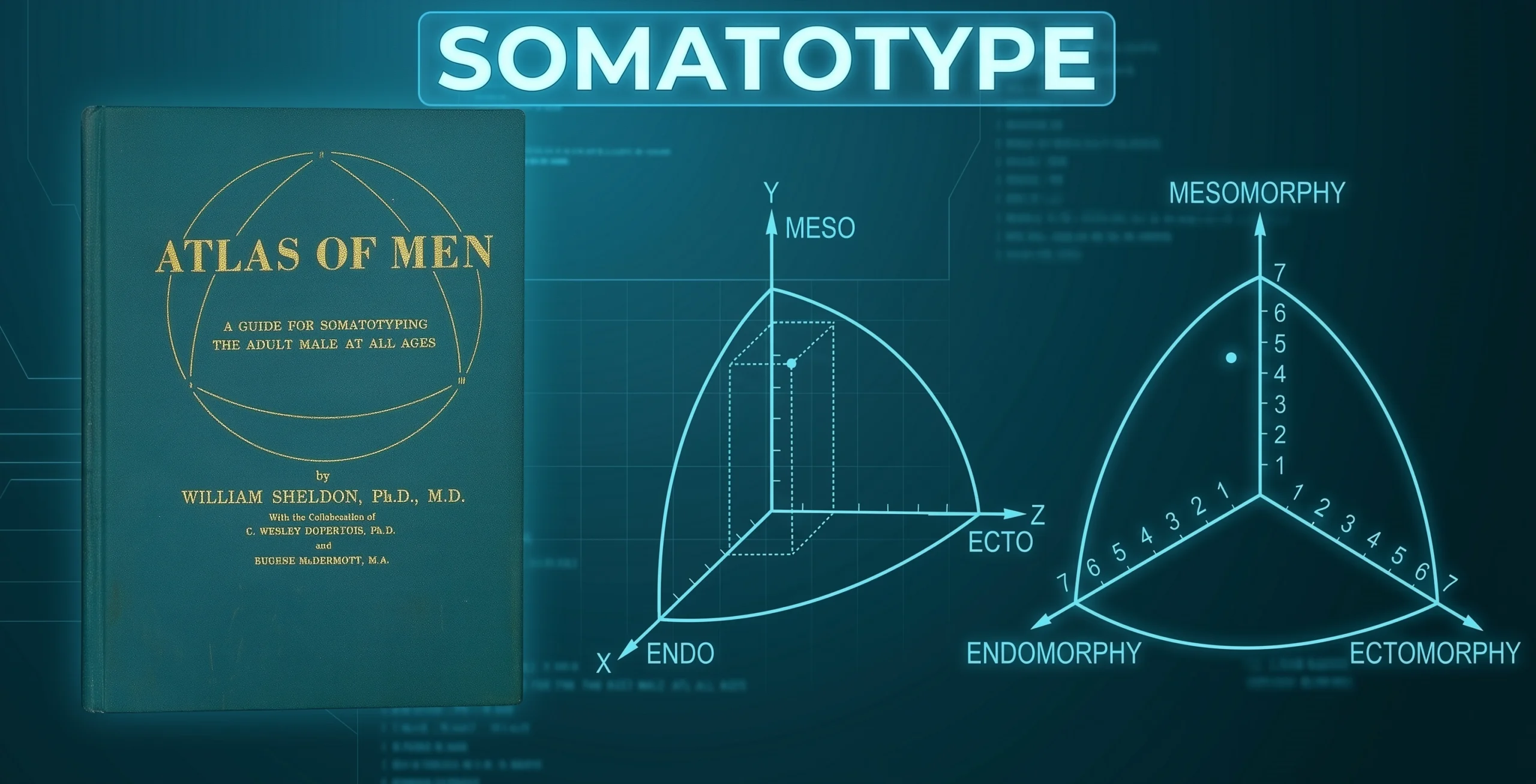
William Sheldon coined the term “somatotype” and named its three components — endomorph, mesomorph, ectomorph. The classification system used in sports science today started with him. So did discredited claims about personality and behaviour, and the photographic methodology that produced the Ivy League posture photo scandal.
Sheldon was born in Pawtuxet, Rhode Island, in 1898. His godfather was William James, the philosopher and psychologist who anchored American pragmatism. He took his BA at Brown, his master’s at the University of Colorado, and his PhD in psychology from the University of Chicago in 1925. He taught at Chicago and Wisconsin before moving to New York to direct the Constitutional Laboratory at the Columbia University College of Physicians and Surgeons from 1947 to 1959. He was also a serious numismatist — his classification system for early American copper coins is still used by collectors today.
His contribution to anthropometry was a three-component framework for describing physique. He took the component names from embryology: endoderm, mesoderm, and ectoderm are the three primary germ layers of the embryo, which develop respectively into the digestive tract, muscle and bone, and skin and nervous system. Sheldon’s somatotype components — endomorphy (rounded, soft), mesomorphy (muscular, robust), and ectomorphy (linear, slender) — were named after the tissues each layer becomes prominent in.
The method itself was photographic. Sheldon’s classification required standardized nude photographs from the front, side, and back. Trained raters then assigned each photograph a three-digit number on a 1-to-7 scale across the three components. The output was rater-dependent — two trained somatotypists could disagree on the same photograph — and the underlying calibration was based on Sheldon’s own visual judgement.
He published the system in The Varieties of Human Physique: An Introduction to Constitutional Psychology (1940), with a companion volume The Varieties of Temperament (1942). The “constitutional psychology” of the titles is the part that aged worst. Sheldon claimed that each somatotype mapped onto a corresponding temperament — endomorphs were “viscerotonic” (sociable, comfort-seeking), mesomorphs were “somatotonic” (assertive, physical, aggressive), and ectomorphs were “cerebrotonic” (introverted, restrained, intellectual). The correlations he reported between body type and temperament were unusually high. The methodology was weak: Sheldon had rated both the bodies and the temperaments himself, in the same subjects, knowing his own hypothesis. Independent researchers using blinded methods could not replicate the findings.
In Varieties of Delinquent Youth (1949), he extended the framework to criminology, comparing the somatotypes of juvenile offenders against those of college students and concluding that delinquents were disproportionately mesomorphic. The implication — that criminality was constitutional, written into body type — was an intellectual cousin of the eugenic theories of his contemporaries. Sheldon was an open eugenicist, and his work was used in support of eugenicist arguments throughout his career.
The posture photo scandal
The most disturbing operational part of his legacy was the photograph collection itself. Programs photographing incoming freshmen nude for “postural research” had existed at elite American colleges since the 1880s, ostensibly to identify and correct poor posture. From the 1940s on, Sheldon’s somatotype research drew on these collections, expanded their scope, and added technical apparatus — many of the photographs included metal pins inserted along the spine to mark vertebral landmarks. Students at Harvard, Yale, Brown, Columbia, Vassar, Wellesley, Smith, and others were required to stand for the photographs as part of orientation. They were told the work was about posture. The subjects included people who would later become unmistakable public figures: George H.W. Bush, Hillary Rodham Clinton, Meryl Streep, Sylvia Plath, Bob Woodward, Diane Sawyer, Nora Ephron. Most had no idea their photographs had any connection to Sheldon’s work.
The story became public in January 1995, when Ron Rosenbaum published The Great Ivy League Nude Posture Photo Scandal in the New York Times Magazine. After the article appeared, Yale and several other institutions recalled and destroyed the photographs they could find. Some surviving plates were transferred to the Smithsonian’s National Anthropological Archives, where they remain restricted from public access.
Sheldon never completed an Atlas of Women counterpart to his 1954 Atlas of Men. The female-subject research was shut down at the University of Washington after a student complained to her parents and the university questioned whether the photographs constituted science or pornography.
What survived
What survived this is narrow but real. The three-component framework — the idea that human physique can be described as a continuous mixture of three tendencies rather than a discrete type — is structurally sound and remains the basis of modern somatotyping. What had to be removed was almost everything around it: the photographic method, the personality and temperament claims, the criminological extension, the artificial 7-point ceiling on each component, and the broader constitutional-psychology project.
That removal was the work of Barbara Honeyman Heath and J.E. Lindsay Carter, who revised the system in 1967. They replaced visual rating with anthropometric measurement (skinfold calipers, bone breadths, limb girths), stripped out the temperamental and behavioural claims, removed the 7-point ceiling, and grounded the equations in an explicit, reproducible measurement protocol. The version still used in sports science today is essentially Heath-Carter — Sheldon’s three components, with everything else rebuilt from the ground up.
I wrote separately about Adolphe Quetelet, who founded anthropometry in the 19th century, and about the somatotype experiment — my own work building on what Heath and Carter salvaged.
Image Credits
Header image: composite by Walter Clayton. Stylised representation of William H. Sheldon’s Atlas of Men (1954) and the somatotype framework.
Leave a Reply
You must be logged in to post a comment.