
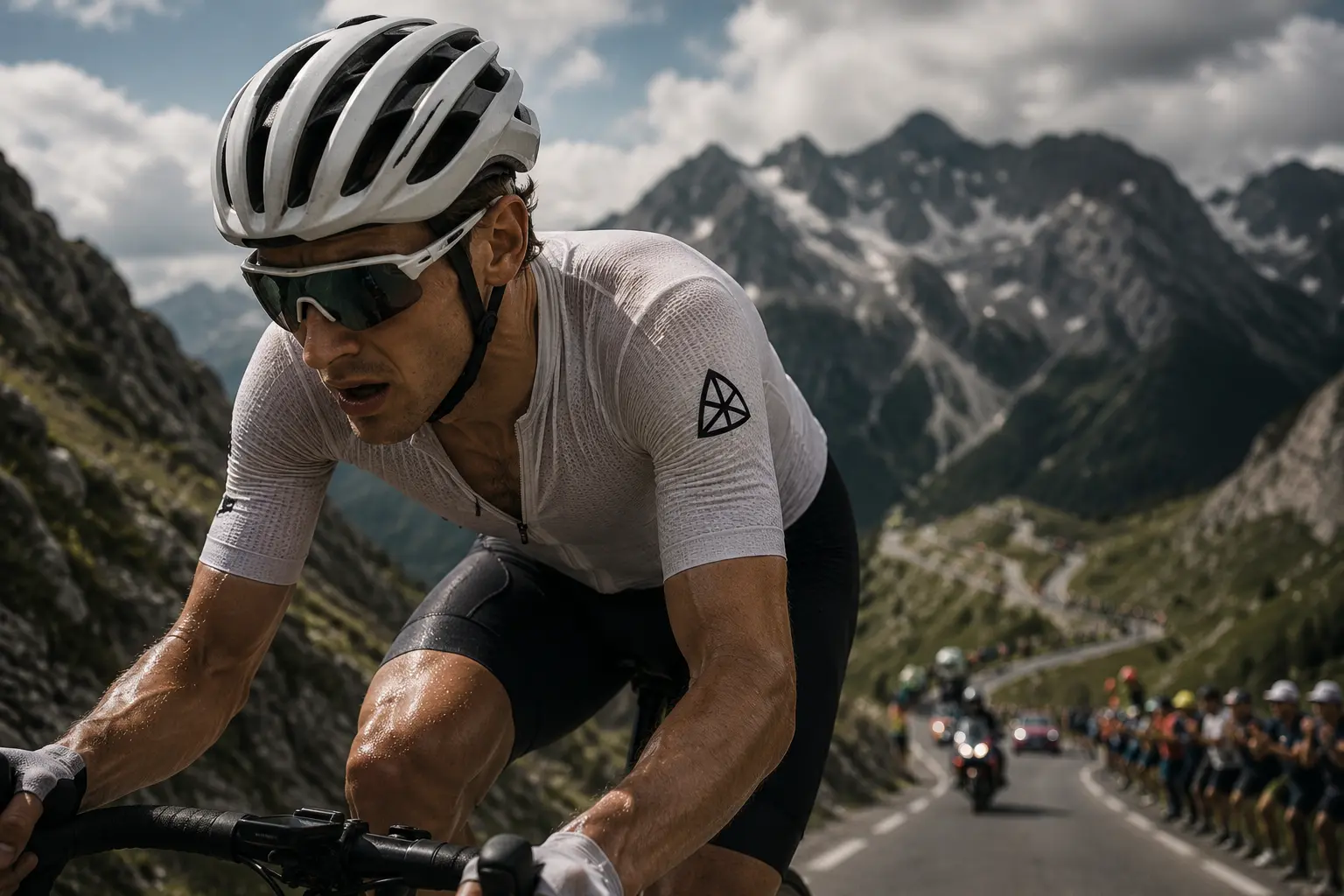
On July 26, Tadej Pogačar crossed the finish line in Paris to win his fifth Tour de France, a result that ties him with Jacques Anquetil, Eddy Merckx, Bernard Hinault, and Miguel Induráin as the only riders in the race’s history to win it five times. He finished 6 minutes and 26 seconds ahead of Remco Evenepoel in second place. He had effectively secured the race as early as stage 6, holding the yellow jersey for every stage from that point on. This article isn’t about Pogačar specifically. It’s about what a result like this actually demands physiologically, using his race as the entry point into training science that applies far beyond one Slovenian cyclist.
The Numbers Behind the Dominance
Pogačar’s total time for the 2026 Tour was 73 hours, 56 minutes, and 26 seconds, across 21 stages and roughly three weeks of racing. He won five individual stages along the way. On stage 6, climbing the Col du Tourmalet in the Pyrenees, he set a new fastest time up the climb: 43 minutes and 12 seconds. That broke his own previous record of 45:32, set in 2023. On stage 19, he won on Alpe d’Huez, arguably cycling’s most storied climb, for the first time in his career. He attacked 4 kilometres from the summit and rode the final stretch solo.
He secured the overall lead on stage 6 and never lost it, an unusually early point in a three-week race to establish that kind of control. Most Grand Tours are decided in the final week; this one was functionally decided in the first.
Holding a Lead for Three Weeks Is a Different Problem Than Taking One
Winning a single mountain stage and defending a lead across 15 subsequent stages are not the same physiological task. The second involves multiple mountain ranges, a time trial, and the accumulated fatigue of three weeks of daily racing. The first requires a peak output on a specific day. The second requires managing recoverable fatigue across dozens of consecutive high-output days without a true rest period. Grand Tours include only a small handful of full rest days across three weeks.
This is where the training science covered elsewhere on this blog becomes directly relevant. A rider defending a Grand Tour lead is living an extreme, compressed version of a familiar relationship: fitness versus fatigue, the same one underlying deload weeks and tapering. Every stage produces both a fitness stimulus and a fatigue cost. Unlike a training block where a coach can schedule a full recovery week, a Grand Tour offers almost none. The margin between managing that fatigue and being overwhelmed by it is what separates a rider who fades in the third week from one who strengthens their position instead. Pogačar, this year, did the latter.
What a Sub-44-Minute Tourmalet Requires
The Col du Tourmalet is roughly 19 kilometres of climbing at an average gradient a little over 7 percent. Climbing it in 43 minutes and 12 seconds requires an exceptionally high sustained power output relative to body weight. That output has to hold for far longer than the interval durations covered in most HIIT research discussed on this blog.
This points to a specific physiological quality: a very high functional threshold power relative to body mass, maintained for 40-plus minutes. That sits closer to the long-interval end of the training spectrum than the short, maximal end. Protocols like the Norwegian 4×4, four-minute efforts at 90 to 95 percent of maximum heart rate, train that same general energy system: sustained high output just below full anaerobic effort. A competitive climb like the Tourmalet is roughly ten times longer than a single 4×4 interval, but the underlying system is the same. The training principle underneath both is the same: raising the ceiling on how much power the aerobic system can sustain before it has to borrow from anaerobic reserves that can’t be maintained for long.
Disruption Is Part of the Physiological Story Too
Reporting on this year’s race noted that several of Pogačar’s UAE Team Emirates teammates fell ill during the race. Nighttime anti-doping controls also disrupted riders’ sleep at points during the three weeks. Neither of these is unusual for a Grand Tour, but both are relevant to the fatigue-management picture this article is describing. Illness in a support team changes the tactical and physical burden on a team leader. Domestiques exist specifically to reduce the physical cost a leader has to absorb on any given stage. Disrupted sleep during a three-week race compounds an already difficult recovery equation. Sleep is one of the primary windows in which the adaptation from each day’s effort is meant to consolidate.
None of this is offered as an excuse or a caveat on the result. It’s offered as a reminder that a Grand Tour win isn’t just a story about peak output on the hardest climbs. It’s also a story about whose fatigue-management system holds up best when conditions around it, team health, sleep, weather, aren’t going perfectly. Pogačar, after the race, was candid about how unpredictable the three weeks can be regardless of how strong the favorite looks on paper. When asked about the race before the final stage, he said: “It’s the Tour, three weeks, a lot of s— can happen.”
The Early-Lead Problem
Taking the overall lead on stage 6 and holding it for 15 more stages creates a specific challenge that’s easy to overlook. It requires racing defensively, conservatively, and adaptively for far longer than taking a late lead would. A rider who takes the yellow jersey in the final week is managing a short, acute period of heightened pressure. Taking it in the first week means every rival specifically targets you, stage after stage, for two and a half additional weeks.
This is a pacing and load-management problem more than a raw fitness one. A team and rider make continuous, race-by-race decisions: when to spend energy defending a margin aggressively, and when to ride conservatively and accept small time losses. All while accumulating the same daily fatigue as everyone else in the field. Reports on this year’s race noted Pogačar’s lead ballooned to over seven minutes at one point in the third week before he eased off. That reads less like fading and more like a rider and team consciously managing risk once the margin was large enough to absorb it.
What This Means Beyond Cycling
The specific numbers here belong to one race and one rider. The underlying principles don’t. Sustaining high output across a compressed schedule with minimal recovery. Managing fatigue accumulation when a scheduled deload isn’t available. Defending a position for longer than planned when circumstances shift. These are the same problems a coach faces when a competition schedule gets condensed, an athlete’s support system is disrupted, or a lead has to be protected longer than anticipated.
The physiological ceiling Pogačar demonstrated on the Tourmalet and Alpe d’Huez is genuinely exceptional. It isn’t something training advice can manufacture for anyone. The fatigue-management pattern across three weeks, absorbing disruption without losing the overall structure of the plan, is the more broadly useful lesson. It’s built from the same principles at any level of competition: recovery timing, load monitoring, and honest tracking of how an athlete is actually responding day to day.
References
- Tadej Pogačar of Slovenia wins the 2026 Tour de France, his fifth victory in the race. NPR. Published July 26, 2026.
- 5 records Tadej Pogačar set during the 2026 Tour de France. BikeRadar. Published July 2026.
- Tadej Pogacar wins fifth Tour de France, ties record amid ever-present perils of the Tour. NBC Sports. Published July 2026.
- Tadej Pogačar confirms status as a cycling great with record-equaling fifth Tour de France title. CNN. Published July 26, 2026.
- Helgerud J, Hoydal K, Wang E, et al. Aerobic high-intensity intervals improve VO2max more than moderate training. Med Sci Sports Exerc. 2007;39(4):665-671.
Leave a Reply
You must be logged in to post a comment.