
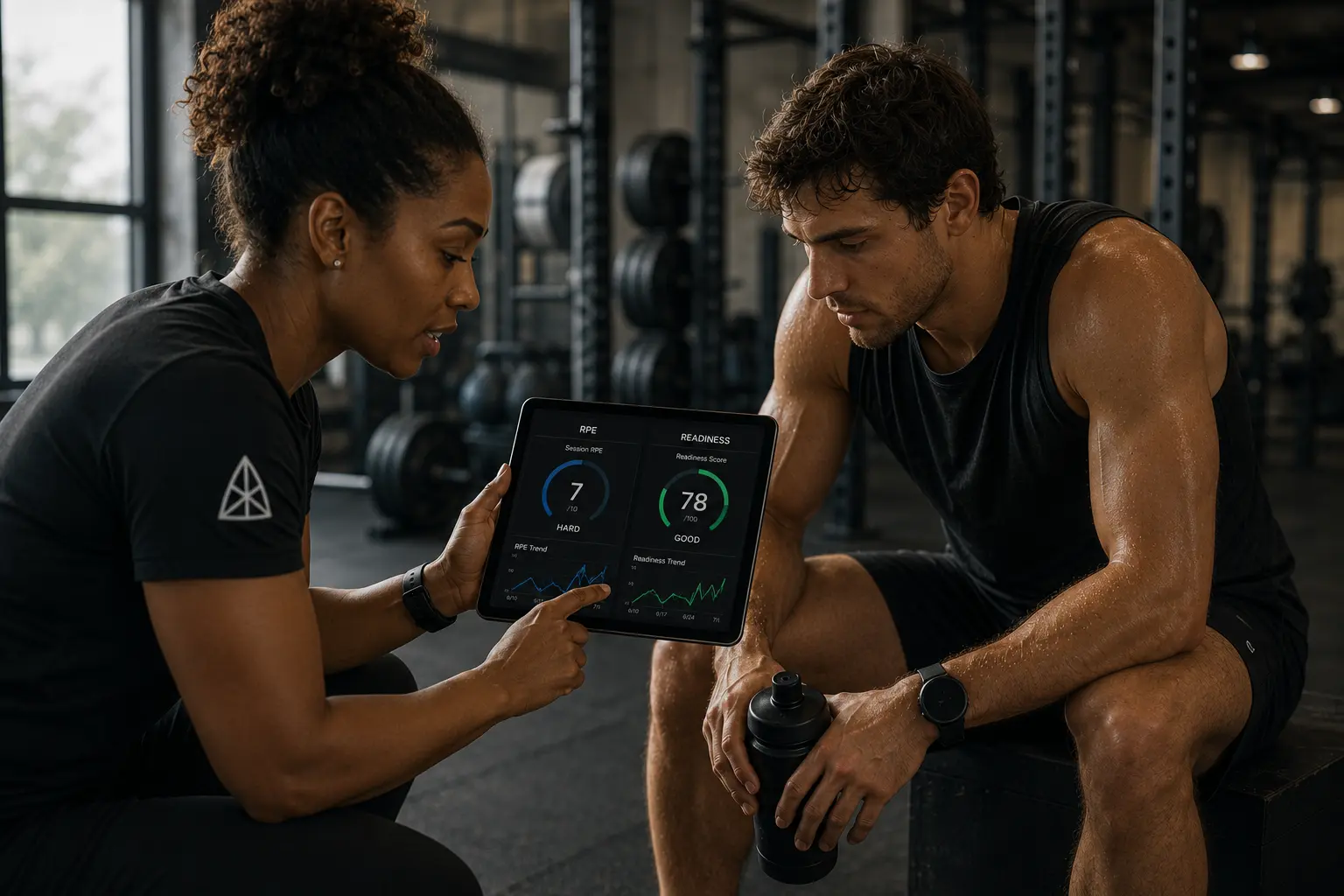
An athlete’s wearable shows a green readiness score, well-rested, ready to push. Fifteen minutes into the session, they report the work feels like an 8 out of 10. That’s a full point harder than the plan expected. The device says recovered. The athlete says otherwise. A coach now has two numbers pointing in different directions, and no obvious rule for which one to believe.
This is a genuinely common situation, not an edge case. The research on it gives a clearer answer than “trust your gut” or “trust the data.” This article covers what each measure is actually good at, where they tend to diverge, and a practical framework for what to do when they disagree.
Two Different Things Being Measured
RPE and wearable readiness scores are not two versions of the same measurement. They capture different things, and expecting them to always agree misunderstands what each one is built to do.
RPE is a direct report of subjective experience. It reflects fatigue, sleep, stress, motivation, and effort. All filtered through the athlete’s own perception in that moment. A landmark 2016 review looked at this. Subjective measures, fatigue, soreness, mood, stress, are often more responsive to workload changes than physiological markers. In some cases they detect a readiness shift before objective measures show any decline at all. Wearable readiness scores work differently. They combine measured physiological signals, typically heart rate variability, resting heart rate, and sleep, into a proprietary composite score. They are consistent and don’t get tired of reporting. They also can’t capture things with no sensor for it: motivation, life stress, mental fatigue, or how something simply feels.
Two different things being measured
What each measure actually captures
Subjective fatigue, mood, stress, and motivation — filtered through how the athlete feels in that moment.
Can be skewed by an athlete downplaying effort, or by not trusting how the data will be used against them.
Heart rate variability, resting heart rate, and sleep — measured, consistent physiological signals.
Motivation, life stress, and mental fatigue — anything with no sensor built to detect it.
Neither measure is “more real.” They’re built to detect different things — that’s why expecting them to always agree misreads what each one is for.
Where the Two Agree
The disagreement gets most of the attention, but it’s worth being clear about how often these measures do line up. A 2025 study followed twenty national team endurance athletes across a full year. It found significant correlations between subjective ratings and their objective counterparts. Coefficients ranged from 0.39 to 0.81 depending on the pairing. That’s a meaningful relationship, not a coincidence.
The same study found something equally important underneath that average correlation: individual variability was substantial. Time-series analysis showed the relationship between subjective and objective measures differed meaningfully from athlete to athlete. Personalized, individual-level analysis was more accurate than any group-level average. In practice, the correlation between an athlete’s RPE and readiness score is a pattern worth learning. It’s specific to that athlete. It’s not a fixed rule you can assume applies to everyone on a roster.
Why They Diverge
Three mechanisms explain most of the disagreement worth paying attention to.
The first is timing sensitivity. Subjective measures often shift faster than physiological ones. An athlete can feel accumulating fatigue early, through mood, motivation, or perceived heaviness. This often happens before heart rate variability or resting heart rate shows any measurable change. When RPE looks worse than a readiness score, this is frequently why: the athlete is detecting something real before the wearable’s inputs have caught up.
The second is context blindness. A wearable has no way to account for a stressful day at work. It also can’t see poor sleep unrelated to training, or emotional strain outside of sport. These factors can suppress how ready an athlete feels. None of it moves the physiological inputs a readiness algorithm relies on. This is a genuine blind spot in objective monitoring, not a flaw in the athlete’s self-report.
The third is honesty and trust. Subjective monitoring is only as reliable as an athlete’s willingness to report accurately. That depends on how the data gets used. Data quality improves when athletes believe their coach will use honest reporting to adjust training. Not to criticize or restrict them. Without that trust, subjective monitoring degrades into noise. Athletes learn to report what they think a coach wants to hear, not what they actually feel.
Reading a disagreement
RPE and readiness score disagree.
Tap the pattern you’re seeing to get a diagnostic question and what to do about it.
A Practical Framework for When They Disagree
The research doesn’t support a fixed rule like “always trust RPE” or “always trust the wearable.” It supports a specific decision process based on what kind of disagreement you’re looking at.
When RPE is worse than the readiness score suggests, lean toward trusting RPE. This applies especially to an experienced athlete with a track record of accurate self-report. This pattern usually means the athlete is detecting something real. Often it’s a life-stress or sleep-quality factor invisible to the device, before it shows up physiologically. Reducing planned intensity or volume in response to this signal is generally the safer error.
When RPE is better than the readiness score suggests, more caution is warranted before overriding the device. This pattern can mean genuine underlying fatigue that hasn’t yet reached conscious awareness, a real phenomenon in overreaching research. Or the athlete is minimizing how hard something felt. That can come from motivation, competitiveness, or a desire to appear tough. Distinguishing between these requires knowing the individual athlete’s reporting tendencies. This is exactly why the research emphasizes athlete-specific patterns over group averages.
Sometimes the two measures diverge consistently and repeatedly for one athlete, not just occasionally. That pattern itself is the more useful signal, more than either single measure alone. An athlete whose RPE consistently runs a point below their readiness score and performance data is showing you something. That’s their personal calibration. Once a coach knows that pattern, correcting for it becomes straightforward. Without tracking that history, every single disagreement looks like a fresh, unexplainable anomaly instead of a known and manageable quirk.
The Larger Point
Neither measure is more “real” than the other. RPE captures something wearables structurally cannot. It’s the athlete’s own integrated read on how they feel, informed by factors no sensor detects. Wearable data captures something self-report can’t reliably provide on its own. It’s a consistent, low-effort, physiologically grounded signal that doesn’t depend on an athlete’s mood or motivation that day.
The research consensus points toward combining both rather than picking a winner. Track each athlete’s individual pattern of agreement and disagreement over time. A coach who does this ends up with something better than either measure alone. They get a working model of how a specific athlete’s subjective experience relates to their physiology. That’s far more useful than trusting either number alone.
References
- Saw AE, Main LC, Gastin PB. Monitoring the athlete training response: subjective self-reported measures trump commonly used objective measures. Br J Sports Med. 2016;50(5):281-291. DOI: 10.1136/bjsports-2015-094758
- Validating subjective ratings with wearable data for a nuanced understanding of load-recovery status in elite endurance athletes. Sports Med Open. 2025. PMC: PMC12696214
- Thorpe RT, Strudwick AJ, Buchheit M, Atkinson G, Drust B, Gregson W. The influence of changes in acute training load on daily sensitivity of morning measured fatigue variables in elite soccer players. Int J Sports Physiol Perform. 2017;12(S2):S2-107-S2-113.
- Doherty C, et al. Readiness, recovery, and strain: an evaluation of composite health scores in consumer wearables. Transl Exerc Biomed. 2025;2(2):128-144.
- Coyne JOC, et al. The current state of subjective training load monitoring: follow-up and future directions. Sports Med Open. 2022.
Leave a Reply
You must be logged in to post a comment.