
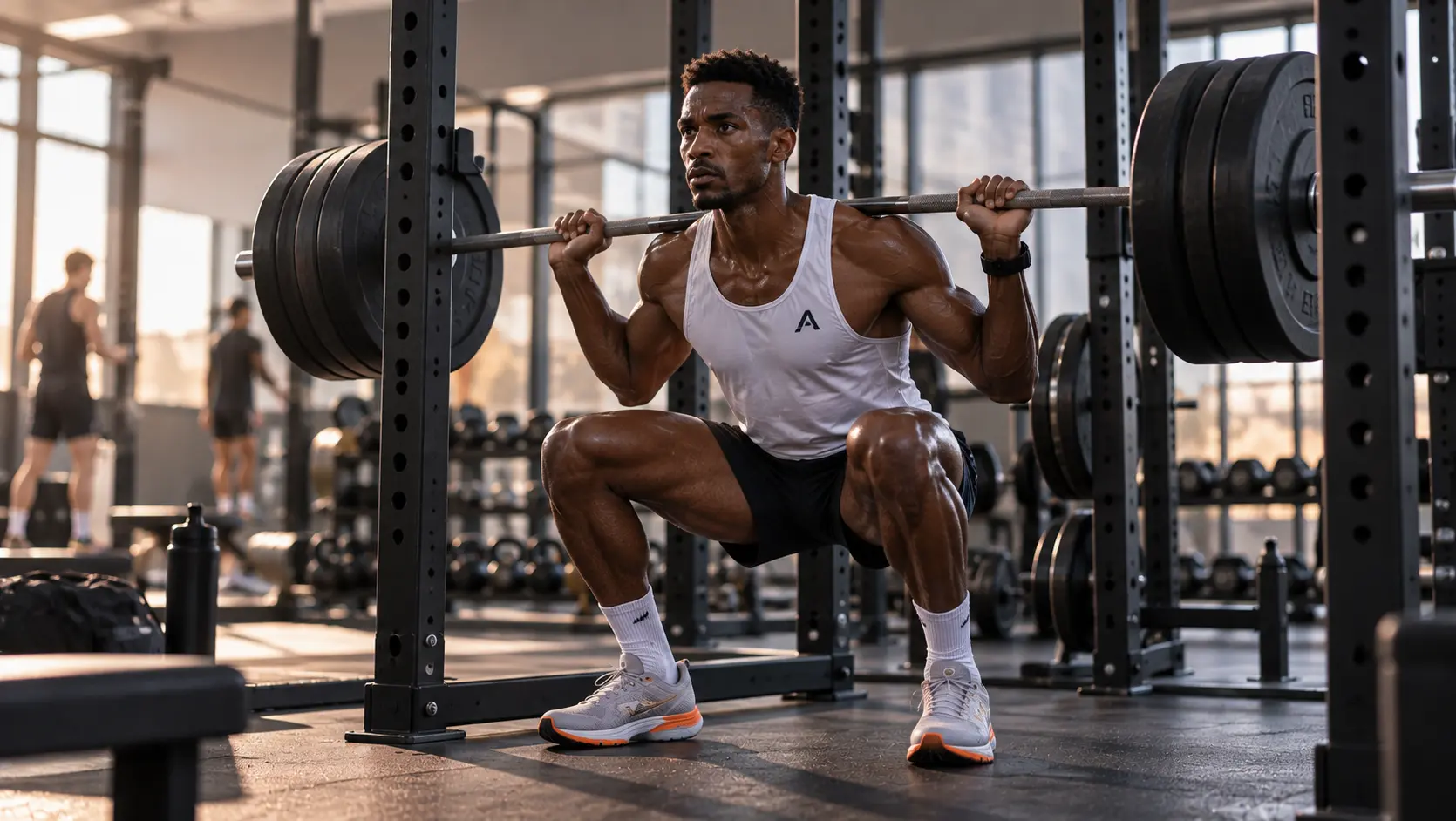
A distance runner stands at the edge of the weight room. She has run for years and never lifted. Her coach says it will help. She worries it will make her heavier and slower, and take time and energy from her running.
Many runners and cyclists share this worry. The research gives a clear answer to most of it. This article explains what studies found, how much to do, and what is still uncertain.
The Worry
Endurance athletes are often told to avoid lifting. The usual fears are three:
- It adds weight.
- It leaves the legs tired for running.
- It takes time from the training that matters most.
These are fair concerns. Each one can be checked against the studies.
What the Review Found
Blagrove and colleagues (2018) reviewed 24 studies, with 469 participants. All were middle- or long-distance runners. The studies used heavy lifting, explosive lifting and jumping exercises.
Running economy improved. Running economy is how much oxygen an athlete uses at a set pace. A better economy means the same speed costs less energy. Gains were generally 2 to 8 percent compared with control groups. Not every study found them.
Race-style tests tended to improve. Time trials over 1.5 to 10 kilometres tended to get faster.
Some things did not change. Maximal oxygen uptake, known as VO2max, was typically unaffected. So were the speed at VO2max, blood lactate and body composition.
That last point answers the first worry. In these studies, lifting did not change body composition.
What About Highly Trained Runners?
Highly trained runners already have a high aerobic fitness. Would lifting still help them?
Balsalobre-Fernandez and colleagues (2016) looked at this. They pooled five controlled trials with 93 competitive runners. All had a VO2max above 60 millilitres per kilogram per minute.
The pooled effect on running economy was large and positive. The programs were modest. They ran for 8 to 12 weeks, two to three sessions a week. They used two to four lower-body exercises, up to 200 jumps and 5 to 10 short sprints. In four of the five trials, the lifting loads were 40 to 70 percent of the athlete’s one-rep max.
So the doses that helped were not extreme.
Why Would It Work?
The reviews do not give a final answer. Rønnestad and Mujika (2014) propose four possible reasons:
- The body may delay using less efficient fast muscle fibers.
- The nerves and muscles may work together more efficiently.
- Some fast fibers may become more fatigue resistant.
- The muscles and tendons may become stiffer, which can save energy.
These are proposals. They are not proven in every study.
Running and Cycling Differ
The same review looked at cycling too.
For running, either heavy or explosive lifting can help. For cycling, heavy lifting has the most consistent support.
Heavy lifting combined with endurance training also raised running speed and power at VO2max. It also lengthened the time athletes could hold those intensities.
How Much Is Enough?
The 2018 review recommends two to three lifting sessions a week, using a mix of methods. Most studies ran for 6 to 14 weeks, and two ran for 24 and 40 weeks.
A simple way to start:
- Begin with two sessions a week.
- Use a mix of heavy lifts, jumps and a few short sprints.
- Keep the volume low to moderate.
- Build up over several weeks, not in the first one.
The second worry was tired legs. A gradual build helps, because a sudden jump in load is where problems start. See the training load and injury article for more.
Session order matters too. When lifting and a hard run fall on the same day, lift first and leave several hours between them. The concurrent training article explains why.
Where It Fits in the Season
Most studies ran for a few weeks and did not look at a full season. A working convention is to build the strength base in the preparation phase. Then keep a small dose during the competition period, so the gains are not lost.
This is not a tested protocol. Adjust it to the athlete and the calendar.
What the Evidence Covers
The reviews found good evidence that lifting helps running economy, time trials and sprint performance. Results were not the same in every study. The reviews point to differences in methods as one reason.
Study quality was modest. The studies scored between 4 and 6 on a 10-point quality scale. Most participants were men. Most programs lasted under 14 weeks.
Little of this work looked at team sports, or at athletes who need both endurance and field skills.
Where to Start
- Pick two sessions a week that do not clash with key runs or rides.
- Choose lower-body lifts, plus jumps if the athlete is ready.
- Start light and add load over several weeks.
- Track how running and riding feel for the first month.
- Keep a small dose in once the season begins.
An athlete who is given a clear plan is more likely to stick with it.
References
Blagrove RC, Howatson G, Hayes PR. Effects of strength training on the physiological determinants of middle- and long-distance running performance: a systematic review. Sports Med. 2018;48(5):1117-1149. DOI: 10.1007/s40279-017-0835-7. PMID: 29249083
Balsalobre-Fernandez C, Santos-Concejero J, Grivas GV. Effects of strength training on running economy in highly trained runners: a systematic review with meta-analysis of controlled trials. J Strength Cond Res. 2016;30(8):2361-2368. DOI: 10.1519/JSC.0000000000001316
Rønnestad BR, Mujika I. Optimizing strength training for running and cycling endurance performance: a review. Scand J Med Sci Sports. 2014;24(4):603-612. DOI: 10.1111/sms.12104
Leave a Reply
You must be logged in to post a comment.