
Tag: Strength Training
-

Unilateral vs Bilateral Training: Is One Better?
Online debate treats unilateral versus bilateral training as a real fork in the road. A 2025 meta-analysis pooling every controlled comparison gives a precise answer: no hypertrophy difference, and strength gains that follow the exact pattern trained. This article covers the findings and how to apply them.
-
How Much Rest Between Sets Actually Matters
The 60-to-90-second rest rule for hypertrophy has a real origin, but the research behind it has moved on. This article covers why longer rest intervals show no hypertrophy disadvantage in recent meta-analyses, why volume-load matters more than metabolic stress, and a practical rest interval range for strength and hypertrophy training.
-

Training to Failure: Science behind it
Training to failure and training with reps in reserve are not simply better or worse versions of the same thing. This article covers the current dose-response evidence showing hypertrophy and strength respond differently to proximity to failure, and a practical framework for when pushing closer to failure is worth it.
-

When the Plan Meets the Athlete: Autoregulation in Practice
Autoregulation adjusts training to the athlete in front of you rather than to numbers set weeks ago. This article covers the main methods, what the evidence supports, and the reporting distortion that quietly undermines every one of them.
-

Muscle Memory: What Actually Stays When You Stop Training
Muscle memory, the fast comeback after a training layoff, has a genuine cellular explanation involving retained myonuclei, and a competing explanation involving the nervous system. This article covers both mechanisms, what animal and human research actually show, and what it means for programming a returning client.
-

Grip Strength and Longevity: What the Research Actually Measures
Grip strength is one of the most consistently replicated longevity markers in the research, predicting mortality more strongly than blood pressure in some large cohorts. This article covers what the studies show, why grip strength is a proxy rather than a lever, and what that means for how coaches should apply it.
-
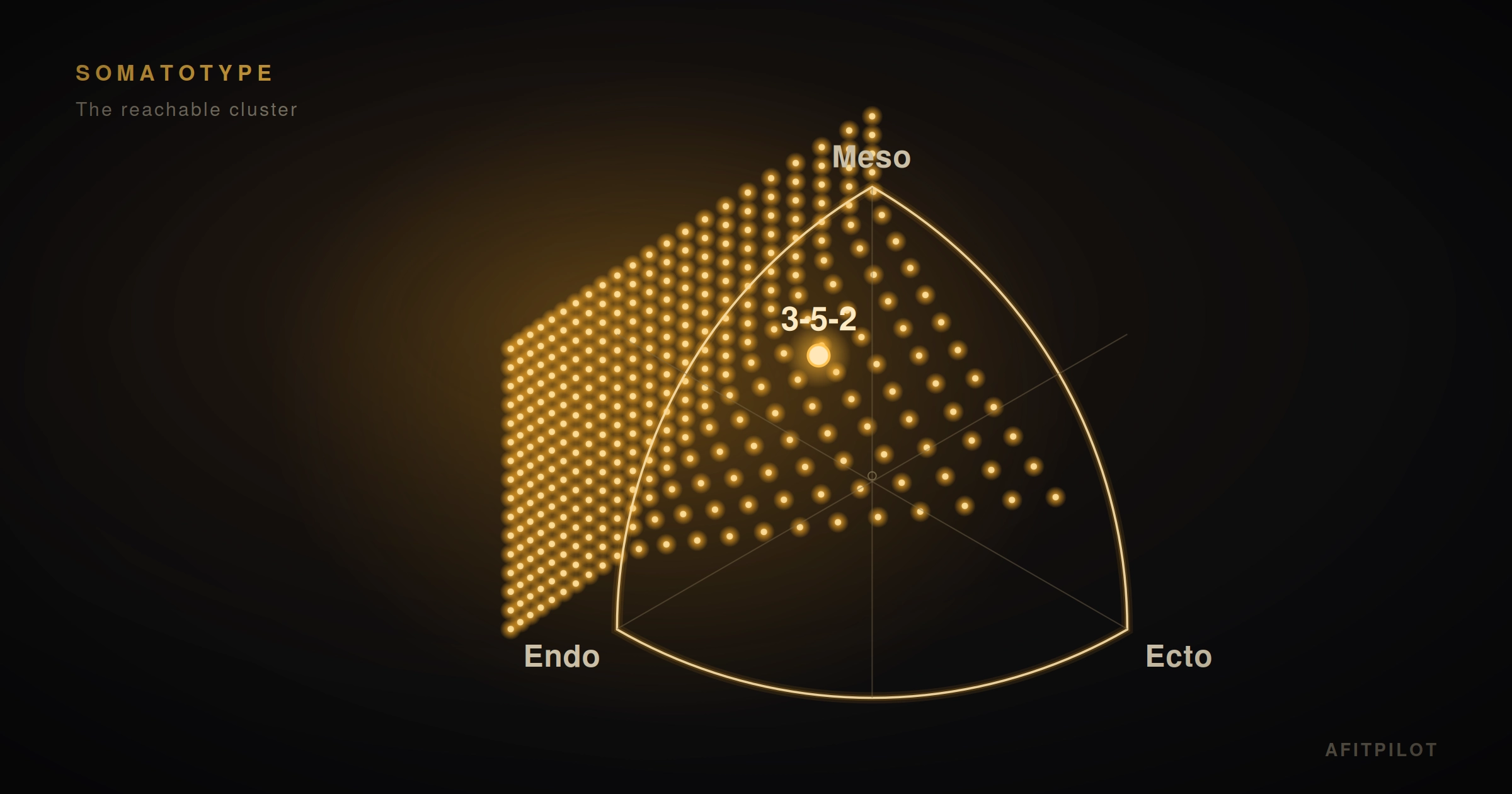
Can You Change Your Somatotype? A Constrained-System View
Somatotype gets treated as a fixed label, but the Heath-Carter equations describe a constrained system. Height and bone breadth are locked; fat, muscle, and weight aren’t. A look at which inputs can actually move, by how much, and how fast — and why ectomorphy is the axis you don’t control directly.
-
Reps in reserve
Reps in reserve is the strength-training cousin of Borg’s perceived exertion scale, applied per set rather than per session. Unlike the other measurement instruments in this series, RIR has no single inventor — it came from a coach in 2008, a research group in 2012, and another in 2016. A history of how a powerlifting…