
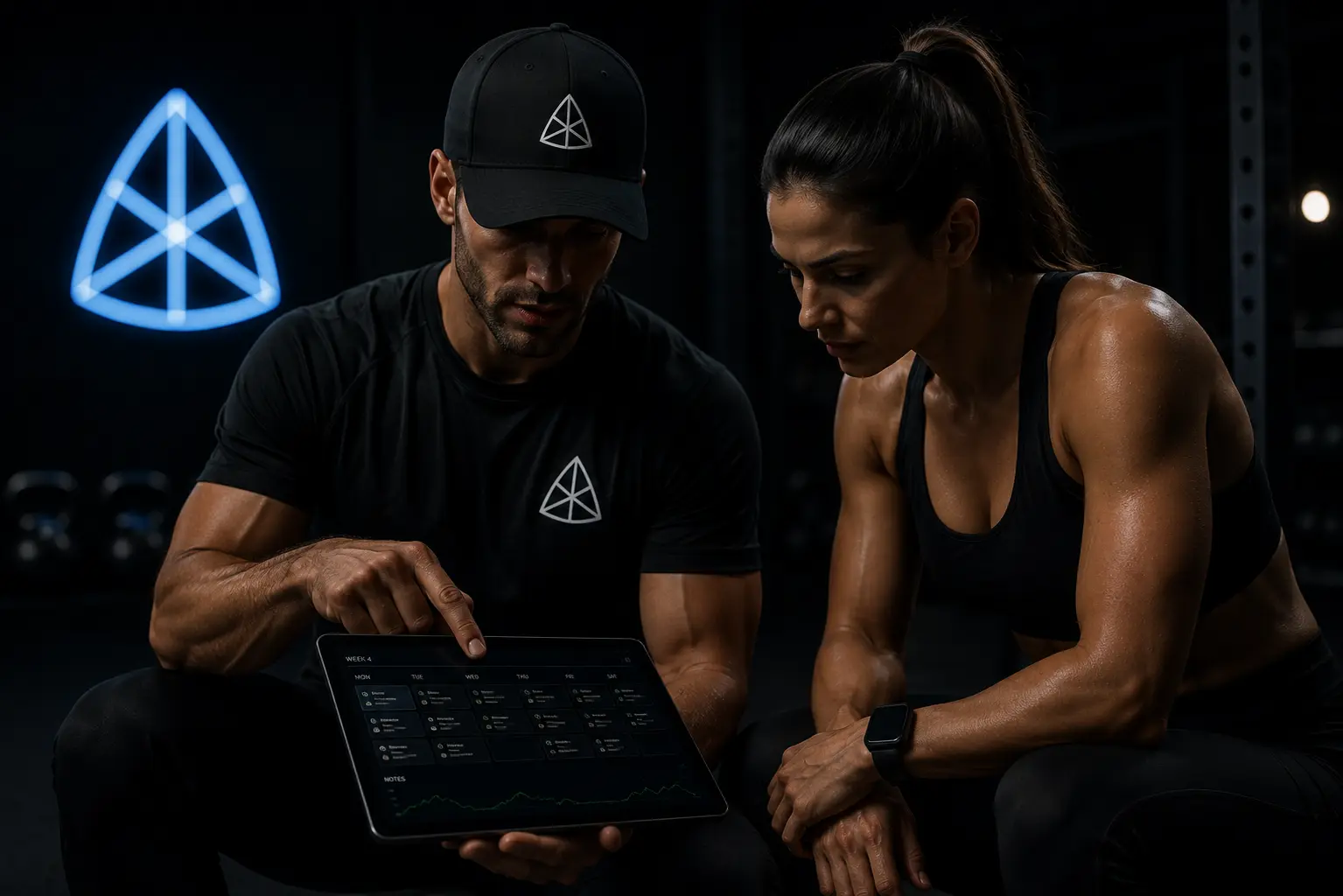
A client opens their app, sees a fresh week of training, and asks a fair question. Did a person build this, or did a machine? The question deserves a direct answer, not a dodge. This article covers why clients are asking it more often. It covers what the honest answer looks like for a coach using adaptive software, and how to give it in a way that builds trust.
Why the Question Is Becoming Common
Clients are not asking this question out of suspicion alone. They are asking because the coaching industry has quietly shifted. Most clients can sense the shift even without knowing the mechanics behind it. Professional standards bodies have moved quickly to catch up. The International Coaching Federation’s guidance on AI in coaching calls explicitly for transparency about a system’s role, and secure client consent up front. The European Mentoring and Coaching Council has published dedicated ethics guidance. It requires disclosure of when technology is used in a coaching relationship.
This is not a fringe concern being raised by a handful of cautious professional bodies. It reflects a broader, well-documented pattern. When people discover undisclosed AI use in a professional relationship, the damage extends past that single interaction to the relationship itself. Silence on this question is a worse strategy than an honest answer, however the answer is structured.
The Honest Answer Is Rarely All-Or-Nothing
The instinct many coaches have is to pick one of two answers. One option is claiming full personal authorship of every session. That becomes untrue the moment software generates structure or adjusts load. Or defer entirely to the tool, which understates the judgment a coach is genuinely exercising. Neither answer is accurate, and clients tend to notice when an answer feels evasive.
The more accurate framing, increasingly recommended in professional guidance on AI-assisted service delivery, is closer to this. The coach designed the approach, set the goals, and reviews and adjusts what the system produces. The system builds the specific session structure and adapts it based on the athlete’s own training data. Consulting professionals facing an identical disclosure question have converged on a useful phrase. The team does not say “the AI did it.” It says “we did it, using a tool, and we stand by it.” That framing keeps responsibility exactly where it belongs, with the coach.
What a Client Wants to Know
Most clients asking this question are not asking for a technical explanation of how a platform works. Research on trust in AI-assisted professional relationships consistently finds three things clients want confirmed. A qualified person is accountable for the outcome. No decision happens without human review. A human remains reachable when something does not fit the plan.
A coach who can confirm these three things directly answers the concern underneath the question. No technical explanation of session generation is needed. The client is rarely asking how the software works. They are asking whether they can trust what shows up in their app next Monday. And whether a person is genuinely behind it.
Why the Honest Answer Should Not Worry a Coach
Some coaches hesitate to describe their process accurately. They assume disclosure will make a client value the service less. The available evidence points the other way. Transparency about a tool’s role, delivered clearly and without defensiveness, is consistently associated with higher trust, not lower. This holds across every professional context where it has been studied. What erodes trust is not disclosure. It is the discovery that something was withheld.
There is also a structural reason the honest answer holds up well under scrutiny. A coach using a platform that adapts sessions based on an athlete’s own RPE and training history is not handing decisions to an unsupervised system. Every adjustment the system makes is grounded in that specific athlete’s own reported data. A coach who set the programme’s goals reviews it and continues to adjust its course. This is meaningfully different from a client typing a request into a generic chatbot with no ongoing relationship attached. It is a difference worth stating plainly, not leaving implied.
A Practical Script
When a client asks this question directly, a short, honest answer holds up better than either extreme. Something close to the following covers the ground clients care about, without overexplaining. The programme is built around the goals we set together. It adapts week to week based on how your training has been going, using the effort ratings you report. I review it before you see it, and I am the one adjusting it when something is not working. You are not training against a static plan a machine wrote once and forgot. You are training against a plan that responds to you, with a person accountable for every decision in it.
This answer does three things at once. It states plainly that software is involved, satisfying the disclosure standard. It locates responsibility clearly with the coach, satisfying the accountability concern. It also explains, in one sentence, why the adaptive structure benefits the client rather than being a reason for concern.
The Underlying Principle
The question “who wrote my programme” is really a question about trust. It arrives in the most concrete form a client has available to ask it. A coach who answers honestly, situating the tool as something they direct rather than something that replaces them, tends to find the question settles quickly. A coach who avoids the question, or answers evasively, tends to find it resurfaces. Each time with more suspicion attached.
The standard worth holding here is simple. If a client would be uncomfortable learning the full truth about how a programme was produced, the process needs to change. Not the explanation given to the client. If the honest answer is one a coach is genuinely proud to give, give it plainly, every time it is asked.
References
- International Coaching Federation. Artificial intelligence coaching standards, a practical guide. 2025.
- European Mentoring and Coaching Council. Ethics guidance for providers of coaching, mentoring and supervision using technology and AI. 2023.
- Why AI disclosure matters at every level. Knowledge at Wharton. 2026.
- Building trust in AI-driven consulting: transparency, ethics, and client confidence. Future of Consulting. 2025.
- Terblanche N. A design framework for artificial intelligence coaching (DAIC): a review of ethical considerations. 2020.
Leave a Reply
You must be logged in to post a comment.