
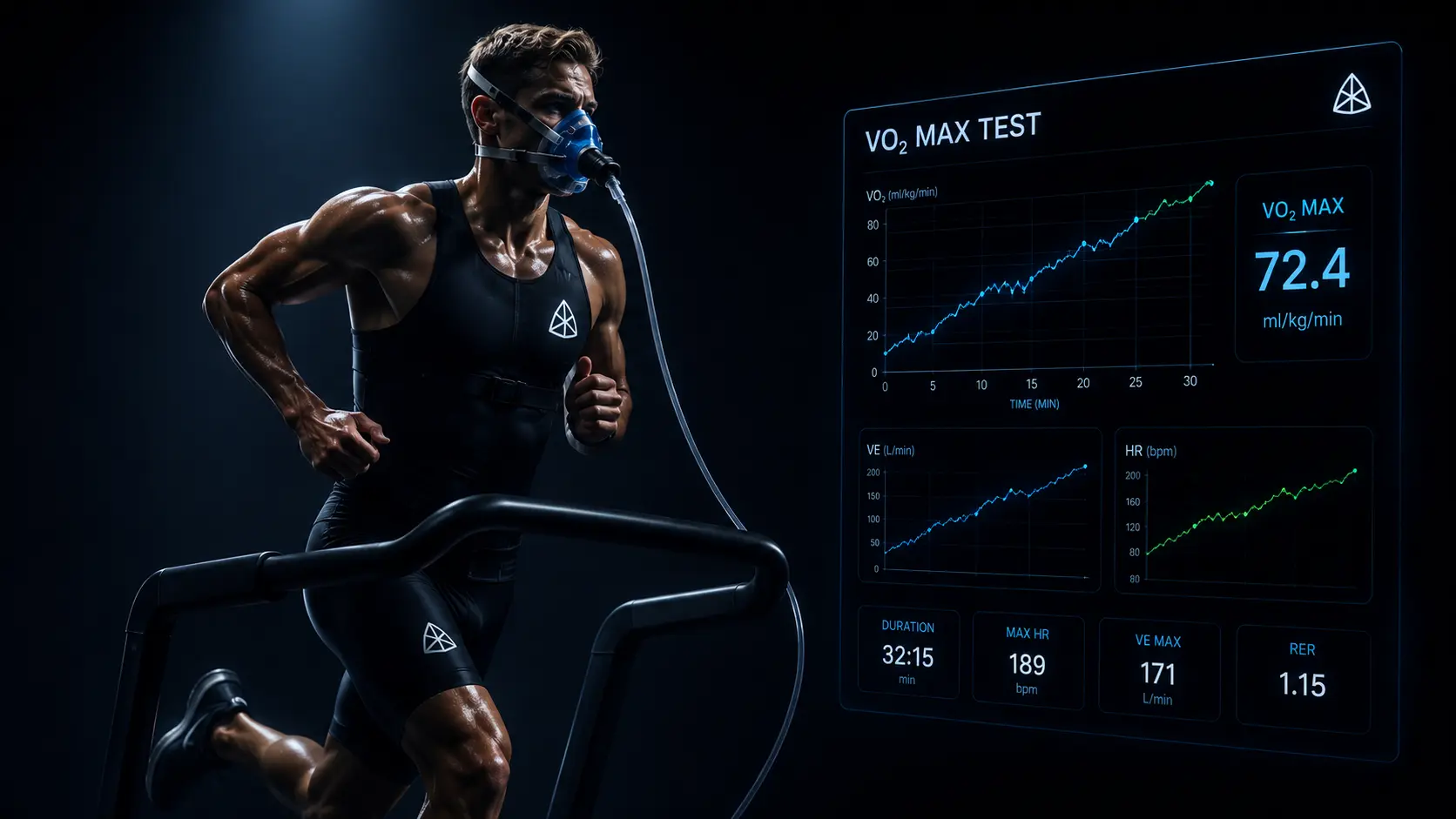
Ask a coach what the most important number in endurance sport is and most will say VO₂max without hesitating.
Ask why, and the answer gets fuzzy fast.
VO₂max (maximal oxygen uptake) is the single most talked-about metric in endurance coaching. It appears on fitness tracker apps, lab reports, Garmin dashboards, and athlete profiles. Coaches use it to classify athletes, predict race times, and justify training decisions.
The problem is that VO₂max is being used well beyond what it was ever designed to do. And when coaches over-rely on it, they miss the metrics that actually determine performance.
What VO₂max Actually Measures
VO₂max is the maximum rate at which an athlete’s body can consume oxygen during exhaustive exercise. It is expressed in millilitres of oxygen per kilogram of bodyweight per minute (ml/kg/min) and measured during a graded exercise test taken to voluntary exhaustion.
As a ceiling metric, it tells you one specific thing: the upper limit of an athlete’s aerobic engine. A high VO₂max means the body can deliver and process a large volume of oxygen at maximum effort. Everything else being equal, a higher VO₂max is better.
The critical word is “equal.” In a heterogeneous group of athletes, a mix of trained and untrained, fast and slow, VO₂max is a solid predictor of endurance performance. The research supports this clearly.
The problem emerges the moment you apply it to a group of athletes who are already similarly trained. At that level, VO₂max stops explaining much at all.
Where VO₂max Fails as a Coaching Tool
Here is the core issue: endurance performance is not determined by VO₂max alone. It is determined by three factors working together.
1. VO₂max – the ceiling of the aerobic system.
2. Lactate threshold – the fraction of VO₂max the athlete can sustain for extended periods without accumulating lactate faster than they can clear it. Two athletes with identical VO₂max scores can have wildly different lactate thresholds. The athlete who can race at 88% of their VO₂max beats the one racing at 76% every time, regardless of whose ceiling is higher.
3. Running economy (or movement efficiency) – how much oxygen the athlete consumes to sustain a given speed or power output. A more economical athlete gets more distance per unit of oxygen. Economy is trainable, highly individual, and completely invisible in a VO₂max score.
When you look at VO₂max in isolation, you are seeing only one leg of a three-legged stool. Scientists and coaches are now openly questioning the importance of VO₂max as a standalone metric, not because it is meaningless, but because it has been elevated far above its actual predictive value.
A 2022 commentary in the Journal of Applied Physiology made this precise argument: VO₂max has significant limitations as a marker of training status in already-trained athletes, and its use as a primary classification tool leads to systematic errors in research and coaching practice.
The Fractional Utilisation Problem
Consider three runners, all with a VO₂max of 60 ml/kg/min.
Runner A finishes a 10km in 40 minutes. They can sustain 92% of their VO₂max, but their running economy is poor, they burn more oxygen per kilometre than they should.
Runner B finishes in 37 minutes. Better economy and they can race at a higher fraction of their max.
Runner C finishes in 35 minutes. Their VO₂max is no higher than the others, but their combination of economy and fractional utilisation is superior.
Same ceiling. Three completely different athletes. VO₂max told you nothing that would help you coach any of them differently.
This is the fractional utilisation problem. Velocity at VO₂max, the actual speed at which an athlete hits their aerobic ceiling, is a significantly stronger predictor of race performance than VO₂max itself, because it incorporates economy into the equation.
Coaches who track only VO₂max are working with one-third of the picture.
What VO₂max Is Actually Good For
To be clear: VO₂max is not useless. It has specific, well-defined applications where it genuinely helps.
Talent identification in young athletes. VO₂max has a significant genetic component and tends to be relatively stable in trained adults. In youth athletes who have not yet reached their aerobic ceiling, it can indicate long-term potential.
Tracking untrained or early-stage athletes. When an athlete starts from a low base, VO₂max improvements track closely with fitness gains. It is a useful progress marker in the first year or two of structured training.
Population-level health screening. VO₂max is an excellent predictor of cardiovascular health risk and all-cause mortality. For clinical and general health purposes, it remains one of the best tools available.
Setting a rough performance ceiling. Even with its limitations, VO₂max tells you something real about the upper boundary of what is physiologically possible. No athlete with a VO₂max of 45 is winning an Olympic 5000m.
Where it fails is as a session-to-session coaching tool, as the primary basis for training intensity prescription, and as the headline number for tracking athlete development in already-fit athletes.
What Coaches Should Track Instead
The metrics that matter most for coaches working with trained athletes are not VO₂max. They are:
Lactate threshold (LT1 and LT2). The intensities at which lactate begins to accumulate meaningfully. These are the numbers that determine how training zones should be set, and they shift meaningfully with training in a way that VO₂max often does not.
Rate of perceived exertion relative to output. How hard an athlete feels a session versus what the data shows. When an athlete’s RPE for a given power or pace output starts rising, without a change in planned load, something is shifting in their fitness or recovery status.
Performance at threshold. Power or pace at lactate threshold is directly trainable and directly race-relevant. Improvements here show up in race results far more reliably than improvements in VO₂max.
Consistency of output over time. Can the athlete hit target paces or powers session after session? Variability in output under fixed conditions tells you more about training adaptation than a once-monthly VO₂max estimate.
The Coaching Trap
The reason VO₂max gets over-used is partly practical and partly cultural. It is a clean, single number. It is easy to communicate to athletes. Fitness apps display it prominently. It has a long history in exercise science, so it carries institutional weight.
The coaches who get the best results from their athletes are not the ones with the most accurate VO₂max estimates. They are the ones who track how each athlete responds, session by session, week by week, and adjust accordingly.
That requires monitoring tools that capture what is actually changing: how sessions feel, how output compares to target, how recovery is tracking. A VO₂max number measured three months ago tells you nothing about whether today’s threshold session should be pushed or pulled back.
When AFitPilot tracks each athlete’s RPE against planned effort and adapts future sessions based on that feedback, it is doing something a VO₂max score never could. It is responding to what the athlete is actually experiencing, in real time.
That is the shift from static metrics to dynamic coaching. And it is the difference that shows up in results.
The Bottom Line
VO₂max matters. It is not a useless number. But treating it as the primary lens through which you assess and coach athletes is a mistake that coaches at every level make.
Performance is determined by the ceiling, by how close to the ceiling an athlete can race, and by how efficiently they move at that effort. All three are required. Only one gets talked about.
Track VO₂max when it is relevant. But build your coaching systems around the metrics that change with training, that vary between athletes, and that tell you something useful every single session.
Resources
- Using VO₂max as a Marker of Training Status in Athletes — Can We Do Better? — Journal of Applied Physiology, 2022
- VO₂max — Does It Really Matter? — INSCYD Performance
- VO₂max Prediction Based on Submaximal Cardiorespiratory Relationships — PMC/NIH
- Special Endurance Coefficients Enable the Evaluation of Running Performance — Scientific Reports, PMC, 2025
- Coaching Endurance Performance: VO₂max, Threshold and Economy — ACE Certified, 2026
Leave a Reply
You must be logged in to post a comment.