
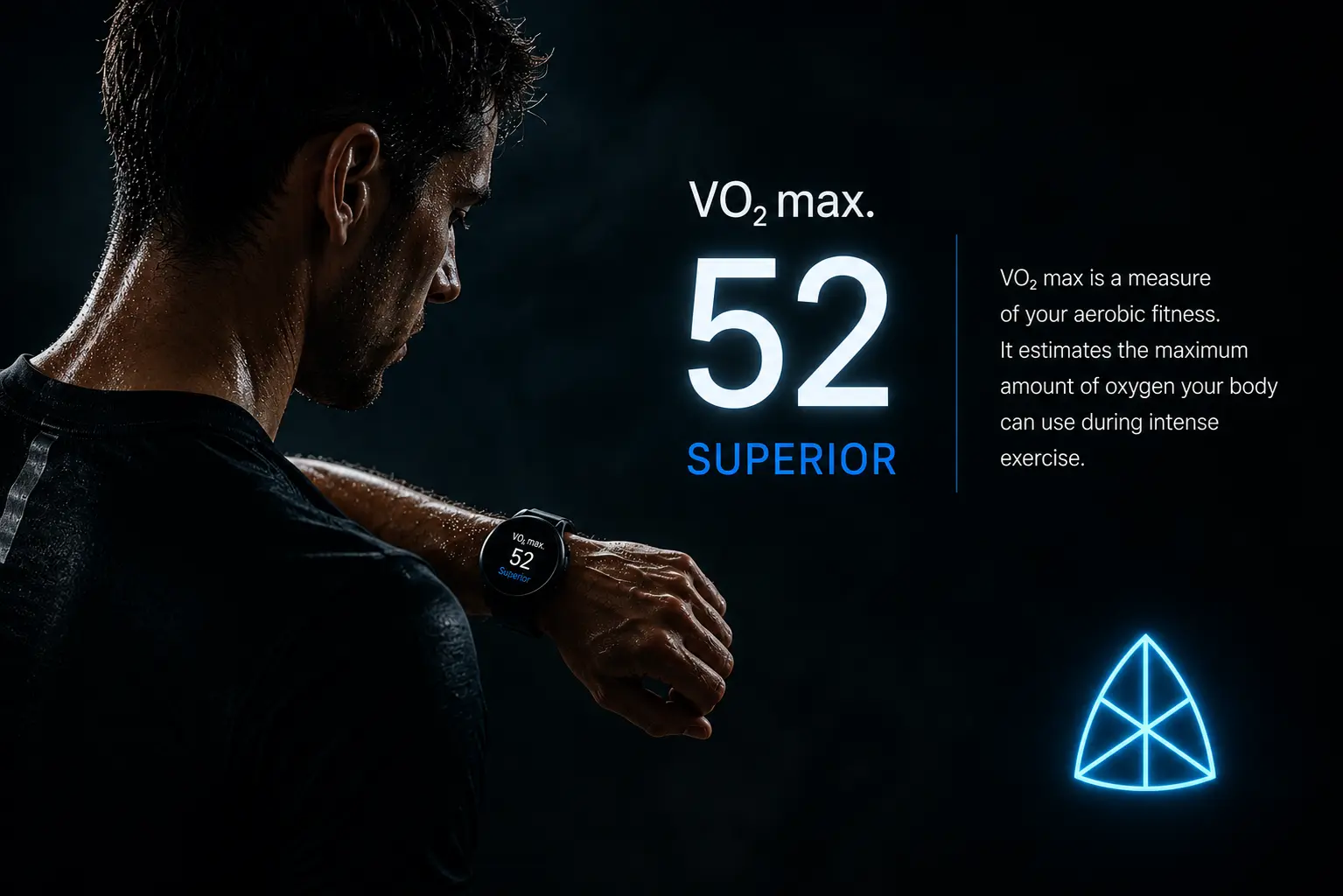
You finish a run. You check your watch. There it is — a number. 47. 52. 58. Sometimes it goes up. Sometimes it drops a point after a hard week and you spend the next ten minutes wondering what you did wrong.
VO₂max is one of the most visible numbers in recreational sport right now. Garmin shows it. Apple Watch estimates it. Whoop references it. Strava talks about it. And most people who see it have no real idea what it means, whether their number is good, or what they should actually do with it.
This article is the honest answer to all of that.
What the Number Actually Represents
VO₂max is your body’s maximum rate of oxygen consumption during intense exercise — expressed as millilitres of oxygen per kilogram of bodyweight per minute (ml/kg/min).
Think of it as the size of your aerobic engine. A higher number means your cardiovascular system can deliver and process more oxygen at maximum effort. Since oxygen fuels endurance performance, a bigger engine is generally better.
That is the ceiling metric. What it does not tell you is how efficiently you use that engine, or how close to the ceiling you can actually race — but more on that shortly.
How Accurate Is Your Watch’s Estimate?
Here is the honest answer: reasonably accurate for most people, but not perfectly accurate for anyone.
A 2025 systematic review published in Frontiers in Sports and Active Living analysed 13 studies on wearable VO₂max accuracy. Most used Garmin devices with chest-belt heart rate sensors and the Firstbeat Technologies algorithm — the same system powering most Garmin watches. In seven of those studies, wearable estimates were found to be valid or acceptable compared to gold-standard laboratory measurement.
So roughly half the research calls it good enough. The other half raises concerns. What are those concerns?
Research on Apple Watch found that smartwatches tend to overestimate VO₂max in people with poor fitness and underestimate it in people with excellent fitness. Garmin shows a similar pattern. If your number seems surprisingly high or suspiciously low compared to how you actually perform, the direction of that error tells you something useful.
The practical takeaway: your watch’s VO₂max estimate is most useful as a relative tracking tool — watching it move over months — not as an absolute number to compare against lab results or other people’s scores.
What Your Number Actually Tells You
So you have your number. Here is what it does and does not mean.
It tells you your aerobic ceiling relative to your bodyweight. A score of 52 ml/kg/min means your body can process up to 52 millilitres of oxygen per kilogram of your bodyweight every minute at maximum effort. That is the upper boundary of your aerobic system.
It tells you where you sit in the population. A good score for a 30-year-old male is around 45–52 ml/kg/min, while a 30-year-old female would aim for 38–45 ml/kg/min. Scores above 60 are typically found in highly trained athletes. Context matters enormously here — the same score means something very different depending on your age and sex.
It tells you your general cardiovascular health status. VO₂max is one of the strongest predictors of long-term health outcomes. Research suggests pushing above average provides substantial longevity benefits — and a person who moves from 25 ml/kg/min to 30 ml/kg/min has meaningfully reduced their mortality risk. You do not need to be an elite athlete for VO₂max to matter for your health.
It does not tell you how fast you will race. Two athletes with the same VO₂max can have very different performance outcomes depending on their lactate threshold and movement efficiency. The ceiling is just one part of the equation.
Why Your Number Can Change — And What Drives It
Fitness typically declines between 5 and 20 percent per decade in healthy individuals between the ages of 20 and 65. That is the bad news. The good news is that most of that decline is not inevitable.
Most people can expect a 15–25% VO₂max improvement over six months of structured training. Meaningful gains usually take six to eight weeks of consistent aerobic work. High-intensity interval training produces faster gains than steady-state training, typically 5–15% in six weeks.
A few things that move the number upward:
Volume of aerobic training. More time spent training your aerobic system — especially easy, consistent effort — raises the baseline over months. This is the foundation.
High-intensity intervals. Short bursts of effort above your threshold are the most efficient way to push VO₂max up quickly. The research is consistent here: two or three hard interval sessions per week, layered on top of easy volume, produce the fastest gains.
Bodyweight. Because VO₂max is expressed relative to bodyweight (ml/kg/min), reducing body fat while maintaining fitness improves the score. This is one reason lighter athletes tend to have higher VO₂max values — not always because their absolute aerobic capacity is higher, but because the denominator is smaller.
Sleep and recovery. Sleep quality, body composition, and lifestyle factors like smoking all play a role — smoking can lower cardiorespiratory fitness to a level equivalent to aging an extra ten years.
The Thing Your Watch Is Not Telling You
Here is the part most fitness content skips.
A VO₂max of 52 with a well-developed lactate threshold and good movement efficiency will outperform a VO₂max of 58 that is poorly utilised. The ceiling matters less than you think. What matters more is how much of that ceiling you can access, and how efficiently your body works at the intensities that actually determine race performance.
Elite coaches know this. That is why they rarely chase VO₂max scores directly. Instead they train the metrics that determine how much of the engine gets used: threshold pace, perceived effort at given intensities, and how the athlete responds to progressive load over time.
The number on your watch is a useful starting point. A trend over months tells you whether your training is working. A single reading after a run tells you very little on its own.
What To Actually Do With Your Number
Stop checking it after every run. VO₂max estimates from wearables fluctuate based on conditions, effort level, and measurement noise. Daily or weekly readings are meaningless. Look at three-month trends.
Compare yourself to yourself, not to others. The cleanest tracking is within the same sport and device over time. Your Garmin number compared to someone else's Apple Watch number is not a useful comparison.
Use it for health context, not just performance. Even if you never race, a rising VO₂max over time is one of the best indicators that your training is producing cardiovascular adaptation. It is a health metric as much as a performance metric.
Do not optimise for the number. Train for fitness. The number will follow. Chasing VO₂max directly — by doing more hard intervals than your recovery can support — usually leads to fatigue, not improvement.
The Honest Summary
Your Garmin VO₂max estimate is a reasonable approximation, not a precise measurement. It is most useful as a relative trend over months, not as an absolute benchmark to stress over.
A score of 52 for a 35-year-old male puts you in solid recreational athlete territory. For a 35-year-old female, the same score is exceptional. Context is everything.
What the number cannot tell you is whether your training is actually working for you individually — whether sessions are building adaptation or accumulating fatigue, whether you are recovering adequately, whether the effort you feel matches what your body is actually producing.
Those questions require more than a ceiling metric. They require tracking how training actually affects you — session by session, week by week. Which is exactly what separates athletes who keep improving from athletes who plateau.
Resources
- Accuracy of Wearables for Determining VO₂max and Lactate Threshold — Frontiers in Sports and Active Living, PMC, 2025
- Assessing the Accuracy of Apple Watch VO₂max Estimation — JMIR Biomedical Engineering, 2024
- What's a Good VO₂max for Me? — Firstbeat / Garmin
- VO₂max by Age: Normative Scores and What's Good — PeakVO2
- Wearable Accuracy Ranked: 17 Studies, 6 Devices — Kygo, 2026
Leave a Reply
You must be logged in to post a comment.