
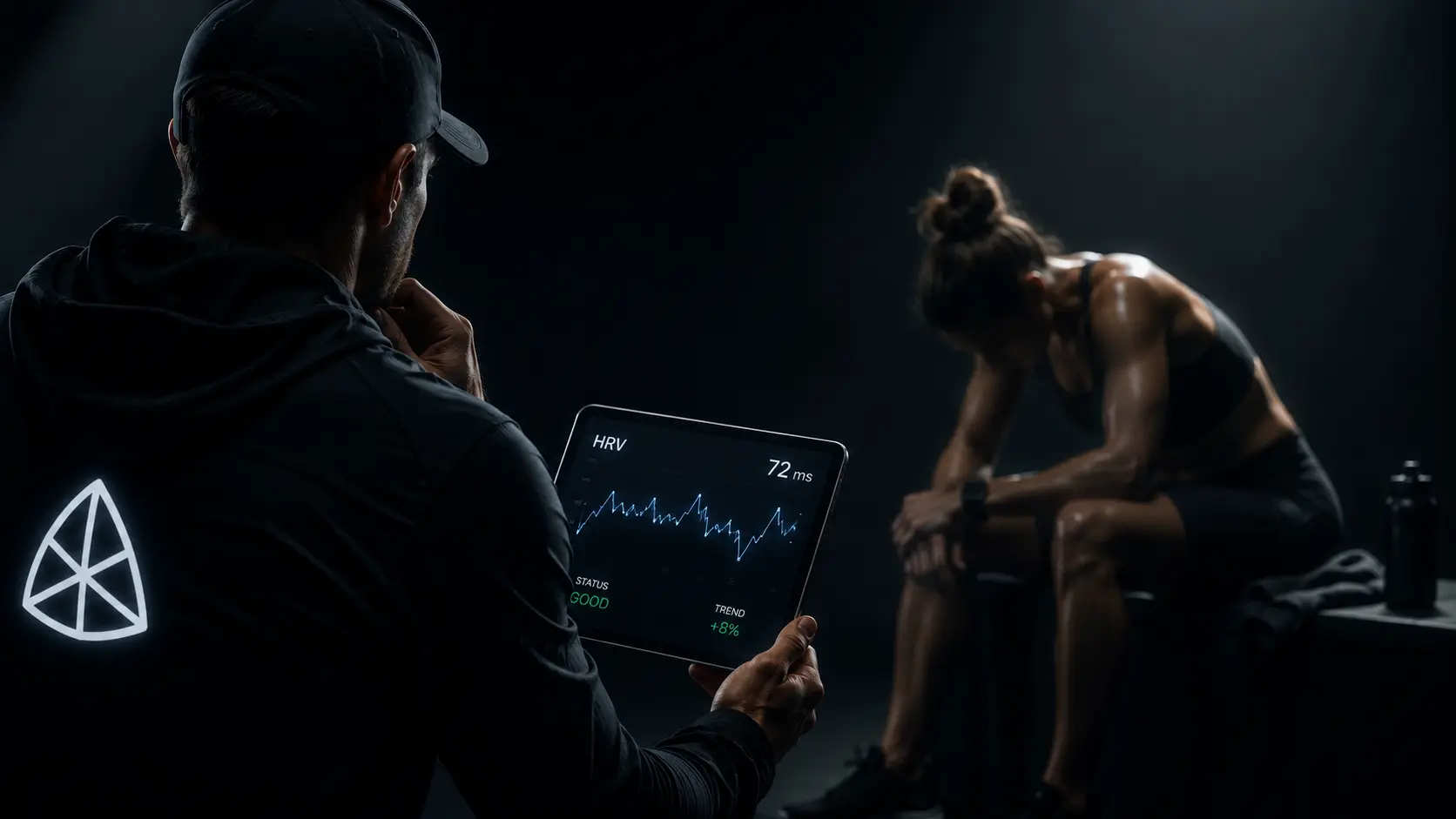
Heart rate variability is everywhere right now.
Whoop sells it. Garmin estimates it. Athletes check it every morning before they decide whether to train hard or go easy. Coaches are expected to understand it, explain it, and act on it.
Most do not fully understand what they are looking at.
HRV is a genuinely useful coaching tool. It is also one of the most misinterpreted metrics in sport, applied in ways that lead coaches to make worse decisions than if they had ignored it entirely.
This article explains what HRV actually measures, what the research says about when it helps, and — critically — when it should not be the thing driving your training decisions.
What HRV Actually Is
Your heart does not beat with mechanical precision like a metronome. Even at rest, the interval between consecutive heartbeats varies slightly from one beat to the next. That variation — measured in milliseconds — is heart rate variability.
A high HRV means the gaps between beats fluctuate more. A low HRV means the intervals are more uniform.
This matters because heart rate is regulated by the autonomic nervous system — the same system that governs recovery, stress response, and physiological readiness. High HRV generally indicates the parasympathetic nervous system (“rest and digest”) is dominant. Low HRV suggests the sympathetic system (“fight or flight”) is more active, which typically signals stress, fatigue, or inadequate recovery.
The most commonly used HRV metric in sport science and coaching applications is RMSSD — the root mean square of successive differences between heartbeats. It correlates strongly with parasympathetic activity and is reliable in short recordings, which makes it practical for daily monitoring with wearable devices.
What the Research Actually Says
The evidence base for HRV in athlete monitoring has grown substantially in recent years, and the findings are more nuanced than most coaching resources suggest.
A 2025 review published in Sensors examined mobile HRV monitoring in athletic populations and found that near-daily HRV measurement is significantly more useful than occasional testing. Weekly averages and tracking changes relative to an individual athlete’s baseline — rather than comparing numbers to population norms — capture both chronic adaptations and acute fatigue states more reliably than single readings.
This is the first important practical point: one low HRV reading tells you almost nothing. A trend over five to seven days tells you something real.
A 2025 review in the International Journal of Innovative Technologies in Social Science found that athletes who adjusted their training based on daily HRV readings improved VO₂max more than those who followed a fixed plan. During heavy training phases, HRV dropped — indicating fatigue accumulation. During taper phases, HRV rose — indicating the body was recovering and approaching peak readiness. The pattern tracked reliably with actual performance.
In strength and conditioning, a 2024 review in Sports concluded that HRV is a helpful metric for assessing training status and recovery, but that coaches should approach each athlete individually. The key phrase: decreasing HRV may be a sign of overreaching — but only when interpreted with contextual factors, not in isolation.
The Three Things HRV Is Actually Good For
1. Detecting accumulated fatigue before it becomes a problem. When an athlete’s HRV starts trending downward across multiple days — particularly during a build phase — it is an early signal that recovery is not keeping pace with load. This is arguably the most valuable application: catching overreaching before it becomes overtraining. By the time an athlete’s performance drops or they report persistent fatigue, the damage is already done. A sustained HRV decline flags it two to three weeks earlier.
2. Confirming taper readiness. Before a major race or test, rising HRV is one of the clearest physiological signals that the body has recovered and is building toward peak readiness. Coaches who use HRV during taper periods can make more confident decisions about whether the athlete is ready to race or needs another easy day.
3. Tracking long-term training adaptation. Over months and years, a gradually rising HRV baseline — measured consistently under the same conditions — indicates improving autonomic fitness. This is a slow signal, not useful week-to-week, but meaningful as a long-term health and adaptation marker.
The Four Situations Where HRV Will Mislead You
This is where most coaching resources stop. They tell you what HRV is good for and skip the limitations. The limitations matter just as much.
1. Single readings. One morning HRV reading reflects last night’s sleep, alcohol consumed two evenings ago, ambient temperature, whether the athlete measured it before or after getting out of bed, and dozens of other confounders. Acting on a single low reading — cancelling a key session, for example — is almost never justified. Trends matter. Single data points do not.
2. Comparing athletes to each other. HRV is highly individual. An athlete with a chronically low RMSSD of 28ms may be in excellent shape. An athlete with a chronically high RMSSD of 95ms who drops to 70ms may be significantly fatigued. Comparing absolute HRV values between athletes tells you nothing. What matters is each athlete’s own baseline and how they deviate from it.
3. High training load phases. During intense training blocks, HRV will drop — and that is entirely expected and appropriate. Productive overload looks like falling HRV followed by recovery and supercompensation. A coach who sees dropping HRV during a planned hard week and panics has misunderstood the signal. The question is not “is HRV dropping?” but “is it recovering between sessions and between weeks as expected?”
4. Athletes under significant life stress. Work deadlines, relationship strain, poor sleep unrelated to training — all of these suppress HRV independently of training load. A coach who sees low HRV and increases easy days when the real issue is a stressful week at work has made a training decision based on a non-training signal. HRV cannot tell you why it is low. It just tells you the nervous system is under load.
HRV and RPE: Better Together
The research increasingly points toward combining HRV with subjective measures rather than relying on either alone.
A 2025 study from Frontiers in Sports and Active Living compared HRV-guided training, personal trainer-guided training, and a control group. The trainer-guided group outperformed the autonomous HRV-guided group — not because HRV was wrong, but because the human coach was able to integrate HRV data with athlete feedback, session feel, and contextual information that the technology alone could not capture.
This is the key insight: HRV is an input, not an answer.
The most effective monitoring system combines objective physiological data — HRV — with subjective session feedback — RPE, perceived recovery, motivation — and puts a coach in a position to interpret both in the context of the full training picture.
When an athlete’s HRV is trending down and their RPE for easy sessions is creeping up simultaneously, the signal is clear and actionable. When HRV is low but the athlete reports feeling great and RPE is normal, the coach should be cautious, not reactive.
Neither signal alone is sufficient. Together, they give the coach something genuinely useful.
Practical HRV Monitoring for Coaches
If you are going to use HRV with your athletes, here is what the research supports:
Measure daily, same conditions. Morning, supine, before getting out of bed. Consistency of measurement protocol matters enormously for reliability.
Track weekly averages, not single readings. A seven-day rolling average smooths out noise and reveals real trends.
Use individual baselines. Establish each athlete’s normal range over four to six weeks before using HRV to make decisions. Act on deviations from the individual baseline, not population norms.
Combine with RPE. HRV and session RPE together are substantially more informative than either alone. If both are signalling the same thing, act on it. If they are contradicting each other, investigate why before changing the plan.
Do not override key sessions on a single bad reading. Trends justify adjustments. Single data points rarely do.
The Coaching Reality
HRV monitoring is genuinely useful when done correctly. It is noise when done poorly.
The coaches who use it well treat it as one input in a larger picture — alongside session RPE, performance data, athlete-reported wellbeing, and training load metrics. They look for convergent signals across multiple data sources before acting.
The coaches who get misled by it treat it as an oracle. They cancel sessions when HRV drops, push athletes when it rises, and end up optimising for the number rather than for the athlete.
At scale, this is where systems matter. A coach with twenty athletes cannot manually cross-reference HRV, RPE, planned load, and performance data for every individual every day. The ones who manage it well have built workflows that surface the athletes who need attention — so the coach can bring human judgment to bear where it is actually needed.
Resources
- Monitoring Training Adaptation and Recovery Status Using HRV via Mobile Devices — Sensors, PMC, 2025
- Heart Rate Variability in Athletes: Indicator of Training Load, Recovery and Cardiovascular Health — IJITSS, 2025
- Heart Rate Variability Applications in Strength and Conditioning — Sports, MDPI, 2024
- Impact of HRV-Based Exercise Prescription: Self-Guided vs Trainer-Guided — Frontiers in Sports and Active Living, 2025
- Heart Rate Variability-Guided Training in Professional Runners — ScienceDirect, 2021
Leave a Reply
You must be logged in to post a comment.