
Gunnar Borg developed the method that exercise science uses to ask people how hard they are working.
He was born in Sweden in 1927 and trained in psychology, philosophy, education, and physiology — a combination that placed him in the field of psychophysics, the branch of experimental psychology that studies how subjective experience relates to measurable physical stimuli. Psychophysics had been founded in the 19th century by Gustav Fechner and developed in the 20th by Stanley Smith Stevens at Harvard, who established the power-law relationships between stimulus intensity and perceived intensity that underpin most modern measurement of subjective experience. Borg’s contribution was to extend the same framework to a question Stevens had not addressed: how hard does it feel to exert physical effort?
He was associate professor at the Medical School in Umeå from 1966 to 1967, headed a unit for clinical psychology at the university hospital, and from 1987 to 1994 was professor of perception and psychophysics at Stockholm University. He died in February 2020, aged 92.
The 6–20 scale
Borg published his first work on perceived exertion in the late 1950s and developed the scale that bears his name through the 1960s. Its definitive form appeared in his 1962 book Physical Performance and Perceived Exertion [1]. The scale was unusual in its choice of numerical range — 6 to 20, rather than the more obvious 1 to 10 or 0 to 100 — and the design choice was deliberate.
Borg observed that for healthy young adults, resting heart rate sits around 60 beats per minute and maximum heart rate around 200 bpm. He chose the 6–20 range so that, multiplied by ten, the rating would approximately predict the heart rate at that level of perceived effort. A rating of 6 (“no exertion at all”) corresponds to roughly 60 bpm; a rating of 13 (“somewhat hard”) to roughly 130 bpm; a rating of 20 (“maximal exertion”) to roughly 200 bpm. The verbal anchors — “very light,” “hard,” “very hard” — were positioned along the scale so that the perceived intensity grew linearly with the number, allowing direct comparison with measured physiological variables.
This was a piece of design work, not just a survey instrument. The scale was constructed to have interval properties — equal numerical steps reflecting equal perceptual differences — which made it usable in regression and other statistical procedures alongside continuous physiological data. The heart-rate calibration was the practical anchor that made the scale legible to clinicians who were not psychophysicists.
The 6–20 scale was first recommended as a guide for monitoring exercise intensity in the third edition of the American College of Sports Medicine’s Guidelines for Exercise Testing and Prescription in 1986 [2]. From there, it became standard infrastructure in cardiac rehabilitation, fitness assessment, and exercise prescription worldwide.
The CR10 scale
In 1982 Borg published a different scale in a paper titled “Psychophysical bases of perceived exertion” in Medicine & Science in Sports & Exercise [3]. This was the category-ratio 10 scale, or CR10. It runs from 0 (“nothing at all”) to 10 (“extremely strong, almost max”), with the option to report ratings above 10 for absolute maximal effort.
The CR10 was constructed differently from the 6–20 scale. It is a level-anchored ratio scale, meaning the verbal descriptors are positioned to preserve ratio relationships — a rating of 6 represents twice the perceived intensity of a rating of 3, in a way that the 6–20 scale’s interval properties do not support. That mathematical property matters because it allows the scale to be combined arithmetically with other measurements without violating its underlying structure.
The CR10 is also the scale Borg recommended for measuring localised symptoms — breathlessness, muscle pain, perceived exertion in a specific limb — where the 6–20 scale’s whole-body cardiovascular framing is less appropriate.
Session RPE and training load
The application of Borg’s CR10 scale that has become most influential in modern training science is session RPE.
In a 2001 paper in the Journal of Strength and Conditioning Research, Carl Foster and colleagues operationalised what Borg’s framework made possible [4]: take a single CR10 rating after a training session ends, multiply it by the session duration in minutes, and treat the product as a unit of training load. A 60-minute session at sRPE 7 produces a load of 420; a 30-minute session at sRPE 9 produces 270. Sum across a week and you have weekly training load. Track the ratio of acute to chronic load and you have, in Foster’s original framing, a model for monitoring training stress and recovery.
The framework is the basis of how most modern coaching software handles training-load currency, including the work I do with Afitpilot. It is also genuinely contested in current literature. Critics point out that sRPE × duration treats a single rating as representative of an entire session, that the rating is collected after the fact and subject to recency bias, and that the linear combination of two variables with very different measurement properties is mathematically uncomfortable. The acute:chronic workload ratio in particular has come under sharp scrutiny — Impellizzeri’s 2020 and 2023 papers argue persuasively that the evidence does not support ACWR as a predictor of individual injury risk, and that surfacing it as a risk signal misuses what is fundamentally a descriptive trend [5, 6]. Defenders of session RPE itself respond that the practical correlation between sRPE-based load and physiological markers of training stress is robust across sports and populations, and that the cost-to-utility ratio of asking a single question after each session is unbeatable.
Whichever side that debate lands on, the underlying measurement is Borg’s. Without a validated, ratio-property scale for self-reported intensity, there is no session RPE.
In Afitpilot
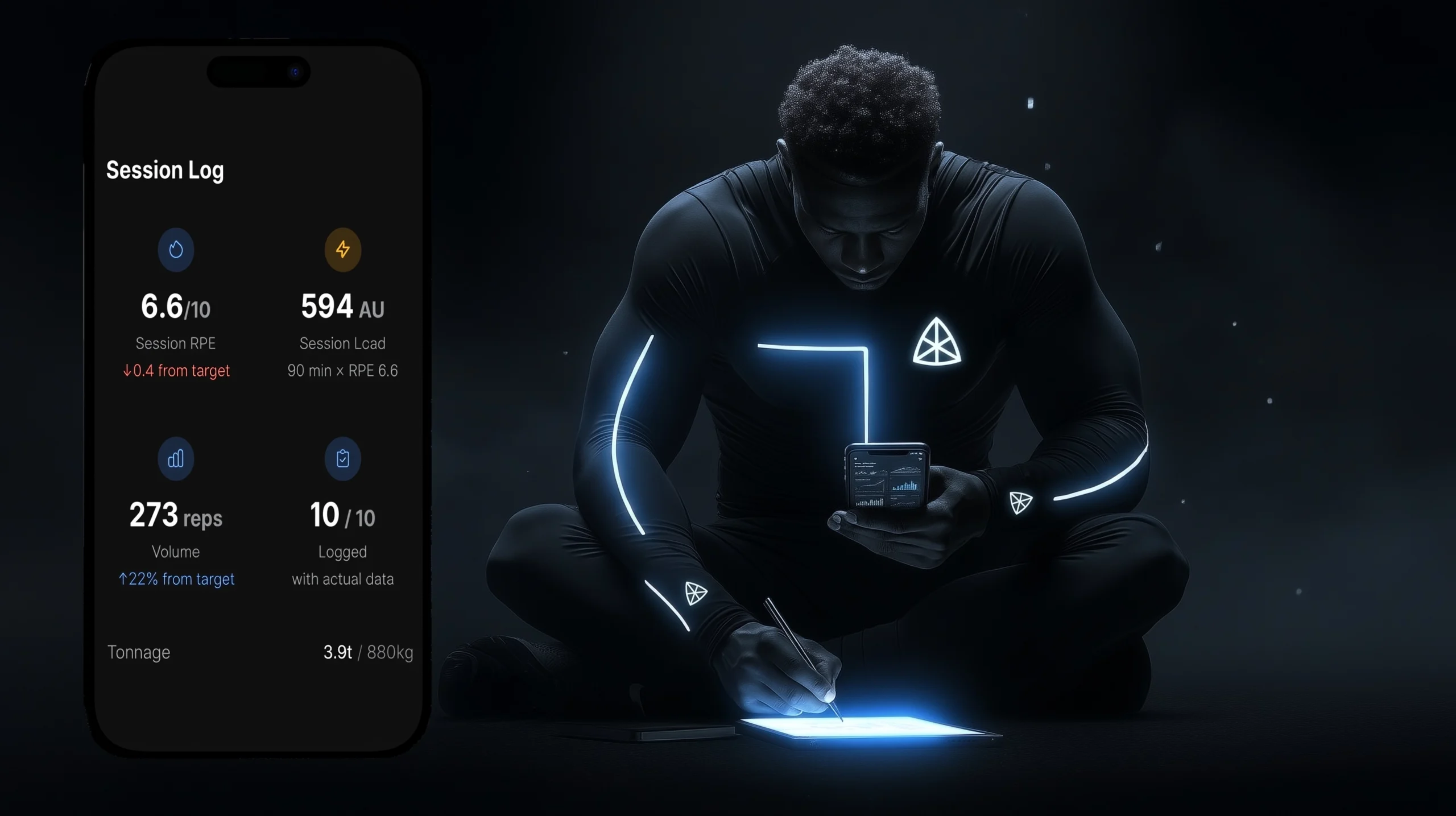
Session RPE is Afitpilot’s primary unit of training-load currency. After a session, the athlete reports a single CR10 rating and confirms or adjusts the session duration; the platform multiplies the two to produce a session AU (arbitrary unit) figure using Foster’s method, persisted alongside the session record. Tonnage, the older currency, is retained as a secondary number for strength-prescription adherence but no longer leads the display. Per-set RIR is captured optionally on strength sessions and feeds RIR-aware e1RM calculations without ever blocking the athlete from saving a log.
The platform does not enforce Foster’s “30 minutes post-session” timing for the sRPE prompt — the rating window is at the athlete’s discretion. This is a deliberate trade against protocol fidelity. The literature on whether the 30-minute window meaningfully changes the rating’s properties is mixed, and forcing a timing constraint into a self-coached app costs compliance against an uncertain accuracy gain.
Weekly session AUs are aggregated into a weekly load total, split across three coarse modality buckets — strength, endurance, and mixed — so that two athletes with the same weekly AU but different training compositions are legible as different. A nightly job produces EWMA-smoothed seven-day acute and 28-day chronic load figures and a descriptive trend label (rising, falling, stable). Following Impellizzeri 2020 and 2023, the acute:chronic chart ships descriptive-only: no ratio surfaced as a number, no severity colours, no automated alerts, no injury-risk framing. The figure is there because the trend is informative; the use of the figure as a predictive risk signal isn’t supported by the literature, and pretending otherwise would be a misrepresentation of what the underlying data can tell anyone.
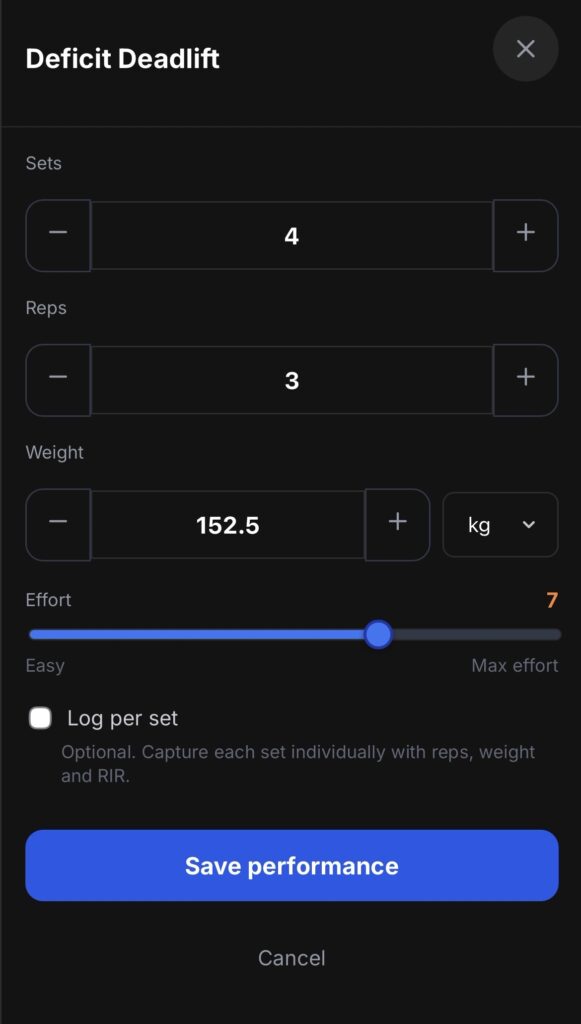
What this adds up to is that sRPE is wired up at the currency level — collection, per-session load, weekly rollup, modality split, descriptive trend — and is the basis of how Afitpilot represents training load to the athlete and the coach. It is not yet the input to the closed-loop adaptation engine; deload triggers and volume modulation currently operate on tonnage-based delivery-rate signals rather than AU. The migration of adaptation logic onto AU is on the roadmap; the display layer is what’s shipped today.
What survived
Borg’s substantive contribution is narrower than someone like Hill’s, but it is durable. He took a question — how hard does this feel? — that was treated as too subjective to be measurable, applied the formal tools of psychophysics, and produced an instrument that survived translation from research laboratory to clinical practice to elite sport to recreational fitness. The 6–20 scale appears on the wall of every cardiac rehab gym; the CR10 sits inside every modern training-load calculation.
What did not survive cleanly is the assumption that perceived exertion maps onto a single physiological variable. The original heart-rate calibration of the 6–20 scale works for healthy young adults at moderate intensities and breaks down at the extremes, in older populations, and in people on rate-altering medications. Borg himself wrote about this. The scale’s value was never that it accurately predicted heart rate; it was that it gave a quantitative handle on subjective effort, which turns out to track multiple physiological variables in combination — heart rate, ventilation, blood lactate, muscle metabolite accumulation, central neural drive — none of which alone explains it.
That is the same thread that runs through the rest of this series: a 19th- or 20th-century scientist takes something that was thought to be unmeasurable, builds an instrument for it, and the instrument outlives the specific physiological model the inventor attached to it.
I wrote separately about A.V. Hill and Claude Gordon Douglas, two earlier figures whose measurement work runs in parallel to Borg’s.
References
[1] Borg, G.A.V. (1962). Physical Performance and Perceived Exertion. Studia Psychologica et Paedagogica, Series altera, Investigationes XI. Lund: Gleerup.
[2] American College of Sports Medicine (1986). Guidelines for Exercise Testing and Prescription, 3rd edition. Philadelphia: Lea & Febiger.
[3] Borg, G.A.V. (1982). Psychophysical bases of perceived exertion. Medicine & Science in Sports & Exercise, 14(5), 377–381.
[4] Foster, C., Florhaug, J.A., Franklin, J., Gottschall, L., Hrovatin, L.A., Parker, S., Doleshal, P., & Dodge, C. (2001). A new approach to monitoring exercise training. Journal of Strength and Conditioning Research, 15(1), 109–115.
[5] Impellizzeri, F.M., Tenan, M.S., Kempton, T., Novak, A., & Coutts, A.J. (2020). Acute:chronic workload ratio: conceptual issues and fundamental pitfalls. International Journal of Sports Physiology and Performance, 15(6), 907–913.
[6] Impellizzeri, F.M., Shrier, I., McLaren, S.J., Coutts, A.J., McCall, A., Slattery, K., Jeffries, A.C., & Kalkhoven, J.T. (2023). Understanding training load as exposure and dose. Sports Medicine, 53(9), 1667–1679.
Leave a Reply
You must be logged in to post a comment.