
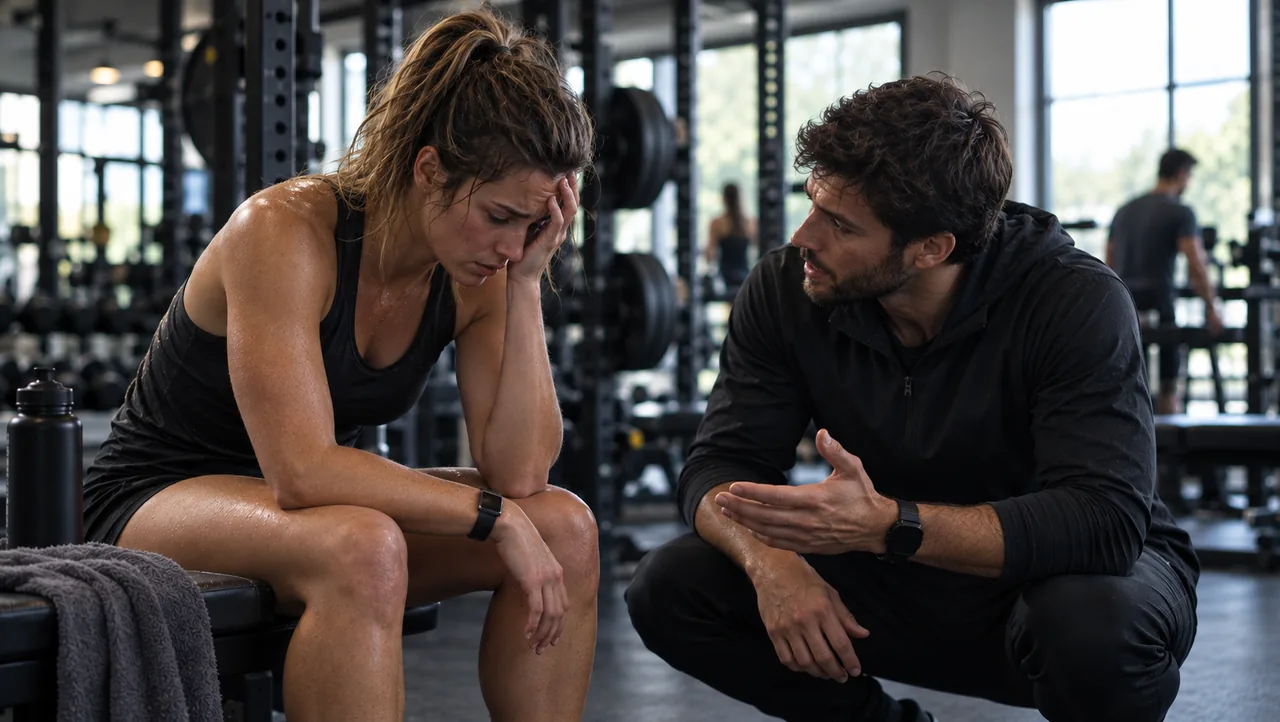
A client who never misses a session cancels twice in a row. She replies with one word. When she does arrive, she looks tired and leaves early. The coach notices, and is not sure what to do.
Many coaches meet this moment. Training can help with how people feel, and coaches are close to their athletes. They are not therapists, and the line between the two matters. This article covers what the research shows and what kind of exercise helps. It also covers what a coach should and should not say.
What the Research Shows
Singh and colleagues (2023) reviewed the reviews. They gathered 97 systematic reviews, covering 1,039 trials and 128,119 participants.
Physical activity improved three things compared with usual care:
- Depression. A moderate effect, with a median effect size of -0.43.
- Anxiety. A moderate effect, with a median effect size of -0.42.
- Psychological distress. An effect size of -0.60.
An effect size describes how large a change is. A moderate one is noticeable. It is not a cure.
The largest benefits were seen in people with depression, HIV or kidney disease. They were also seen in pregnant and postpartum women, and in healthy people.
Which Kind of Exercise?
A second large review looked at depression alone. Noetel and colleagues (2024) pooled 218 studies with 14,170 participants. They compared exercise types against active control groups, such as usual care.
The five types with enough data all helped. The largest average effect was for walking or jogging, followed by yoga and strength training.
The differences between types were small compared with the uncertainty around them. This suggests the best type may be the one a person will keep doing. Offering a choice is a safer plan than pushing a single option.
How Hard and How Long?
Both reviews point to intensity. Singh and colleagues found that higher intensity was linked to greater improvement. Noetel and colleagues found that effects went up with the prescribed intensity. This was clearest for walking or jogging, yoga and strength training.
Duration points the other way. Singh and colleagues found that longer programs were linked to smaller effects.
These are averages across many trials. They do not tell you how hard one person should train. A person who is struggling may not be ready for hard sessions. A start that feels doable matters more than a perfect dose.
What a Coach Can Do
A coach is in a good position to notice and to help. Four steps cover most of it.
- Notice. Look for changes. Missed sessions, low energy, withdrawal or changes in mood.
- Talk. Ask in private, in a calm way. Listen more than you speak.
- Adjust. Lower the pressure. Keep sessions short, social and doable.
- Refer. Point to the athlete’s doctor or a mental health professional.
What a Coach Should Not Do
Coaches are not trained to diagnose or treat mental health conditions. Some things are outside the role:
- Do not label what the person is going through.
- Do not promise that training will fix it.
- Do not give advice about medication, or suggest stopping treatment.
- Do not use hard sessions to push someone out of a low mood.
If you think someone may be in danger, do not handle it alone. Contact local emergency services or a crisis line.
What the Evidence Covers
The reviews show that exercise helps on average. They do not show that it works for every person, or that it replaces treatment. Exercise is a useful part of care. It is not a substitute for professional help.
The reviews pool many trials, which vary in size and design. Averages do not predict one person’s response. The studies also do not cover what a coach should say in conversation. That part comes from good practice and from the limits of the role.
Where to Start
- Learn who the local mental health options are, so you can refer without delay.
- Offer more than one kind of exercise, and let athletes choose.
- Keep a few easy, social sessions in the plan.
- Check in on athletes as people, not only on their training.
- Know where your role stops.
A coach who does these things is not treating anyone. They are making it easier to stay active and to ask for help.
Related reading: Training load and injury and The transition phase.
References
Singh B, Olds T, Curtis R, Dumuid D, Virgara R, Watson A, Szeto K, O’Connor E, Ferguson T, Eglitis E, Miatke A, Simpson CEM, Maher C. Effectiveness of physical activity interventions for improving depression, anxiety and distress: an overview of systematic reviews. Br J Sports Med. 2023;57(18):1203-1209. DOI: 10.1136/bjsports-2022-106195
Noetel M, Sanders T, Gallardo-Gomez D, Taylor P, del Pozo Cruz B, van den Hoek D, Smith JJ, Mahoney J, Spathis J, Moresi M, Pagano R, Pagano L, Vasconcellos R, Arnott H, Varley B, Parker P, Biddle S, Lonsdale C. Effect of exercise for depression: systematic review and network meta-analysis of randomised controlled trials. BMJ. 2024;384:e075847. DOI: 10.1136/bmj-2023-075847
Leave a Reply
You must be logged in to post a comment.