
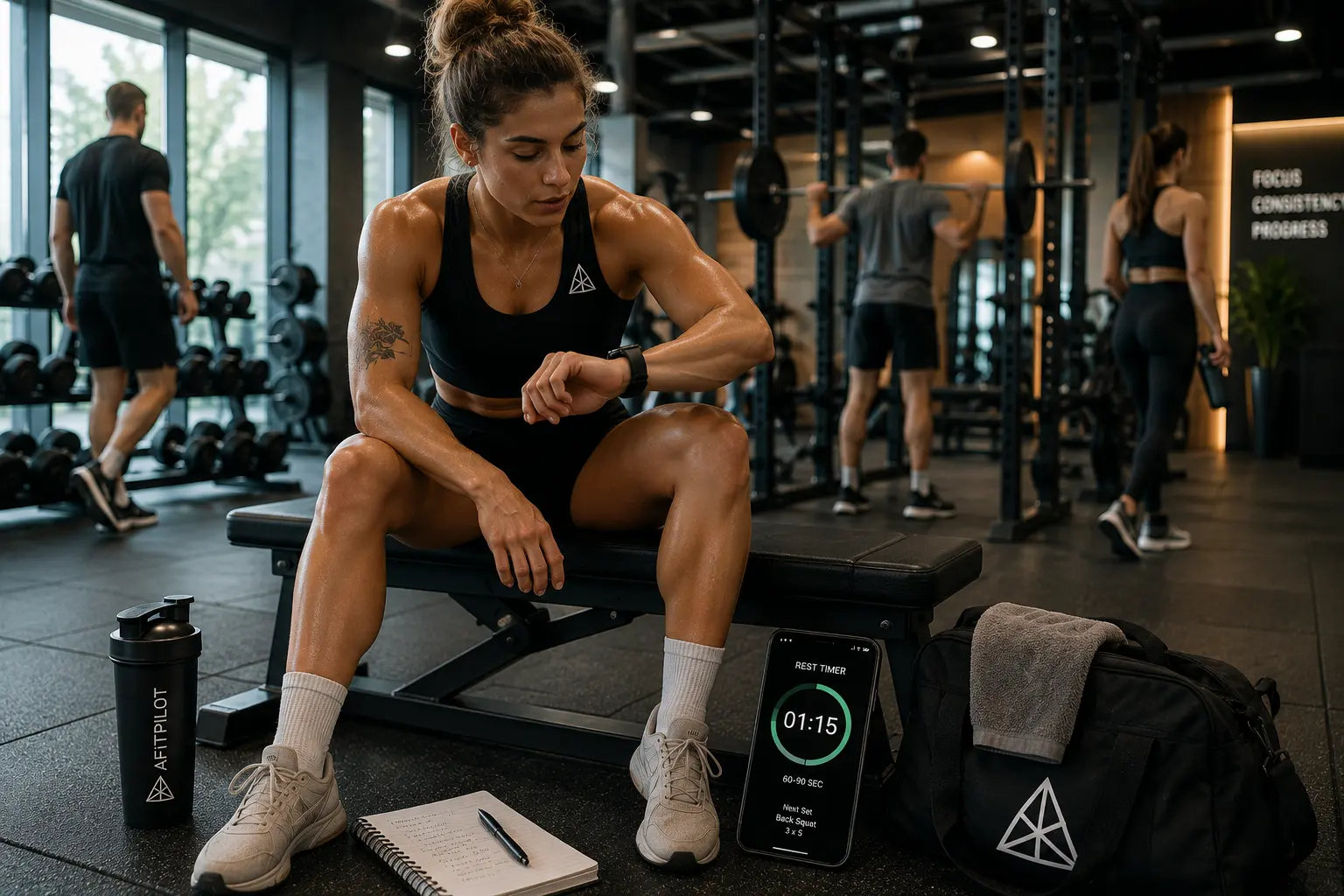
A lifter finishes a set of squats. They glance at a phone timer set to 90 seconds and wait it out before the next one. The number came from somewhere, a coach, an app, a magazine years ago. It has been repeated so often it now sounds like settled science. It is worth asking where that number came from, and whether the research still supports it. This article covers what the evidence shows about rest interval length for strength and hypertrophy. It covers why the old 60-to-90-second rule is weaker than its reputation suggests.
Where the 60-to-90-Second Rule Came From
The short-rest-for-hypertrophy idea has a real scientific origin. Early research proposed that shorter rest periods increase metabolic stress and hormonal response. Both were once believed to be significant drivers of muscle growth. Longer rest periods, by contrast, were associated with strength training. More complete recovery between sets allows heavier loads and better technique consistency.
This split hardened into common advice: roughly 60 to 90 seconds for hypertrophy work, 3 to 5 minutes for strength work. The advice was reasonable given what was understood at the time. The research since has moved in a direction that complicates it.
The Study That Complicated Everything
A frequently cited 2016 trial compared resistance-trained men on an identical programme. One group rested 1 minute between sets, the other 3 minutes, across 8 weeks. The longer-rest group showed greater improvements in both strength and hypertrophy. This result ran counter to the assumption that short rest was necessary, or even preferable, for muscle growth.
A more recent systematic review and meta-analysis focused specifically on resistance-trained men with over a year of training experience. It pooled six controlled studies comparing rest intervals under and over 60 seconds. Strength showed a moderate-to-large improvement with longer rest intervals. Hypertrophy showed only a trivial difference between conditions. The review’s own conclusion was direct. Longer rest intervals may not carry the hypertrophy disadvantage long assumed in the literature, and shorter rest does not appear to offer a meaningful advantage either.
Why Volume-Load Matters More Than Metabolic Stress
The mechanism behind this finding makes sense once considered directly. Total volume-load, sets multiplied by reps multiplied by load, is the total weight lifted across a session. It is one of the more consistently supported drivers of hypertrophy in the literature. Rest interval length affects volume-load indirectly but significantly. A lifter resting only 60 seconds accumulates more fatigue heading into each subsequent set. This forces a reduction in either load or reps to maintain the same rep target. A lifter resting 2 to 3 minutes can sustain a heavier load or more reps across the same number of sets. Recovery between efforts is simply more complete.
The old metabolic-stress rationale for short rest and the newer volume-load rationale for longer rest are pointing in different directions. For the same outcome. The volume-load pathway appears to be the more robust and better-supported mechanism. Short rest may still produce a meaningful metabolic stress response. That response does not appear to translate into a measurable hypertrophy advantage once volume-load is accounted for.
Where Shorter Rest Still Makes Sense
None of this means short rest intervals are without a place in a well-built programme. A separate line of research on hypoxic or metabolically demanding training conditions found something specific. Short rest intervals, under roughly 60 seconds, favoured hypertrophy outcomes under those conditions, while longer rest intervals continued to favour strength outcomes even there. This suggests the metabolic-stress pathway is not irrelevant. It appears to matter more under specific training conditions than as a general rule for standard resistance training.
Shorter rest also has a clear practical use outside of pure adaptation outcomes: training density. A session with 60-second rest periods finishes considerably faster than one with 3-minute rest periods. That matters directly for a lifter with limited training time. If volume-load can still be maintained reasonably well at a shorter rest interval, choosing it for session efficiency is a reasonable trade. Not a mistake.
What the Research Doesn’t Fully Settle
A few limits on this research are worth naming plainly. Most included studies have used moderate training volumes. It remains unclear how rest interval length interacts with very high weekly volume, a genuinely common approach among experienced lifters. Most studies have also focused on limb muscles rather than torso muscle groups. Extending these findings confidently to exercises like bench press or lat pulldown carries some uncertainty, even though there is no strong reason to expect a fundamentally different response.
A meaningful share of the foundational research was also conducted in untrained or recreationally trained participants. This population tends to respond well to almost any reasonable training stimulus. The more recent research, focused specifically on lifters with over a year of consistent training experience, is a meaningful improvement. Its conclusions, minimal hypertrophy difference, real strength advantage for longer rest, deserve more weight than older studies using less experienced samples.
A Practical Approach
For strength-focused training, resting 2 to 3 minutes between working sets is supported by consistent evidence. It should be treated as the default, not an option reserved for advanced lifters. For hypertrophy-focused training, the evidence no longer supports treating 60 to 90 seconds as necessary or optimal. Resting 90 seconds to 2 minutes captures the practical benefits of both worlds for most lifters. Enough recovery to sustain meaningful volume-load, without inflating session length unnecessarily.
Shorter rest, closer to 60 seconds, remains a reasonable choice when session time is genuinely limited. This works provided the lifter can still complete the targeted reps at a reasonable load, without volume-load collapsing across the session. The old rule was not baseless when it was written. The current evidence supports a wider, more forgiving range. Wider than the confident 60-to-90-second figure that got repeated long after the research behind it moved on.
References
- Schoenfeld BJ, Pope ZK, Benik FM, et al. Longer inter-set rest periods enhance muscle strength and hypertrophy in resistance-trained men. J Strength Cond Res. 2016;30(7):1805-1812.
- Investigating the impact of less than or greater than 60 seconds of inter-set rest on muscle hypertrophy and strength increases in males with more than 1 year of resistance training experience: systematic review with meta-analysis. medRxiv. 2025. DOI: 10.1101/2025.09.22.25336351
- Give it a rest: a systematic review with Bayesian meta-analysis on the effect of inter-set rest interval duration on muscle hypertrophy. Front Sports Act Living. 2024. DOI: 10.3389/fspor.2024.1429789
- Efficacy of resistance training in hypoxia on muscle hypertrophy and strength development: a systematic review with meta-analysis. Eur J Appl Physiol. 2023. PMC9985626.
- Senna G, Willardson JM, de Salles BF, et al. The effect of rest interval length on multi and single-joint exercise performance and perceived exertion. J Strength Cond Res.
Leave a Reply
You must be logged in to post a comment.