
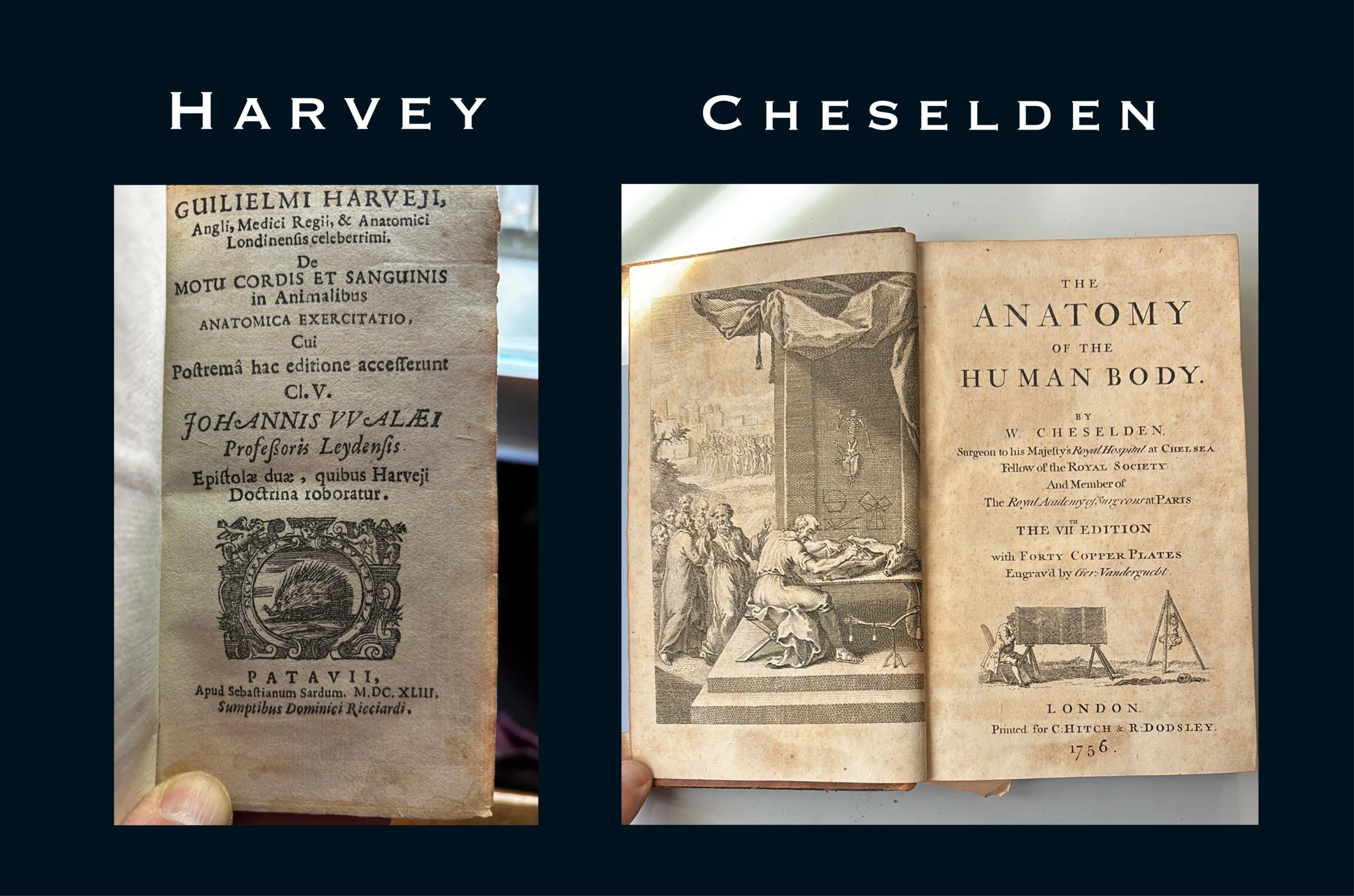
In May 2021 my grandfather gave me two books from his shelves. They came with a folded note in his handwriting:
William Harvey, De Motu Cordis (trigesimo-secundo ie 5.5 inches high) — valued at Keys valuation day at Greshams school 4/7/04 £800. N.B. this was a student copy meant to be carried in a student’s bag, pocket or sleeve in those times. Given to Walter 27/5/2021.
Cheseldon — Valued at Keys valuation day at Greshams school 4/7/04 £180–£200. N.B. The Cheseldon could do with a bit of hide oil and some water based glue. Given to Walter 27/5/21.
He died on the 4th of April this year. Going through what he left, I have only recently looked properly at what those two books are.
The Cheselden is the seventh edition of The Anatomy of the Human Body, London, 1756, printed for C. Hitch and R. Dodsley, with forty copperplates engraved by Gerard Vandergucht. The frontispiece shows Hippocrates visiting Democritus mid-dissection. Cheselden’s Anatomy went through thirteen editions into the early nineteenth century and was the standard English anatomical textbook of its period. The German bibliographer Ludwig Choulant, writing in the 1850s, singled out the seventh edition as the finest of the English printings.
The Harvey is the more important of the two.
Exercitatio Anatomica de Motu Cordis et Sanguinis in Animalibus is the founding text of cardiovascular physiology — the book in which Harvey first set out the discovery of the circulation of the blood. The first edition, Frankfurt 1628, was printed on poor paper; fewer than seventy copies survive, almost all institutional. My grandfather’s copy is not that. The title page reads:
De Motu Cordis et Sanguinis in Animalibus Anatomica Exercitatio… Patavii, Apud Sebastianum Sardum. M.DC.XLIII.
Padua, 1643. Keynes 4. The second authorised edition — the first complete printing in which Harvey’s text appears as he wrote it, uninterrupted by hostile annotations from earlier editors. It is also the first edition ever printed in Italy.
Harvey himself studied at the University of Padua between 1598 and 1602, under the Italian anatomist Hieronymus Fabricius ab Aquapendente. In Fabricius’s lectures he first encountered the valves in the veins — the small one-way structures that, decades later in London, gave him the mechanical proof that blood must move in a single direction around a closed circuit. The seed of the discovery is a lecture theatre in Padua, around 1599, an English nineteen-year-old watching the veins of an arm being dissected.
My grandfather knew what he had. He was a GP for forty years, taught himself coding in the early 1970s, and built one of the first electronic patient record systems in British general practice. His shelves held a Thomas Paine Common Sense of 1776 and a 1640 Physiologiae Peripateticae a few spaces along from the Harvey. The way he gave me these two — without remark, with a folded slip of paper and a note about hide oil — was the way he tended to give things. He was a clinician by training and a quiet man by temperament, not in the habit of telling you what he had handed over.
I did not look at the title page of the Harvey properly until last month. Until then it was a Harvey, somewhere on the shelf, given to me by my grandfather. The Padua imprint, the 1643 date, the connection to where Harvey was educated — none of that registered. He may have assumed I would work it out eventually, which is the kind of assumption he tended to make.
The book was printed in Padua in 1643, on Sebastiano Sardo’s press, in the city where Harvey had been a student forty-odd years earlier. By some chain of owners across nearly four centuries it reached my grandfather’s library in England. From there it crossed his kitchen table in May 2021. It now sits on a shelf in Brussels, above the desk where I work.
— Walty, May 2026
Leave a Reply
You must be logged in to post a comment.