
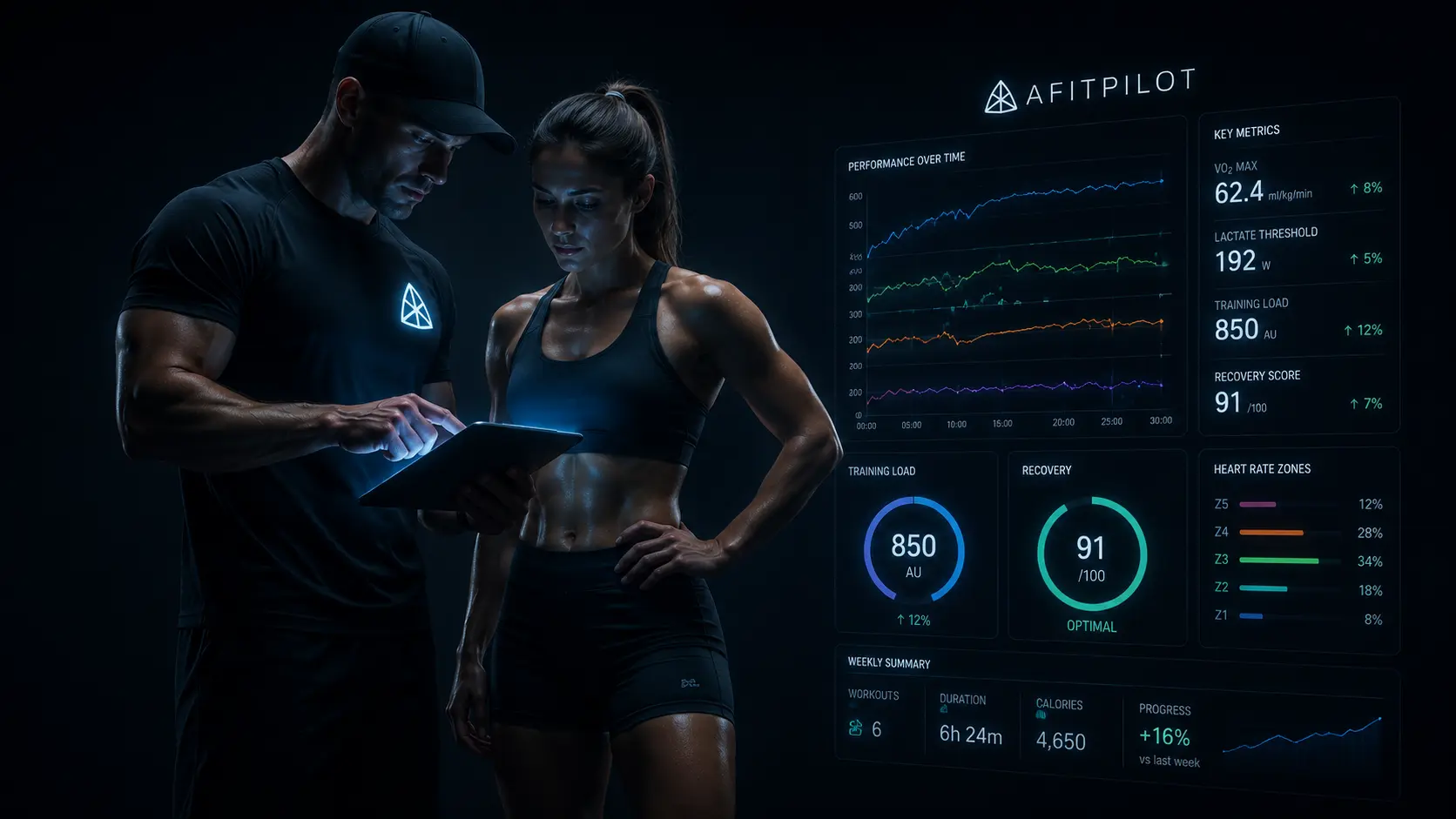
Why the Best Fitness Coaches Are Replacing Guesswork with Data — and What That Means for You
7 min read
Every fitness coach eventually runs into the same problem, usually around client number five or six.
You write a solid program built on the principles you studied — progressive overload, periodization, recovery windows. The logic is clean. Then two clients follow the same plan and respond completely differently. One thrives. The other spins their wheels, or worse, accumulates fatigue without adapting. So you adjust, you guess, and you try something else next week.
This is not a failure of coaching. It is a failure of information.
The Science of Why One Plan Can’t Fit Everyone
This is not an opinion — it’s one of the most replicated findings in exercise science.
The HERITAGE Family Study, a landmark multi-site research project published in the Journal of Applied Physiology, put 481 sedentary adults through the same standardized 20-week endurance training program. Same protocol. Same duration. Identical conditions.
The results were striking. On average, participants improved their VO₂max by around 400 ml/min. But individual responses ranged from virtually no improvement at all to gains exceeding 1,000 ml/min. A follow-up analysis in PubMed found the same pattern across multiple cardiometabolic outcomes: every single trait showed wide interindividual variation, and a strong response in one area did not predict a strong response in another.
In plain terms: the same program produced radically different outcomes depending on the individual.
Researchers estimated the heritability of the VO₂max training response at 47%. Nearly half of how your client responds to a given training stimulus traces back to their biology — before you write a single session.
This is the core problem with standard programming. And it is exactly what data-driven coaching solves.
What Coaching Without Data Actually Looks Like
Think about the typical coaching workflow.
A client shares their goals. You assess their starting point, maybe run a fitness test, then write a program based on your experience, a template, or a training philosophy. You check in weekly and ask how they feel. You adjust based on what they tell you — if they tell you anything at all.
The feedback loop runs slow, subjective, and incomplete. A client might accumulate fatigue beyond what the program intended for several sessions before you notice the damage. Another might adapt faster than expected, leaving weeks of potential progress on the table while the stimulus stays too easy.
Coaching on feel alone isn’t bad. Experience matters enormously. But a coach working without data operates with one eye closed.
What Changes When You Add Data
This shift doesn’t replace the coach. It gives the coach a complete picture.
When clients log their sessions — effort, RPE, how the workout actually felt versus how you prescribed it — a feedback loop opens up that changes everything.
Consider the gap between target RPE and actual RPE. Afitpilot tracks this precisely. When you prescribe an RPE 6 session and a client consistently logs RPE 8, that gap means something: accumulated fatigue, poor sleep, life stress, or a load that ran too high for this individual at this point in their cycle. Without that data, you might miss it for weeks. With it, you adjust before the problem compounds.
The inverse matters just as much. A client logs RPE 5 on a session you meant to be RPE 8. That athlete has adapted faster than projected, and their program needs to advance, not hold steady.
These are not edge cases. This is the daily reality of coaching multiple clients across different physiological profiles, recovery capacities, and life circumstances.
The Kinesiology Principle Behind Adaptive Coaching
Every kinesiology student learns the principle of individual differences in their first year. The SAID principle — Specific Adaptations to Imposed Demands — tells us the body adapts specifically to the demands you place on it. What it leaves out: two athletes under identical demands adapt at different rates, in different magnitudes, through different physiological pathways.
Lactate threshold varies between individuals, and so do recovery rate, hormonal response to training stress, and the speed at which neuromuscular fatigue builds. That threshold — the point where blood lactate accumulates faster than the body can clear it, typically around 2–4 mmol/L — ranks among the most important markers in endurance coaching. But it isn’t a fixed number. It shifts with training, with fatigue, and with how each athlete responds.
Elite coaches have understood this for decades. The Norwegian Method — the training philosophy behind Olympic and Ironman champion Kristian Blummenfelt — monitors each athlete’s actual physiological response in real time, using blood lactate measurements to control every session. Not a generic zone. Not a pace chart. The individual’s real signal, measured and acted on.
Most coaches can’t run blood lactate tests for 20 clients a week. But consistent session data, effort ratings, and feedback logs reveal that same individual variability — at scale.
Where AI Enters the Picture
Collecting the data has never been the hard part. Knowing what to do with it has.
A coach managing 20 clients can’t manually cross-reference every client’s RPE history against their load progression, recovery patterns, and weekly volume. The cognitive load runs too high, so patterns slip through and adjustments arrive late.
This is exactly where AI earns its role in coaching.
An AI system that ingests session data — logged effort, completed versus prescribed load, recovery feedback — surfaces patterns that no coach has time to track by hand. It flags the client who has overreached for three weeks before their joints start complaining. It spots the client ready for a step up in intensity that their numbers have quietly signaled for a fortnight.
This doesn’t replace coaching judgment. It gives coaches the information they need to apply that judgment correctly — and earlier.
A coach using data-driven tools can finally deliver something close to the gold standard: individualized, responsive, adaptive programming at a scale that once required a full sports science support team.
What This Means for Fitness Coaches Today
The most effective coaches over the next decade won’t necessarily hold the most certifications. They’ll be the ones who close the feedback loop between prescription and reality.
That means tracking the gap between what you prescribed and what your client actually experienced. It means acting on early signals instead of waiting for obvious problems to surface. And it means building systems that make individualization scalable rather than heroic.
The science has been clear for decades: the same program produces different results in different people. The tools to act on that knowledge now exist. The only open question is which coaches will use them.
In Afitpilot
This thinking drives how Afitpilot approaches coaching. Every logged session, every RPE entry, and every gap between target and actual performance becomes a data point that shapes what comes next.
The AI doesn’t override the coach. It completes the picture. For coaches who have spent years running on experience and instinct alone, that layer of data isn’t a disruption — it’s the missing piece they’ve worked around their entire career.
Guesswork is not a coaching philosophy. Data is.
Resources
- HERITAGE Family Study — Familial aggregation of VO₂max response to exercise training. Journal of Applied Physiology, 1999.
- Regular exercise and patterns of response across multiple cardiometabolic traits: the HERITAGE Family Study. PubMed / British Journal of Sports Medicine, 2021.
- Lactate Threshold — Wikipedia / Exercise Science
- Training Session Models in Endurance Sports: A Norwegian Perspective — PMC / NIH
- Kelemen, B., Benczenleitner, O., & Tóth, L. (2023). The Norwegian Double-Threshold Method in Distance Running. Scientific Journal of Sport and Performance.
Leave a Reply
You must be logged in to post a comment.