
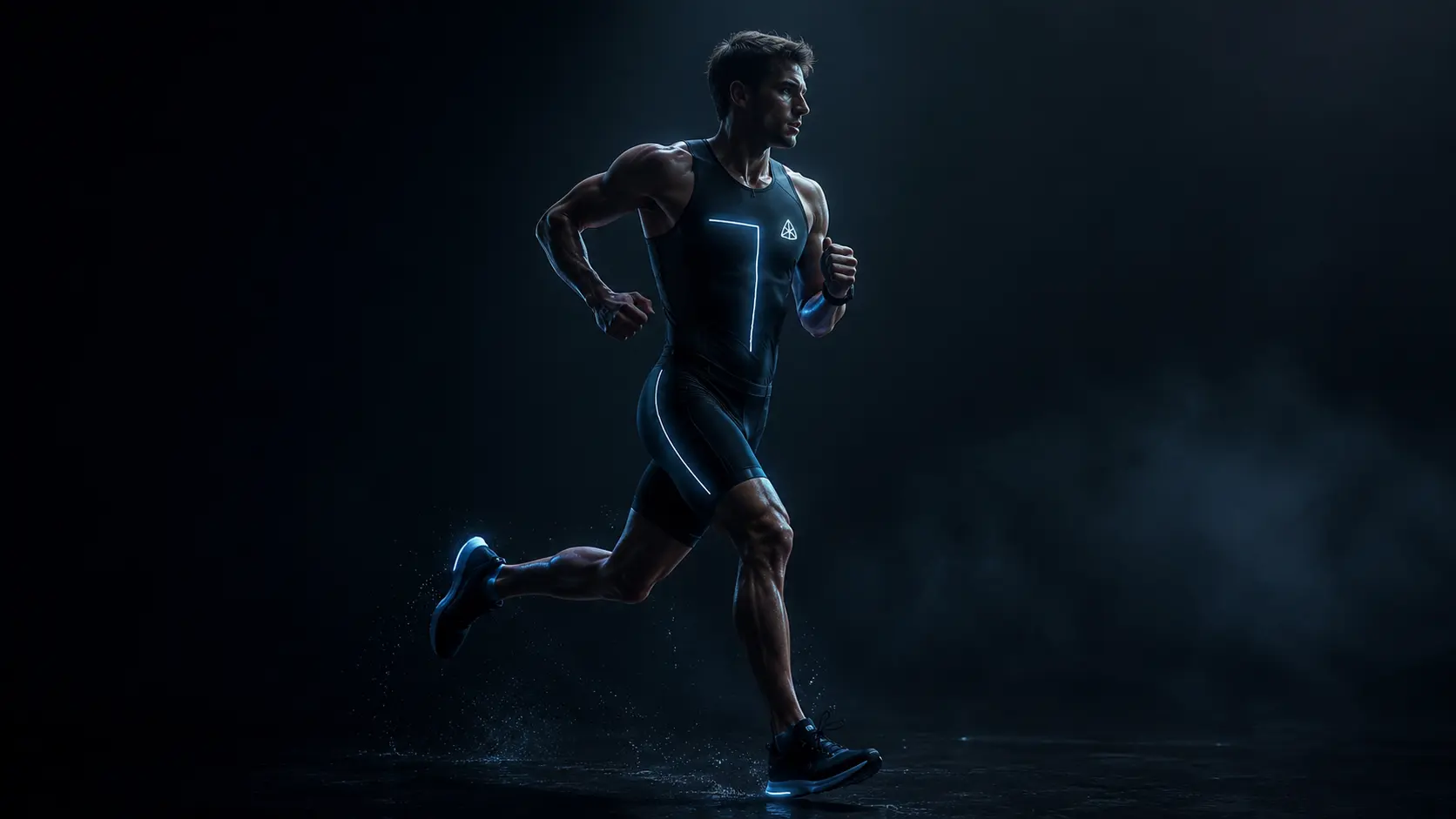
There is a man from Bergen, Norway, who has done something no one in the history of triathlon has ever done. He held the Olympic title, the World Triathlon Championship Series title, the Ironman World Championship title, and the Ironman 70.3 World Championship title — all at the same time.
His name is Kristian Blummenfelt. And the way he trains might be the most important lesson in endurance sport today.
Who Is Kristian Blummenfelt?
Born on February 14, 1994 in Bergen, Blummenfelt was a competitive swimmer and footballer before transitioning to triathlon as a teenager. He became Norwegian national champion before his 20th birthday, but it took years of refinement before he became a dominant force on the World Triathlon Series circuit.
The breakthrough came in 2021. He won Olympic gold in Tokyo. He won the World Triathlon Championship Series title. Then — just months later — he stepped up to the full Ironman distance for the very first time, at Ironman Cozumel, and immediately set the fastest Ironman time ever recorded: 7:21:12.
He followed that with the 2022 Ironman World Championship title in St. George, Utah — making him the first triathlete in history to hold the Olympic and Ironman world titles simultaneousl
Then came the Sub7 Project. On June 5, 2022, in Dresden, Germany, Blummenfelt became the first human being to complete an iron-distance triathlon in under seven hours, finishing in 6:44:25.
In 2025, he returned to Ironman dominance with wins in Texas, Aix-en-Provence, and Frankfurt. At 31 years old, he may still be at the peak of his powers.
The Training Load: What "Hard Work" Actually Means
Blummenfelt trains up to eight hours a day. Every week, he typically covers approximately:
- 10 km of swimming
- 300–400 km of cycling
- 100–120 km of running
That is not a typo. Most recreational athletes consider a 10 km run a meaningful training session. Blummenfelt does ten times that — on foot alone — every single week.
But training volume alone doesn't explain his dominance. What makes Blummenfelt fascinating from a scientific perspective is how that volume is structured.
The Norwegian Method: Science, Not Suffering
Blummenfelt is the most high-profile athlete associated with what has become known as the Norwegian Method — a training philosophy built around lactate-controlled threshold work.
The core of the method is this: instead of pushing hard in the "gray zone" of moderate intensity (where many athletes spend most of their quality training), Norwegian athletes stack their hard work tightly around the lactate threshold, using blood lactate measurements to control every session with precision.
A 2023 systematic literature review published in the Scientific Journal of Sport and Performance described the structure clearly: athletes perform two to four lactate threshold sessions per week, with blood lactate kept below 2–4 mmol/L, often conducted twice on the same day in what are called double-threshold days.
The logic, as explained in research published by PMC (National Institutes of Health), is that double-threshold days allow athletes to maximize aerobic stimulus and recovery simultaneously — concentrating hard work into stacked sessions rather than spreading fatigue across the week.
This defies a lot of conventional endurance wisdom. The hard/easy rule has guided coaches for over a century. But the Norwegian Method proposes a different organization: let the hard days be very hard (but precisely controlled), and let the easy days be genuinely easy.
The intensity distribution that emerges from this approach aligns closely with what exercise physiologist Dr. Stephen Seiler has documented across elite populations: approximately 80% of training volume at low intensity, with quality work concentrated at or above the lactate threshold — avoiding the seductive but under-productive "moderate effort" zone.
The VO₂max Question
No conversation about Blummenfelt is complete without addressing his aerobic ceiling.
In January 2026, Blummenfelt shared footage from a laboratory test in Bergen showing a VO₂max value of 101.1 ml/kg/min — which would be the highest ever recorded under lab conditions. The previous benchmark was approximately 97.5 ml/kg/min, set by Norwegian cyclist Oskar Svendsen in 2012.
This number immediately sparked debate in the scientific community. Multiple exercise physiologists questioned the accuracy of the metabolic cart used and raised concerns about the testing protocol. Questions about equipment calibration and mathematical plausibility were raised publicly by researchers including British sports scientist Jamie Pringle. The skepticism is legitimate: metabolic testing equipment is not designed for athletes who can consume more than seven liters of oxygen per minute, and such extreme values always warrant scrutiny.
What is not in dispute: Blummenfelt's aerobic capacity is genuinely extraordinary. His pre-Olympics VO₂max was documented at approximately 90 ml/kg/min — already elite by any standard. Interestingly, when preparing for Ironman racing, Blummenfelt and coach Olav Aleksander Bu deliberately trained the number down toward 80 ml/kg/min to optimize fat oxidation and metabolic efficiency at the sustained efforts required for long-course racing.
That intentional trade-off between peak aerobic capacity and metabolic efficiency is one of the most sophisticated aspects of his preparation — and one that has direct implications for any endurance athlete managing multiple distances or modalities.
Data as the Steering Wheel
What separates Blummenfelt's generation from previous champions is not just physiology — it is the integration of real-time data into every training decision.
In interviews with VO2 Master, Blummenfelt has described using field-based metabolic testing since 2017 to understand what his energy systems are doing during sessions. The goal is not just to measure fitness — it is to identify weaknesses, confirm adaptation, and set precise goals for the next training block.
He and coach Olav Aleksander Bu used VO₂ and lactate data to make decisions that would have previously required years of trial and error — including the transition from Olympic-distance to Ironman racing, a move that broke many elite short-course athletes before him. With data, that transition became a model of precision rather than guesswork.
What Coaches and Athletes Can Learn
Blummenfelt is an extreme case — genetically gifted, professionally supported, full-time dedicated to performance. But the principles behind his success are not exclusive to elite sport.
Lactate-controlled training works. The scientific literature behind the Norwegian Method is robust and growing. Threshold training that is too intense becomes junk volume; training that is genuinely controlled and repeated produces lasting aerobic adaptation.
Honesty about intensity matters. Most athletes train too hard on their easy days and not hard enough — or not precisely enough — on their hard days. The gap between planned effort and actual effort is where adaptations break down.
Data enables better decisions. Whether it is RPE, heart rate, lactate, or power output, feedback loops between training load and physiological response are what allow a plan to adapt to the athlete — not just the other way around.
Volume follows structure. Blummenfelt's enormous weekly load is only productive because the underlying structure is sound. More hours in the wrong zones would produce fatigue, not adaptation.
The Bigger Picture
What Kristian Blummenfelt represents is a new standard for evidence-based endurance training. His results are not a product of talent alone, or suffering alone — they are a product of a precise, data-driven system applied consistently over many years at extraordinary volume.
For coaches and athletes looking to train smarter, not just harder, his career is the most compelling argument currently available.
The science is not secret. The principles are teachable. The question is whether athletes and coaches are willing to apply them with the same level of precision that has made a triathlete from Bergen the most decorated multi-distance champion in the history of the sport.
Resources
- Kelemen, B., Benczenleitner, O., & Tóth, L. (2023). The Norwegian double-threshold method in distance running: Systematic literature review. Scientific Journal of Sport and Performance, 3(1), 38–46.
- Training Session Models in Endurance Sports: A Norwegian Perspective – PMC / NIH
- Kristian Blummenfelt – Official World Triathlon Athlete Profile
- Blummenfelt's Physiology: Olympic to Ironman – VO2 Master
- The Norwegian Method: Blummenfelt on Success and Paris 2024 – VO2 Master
- The VO₂max Record That (Probably) Wasn't – Sweat Science / Alex Hutchinson
Leave a Reply
You must be logged in to post a comment.